How Many Grams in an Ounce of Weed? 28 — and Why Your Scale Disagrees
There are 28 grams in an ounce of weed — 28.35 if you want the exact figure. That’s the whole answer to how many grams in an ounce of weed, and it fits in one line. The interesting part is everything that answer leaves out: why everyone rounds down, why the jar you weigh at home almost never reads exactly what the label says, and why two honest scales can look at the same bud and disagree.
This is the GanjaTech version of the weights guide: one clean chart, zero prices, then the mechanics nobody else bothers with. It’s written for adults 21 and over, and it stops at the ounce on purpose — we’ll explain why near the end.
How many grams in an ounce of weed: 28 (and the full chart)
Cannabis in the US is sold and talked about in fractions of an ounce, but scales, labels, and anything regulated work in grams. So the useful thing to memorize is the bridge between the two. Here it is, with the rounded number everyone uses and the exact number the math produces:
| What people call it | Fraction of an ounce | Grams (as used) | Grams (exact) |
|---|---|---|---|
| A gram | about 1/28 | 1 g | 1 g |
| An eighth | 1/8 oz | 3.5 g | 3.54 g |
| A quarter | 1/4 oz | 7 g | 7.09 g |
| A half | 1/2 oz | 14 g | 14.17 g |
| An ounce | 1 oz | 28 g | 28.35 g |
If you came here for how many grams are in an eighth, it’s 3.5 grams. That’s the single most common size on a shelf, and it’s the number most people are actually trying to sanity-check when they search this.
Notice that the “as used” column is a clean halving chain: 28, 14, 7, 3.5. Every size is exactly half the one above it. That’s not a coincidence, and it’s the main reason the rounded numbers won — more on that in the next section.
The ounce we’re talking about
There’s more than one ounce in the world, which trips people up more than you’d expect. Cannabis uses the ordinary avoirdupois ounce — the same one on a bag of coffee or a package of cheese. Since 1959 it has been defined precisely as 1/16 of a pound, which works out to 28.349523125 grams. The troy ounce used for gold and silver is heavier, at about 31.1 grams, and has nothing to do with flower. If you ever see 31 grams quoted as “an ounce” of weed, someone has mixed up their metals.
The fluid ounce is a third, unrelated thing — a measure of volume, not weight. A one-ounce jar is not a jar that holds an ounce of weed. Flower is light and airy, so an actual ounce takes up far more space than that, and how much space depends heavily on how dense the buds are.
Why everyone says 28 when the math says 28.35
The honest answer is convenience, and it’s a pretty good reason. The rounding exists because of the halving chain. Start at 28 and you can divide in your head all the way down — 14, 7, 3.5 — without ever touching a decimal you can’t say out loud. Start at 28.35 and you get 14.17, 7.09, and 3.54, which nobody wants to say at a counter or remember on a label.
So the culture settled on the round numbers a long time ago, and regulated markets mostly kept them. Packaged flower is labeled by net weight in grams, and the common package sizes follow the same rounded chain you see in the chart. Ask for an eighth anywhere in the US and you’ll get a package marked 3.5 g, not 3.54 g.
How much the rounding actually costs
Less than you’d think, and it scales with size:
- An eighth: 3.54 vs 3.5 g — a difference of about 0.04 g. That’s a crumb. Most pocket scales can barely see it.
- A quarter: 7.09 vs 7 g — about 0.09 g.
- An ounce: 28.35 vs 28 g — about 0.35 g, or roughly 1.2%.
At the eighth level, the rounding is smaller than the normal error of a cheap scale, which means it almost never explains a “short” bag on its own. At the ounce level, 0.35 g is about the size of a small bowl. Noticeable if you’re tracking closely, but still smaller than the moisture swing we’ll get to in a minute.
The one place the decimal matters
There’s one context where 28 versus 28.35 stops being trivia: legal possession limits. Many adult-use laws describe how much you can carry in ounces or grams, and those limits use real units, not counter math. Laws vary a lot by state and country, and the way a given law counts weight can differ too. The practical takeaway is simple — don’t treat the rounding as a buffer, and don’t plan your life around the exact edge of a limit. We’ll cover that properly in the possession-limits section.
Why your scale disagrees with the label
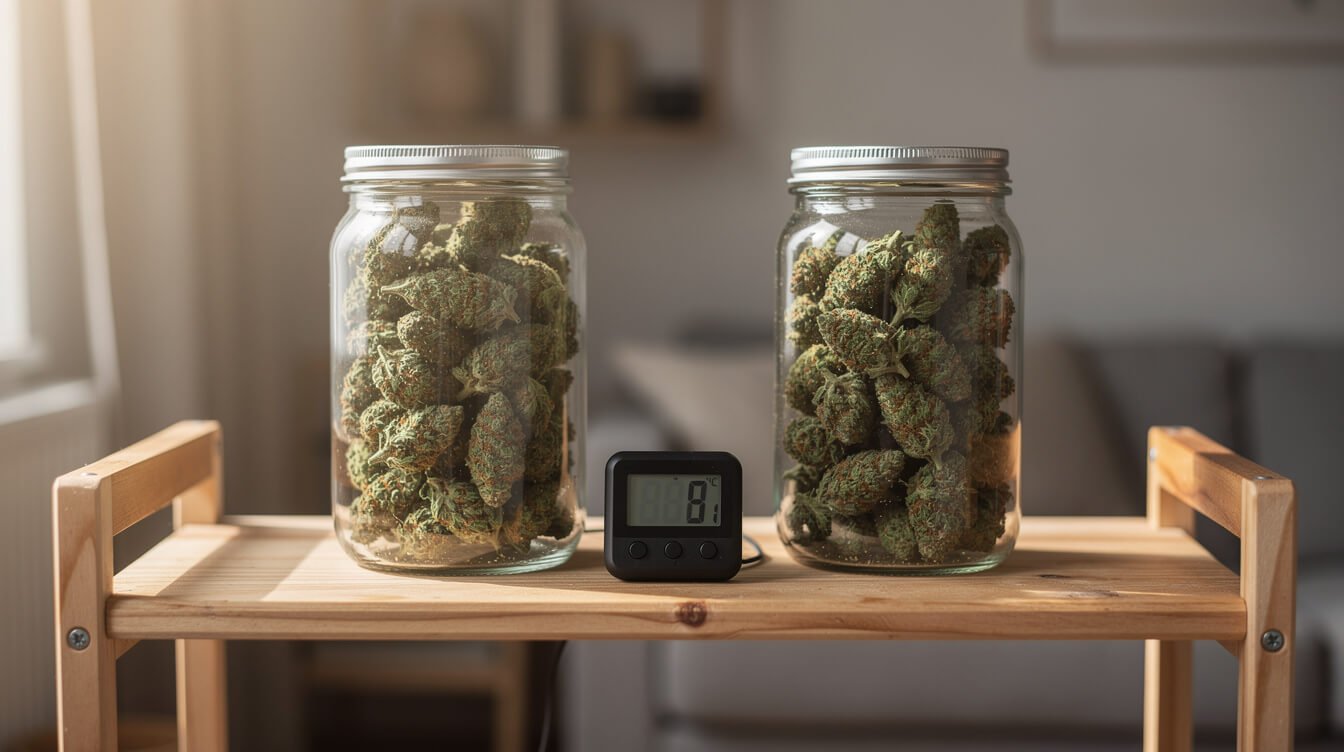
Here’s the situation that sends most people searching: you weigh a 3.5 g package at home and get 3.38 g, or 3.41, or sometimes 3.6. It’s easy to assume you got shorted. Usually you didn’t. Three things move the number, and none of them involve anyone cheating.
1. Flower is still trading water with the air
Dried and cured flower isn’t bone-dry. It typically holds somewhere around 10–15% water by weight, and it keeps exchanging that water with whatever air it’s sitting in. Warm, dry air pulls water out and the bud gets lighter. Cool, humid air pushes water back in and it gets heavier. The cannabinoids don’t change — just the water.
This isn’t a theory. In 2024 the Michigan Department of Agriculture and Rural Development published a cannabis moisture study, presented to the National Conference on Weights and Measures, that did exactly the experiment you’d want. Researchers packaged 3.5 g samples in zip-top bags, plastic pop-top containers, and glass screw-top jars, then stored them for 12 weeks at temperatures from 50°F to 80°F and humidity from about 15% to 80%, weighing them every week.
- A zip-top bag stored warm and dry (80°F, 15% humidity) lost 5.2% of its weight. On a 3.5 g sample, that’s about 0.18 g — so a bag that left the counter at 3.5 g could read about 3.32 g a few months later.
- Stored cool and humid, the same kinds of packages went the other way and gained up to about 5%.
- Glass screw-top jars were the most stable of the three package types across the board, and none of the glass samples went above the 0.55–0.65 water activity range the study treats as acceptable.
That last point matters for two reasons. It means a “light” bag is usually a dry bag, not a short one. And it means storage is part of this story, not a separate topic — if you want weight and quality to hold, glass in a cool, stable spot is the boring right answer. Our guides on whether weed goes bad and cannabis humidity packs cover the storage side in detail.
Growers see this effect at a much larger scale. Fresh-cut plants lose most of their weight as water during the drying stage, and flower keeps shedding a little more during the cure. The few-percent drift on a finished package is the tail end of the same process.
2. Your scale isn’t as precise as its display
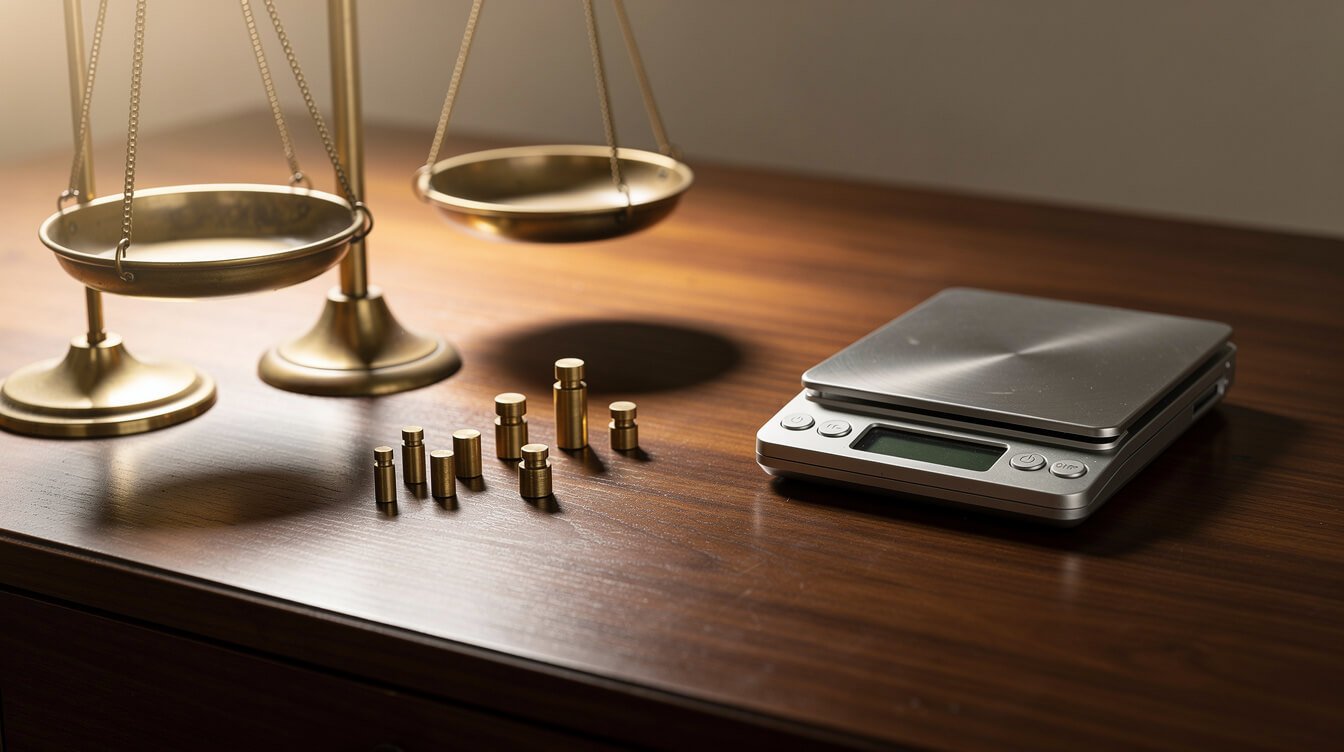
A pocket scale that shows two decimal places is telling you its readability — the smallest step it can display. That’s not the same as its accuracy. An inexpensive scale that reads to 0.01 g can easily be off by a few hundredths, and more if it’s never been calibrated, the battery is low, or it’s been knocked around in a bag. Two decent scales disagreeing by 0.05 g on the same bud is completely normal.
Commercial scales are a different class of instrument. In the US, scales used to sell products by weight are generally expected to be “legal for trade” — certified under the NTEP program and built to tolerances that a pocket scale isn’t. Exact requirements for cannabis sellers vary by state, but this is why the label and your kitchen scale aren’t really measuring on the same footing.
3. What you’re weighing isn’t just flower
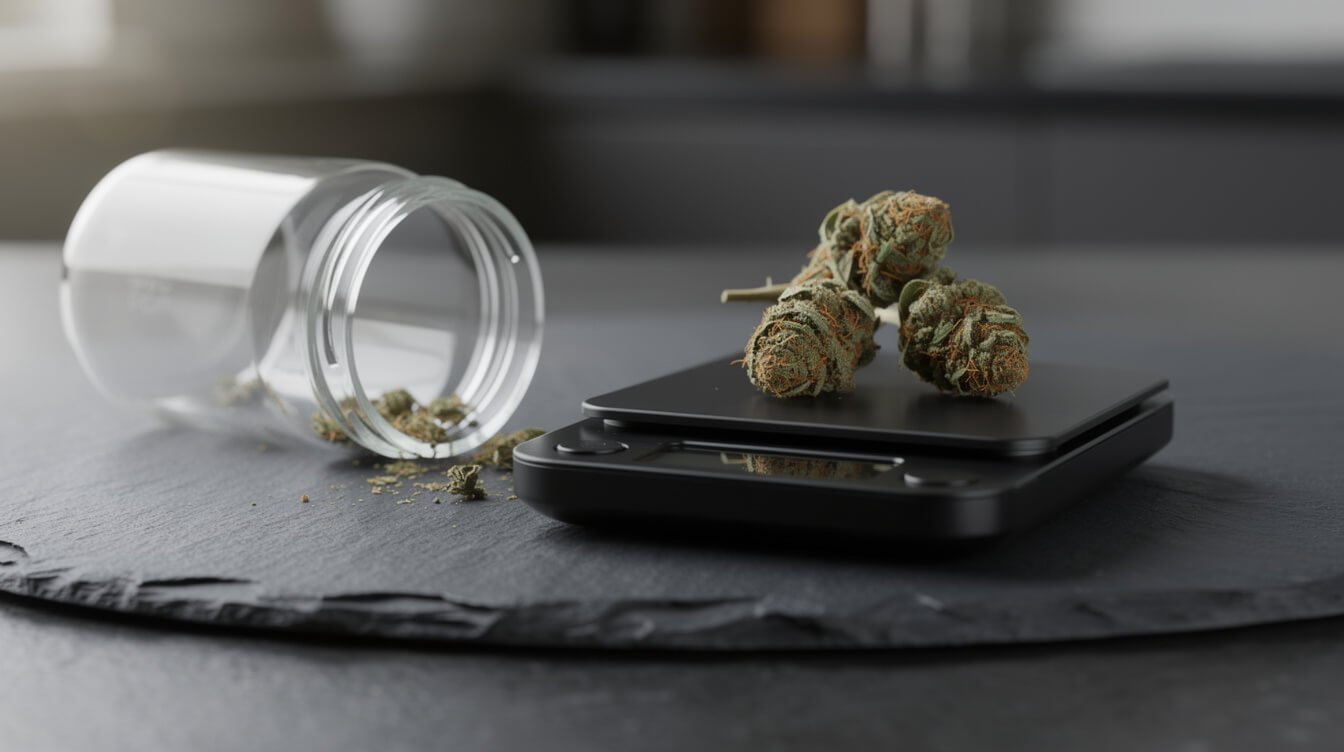
The most common home weighing error is simply weighing the wrong thing. A glass jar weighs a lot more than the flower inside it, and if you don’t tare it out properly, the whole number is meaningless. A humidity pack left in the jar adds its own weight. Even a stray stem matters at this scale — stems are dense, and untrimmed flower carries extra weight that isn’t useful material, which is part of why trimming changes what a finished harvest weighs.
How to weigh flower properly at home
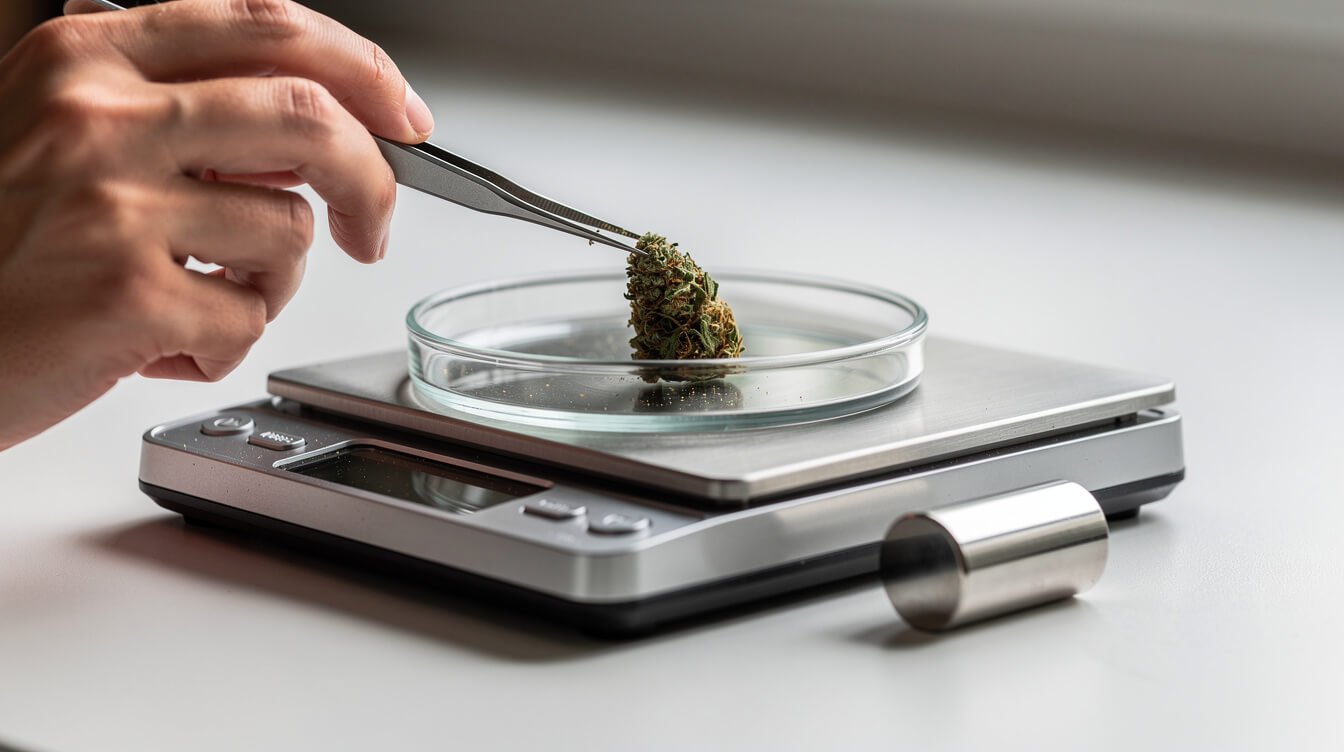
You don’t need lab gear to get a trustworthy number. You need a decent scale, one cheap accessory, and about a minute of patience. Here’s the routine that gets you a reading you can trust.
- Use a scale that reads to 0.01 g. A kitchen scale that reads to the whole gram is fine for flour, not for this. At 1 g resolution, an eighth could display anywhere from 3 to 4 g.
- Put it on a hard, level surface. Not a couch cushion, not a stack of magazines. Tilt and wobble both throw readings.
- Get out of the draft. Precision scales are sensitive enough that a fan, an open window, or breathing on them can move the last digit.
- Turn it on and let it settle before you put anything on it. Many cheap scales drift for the first several seconds.
- Calibrate it occasionally. Most pocket scales come with a small calibration weight, often 50 or 100 g. Run the calibration routine every so often, and any time the readings start to feel suspicious. If yours didn’t come with one, a check weight is a cheap upgrade and the single biggest accuracy win available.
- Tare your container. Place an empty dish or a light container on the scale, press tare so it reads zero, then add flower. Weighing directly in a heavy glass jar works, but only if you tare that exact jar first.
- Take the humidity pack out. Weigh the flower, not the pack.
- Place, don’t drop. Set buds down gently and wait a few seconds for the reading to stop moving before you trust it.
Do all that and you’ll get a number that means something. If it’s still a little under the label, remember the moisture point: check whether the package spent a few weeks somewhere warm and dry before you assume anything else.
Why a good home number is worth having
Weighing isn’t only for checking a label. If you make your own infusions, an accurate gram count is the starting point for estimating potency — our guide to making cannabutter with shake walks through why the math only works when you know what went into the pot. The same logic applies to rolling: an accurate scale is how you find out what your usual joint or blunt actually weighs, which makes it a lot easier to keep consumption consistent. (If you’re working on that skill, our guides to rolling papers and rolling a blunt pair well with a scale.)
GanjaTech, weekly
Cannabis, explained. In your inbox.
One email a week: the clearest explainers, honest gear picks, and what the science actually says. 21+ only. No spam, unsubscribe anytime.
Gram, eighth, quarter, half, ounce: what the names actually mean
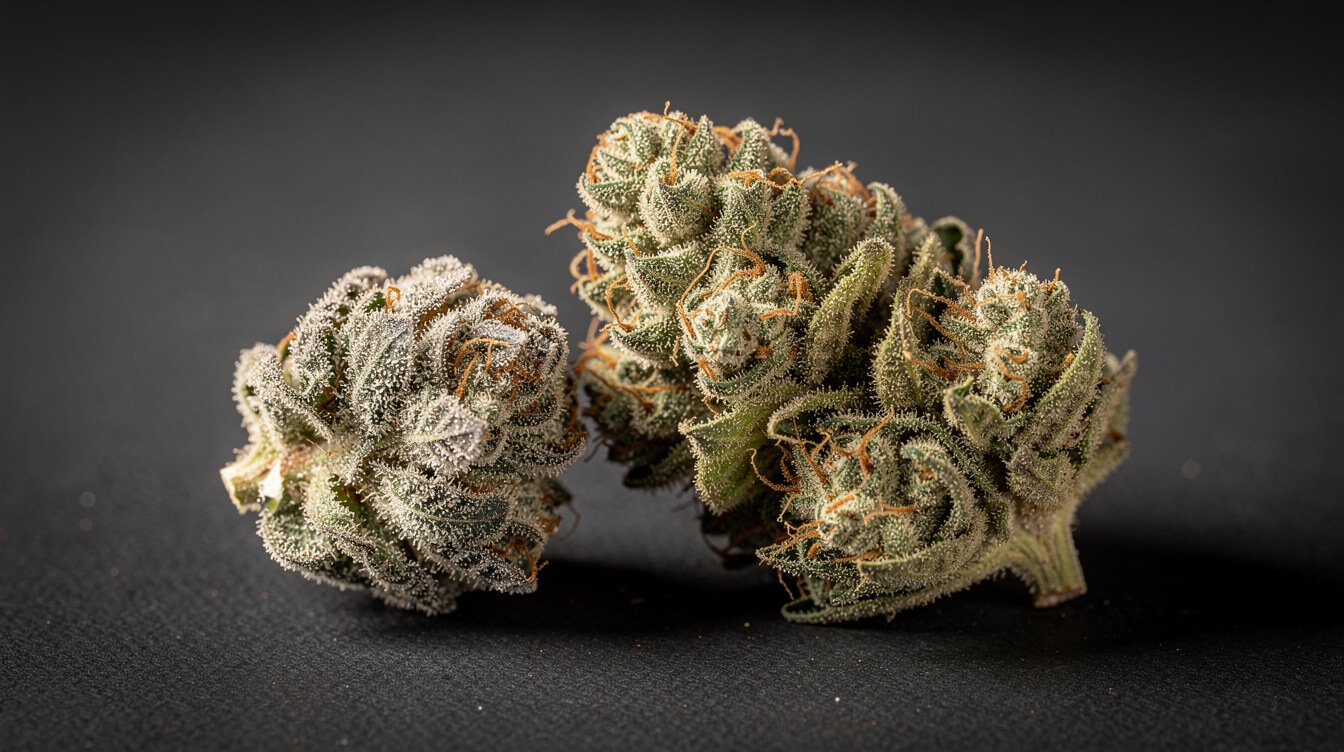
The names are just fractions of an ounce, said casually. Once you know the ounce is 28 grams, everything else is division.
- A gram is the basic metric unit and the smallest standard size. It’s roughly enough for one or two average joints, depending on how you roll.
- An eighth is one-eighth of an ounce — 3.5 grams. It’s the default size for a lot of people, and the one most search queries are really about.
- A quarter is a quarter-ounce, or 7 grams. Two eighths.
- A half is a half-ounce, or 14 grams. Two quarters.
- An ounce is 28 grams. Sometimes shortened to “an O.”
Why the same weight can look completely different
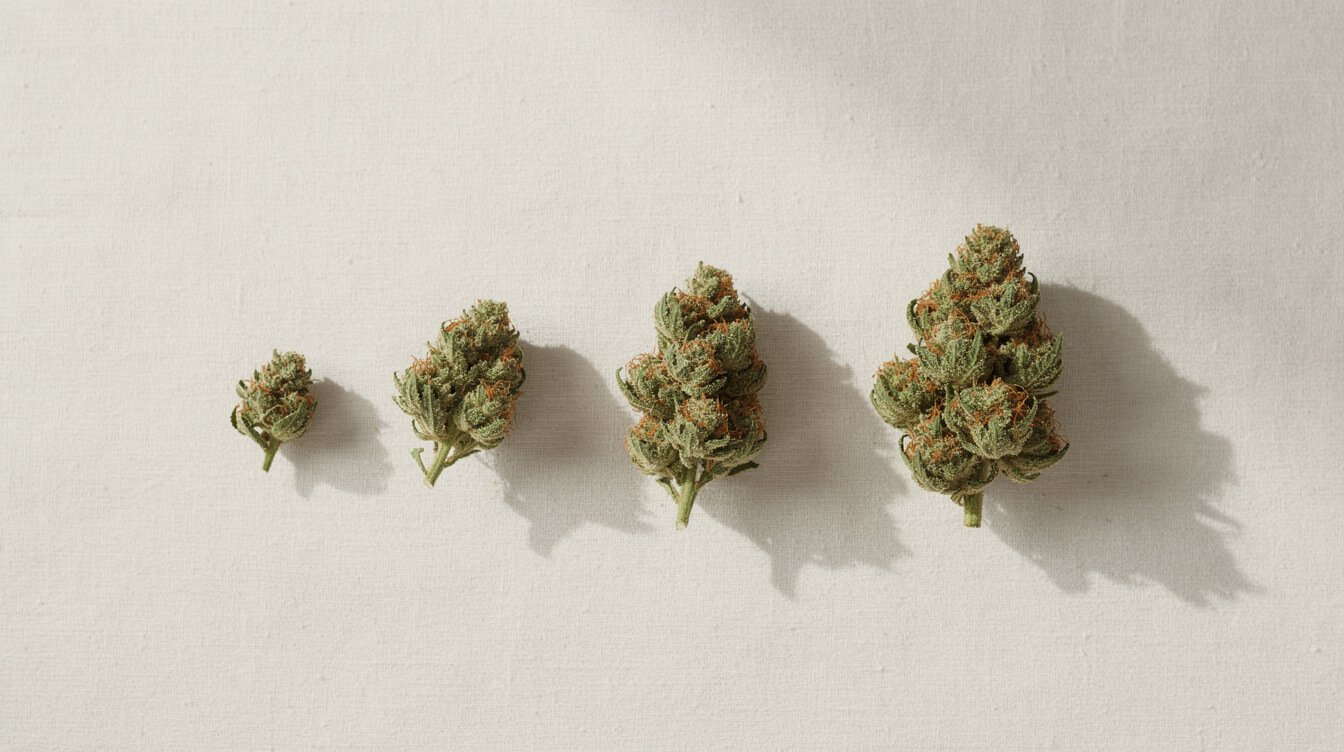
Weight is weight, but volume isn’t. Two eighths can weigh exactly 3.5 g each and look like they came from different universes. Dense, tightly formed buds pack a lot of mass into a small space; airy, loose buds take up much more room for the same weight. Flower grown with less light or harvested at a different stage often comes out fluffier. A tight eighth can look like one or two nugs; a fluffy eighth can look like a small handful.
That’s why eyeballing is unreliable even for experienced people. “That looks light” is a judgment about volume, and volume is exactly the thing that varies. If the question is weight, the only honest answer comes from a scale.
Weight tells you how much plant, not how strong it is
One more distinction worth making: an eighth of one cultivar and an eighth of another weigh the same but can carry very different amounts of THC. A label reading 20% THC means roughly 200 mg of THC per gram of flower in the material itself — but how much of that you actually take in depends heavily on how you consume it. Weight is a fair way to compare quantity, not effect. If you’re new or switching to something stronger, the usual advice still holds: start low, go slow, and never drive after consuming. For more on what actually drives the experience, see our breakdown of trichomes, which is where the cannabinoids actually live.
Possession limits are written in these units, and they vary

Here’s where the units stop being trivia. Legal possession limits — where cannabis is legal at all — are written in weights, and those weights are usually expressed in exactly the units in our chart. Some laws use ounces, some use grams, and some use numbers that don’t line up neatly with either.
A few general things are true across most places that have legalized adult use, and they’re worth knowing even though the specifics aren’t ours to give:
- Limits vary widely. They differ from state to state and country to country, and they change over time as laws are amended. What’s fine in one place can be a problem one border over.
- There is often more than one limit. Some places set a different amount for what you can carry in public versus what you can keep at home.
- Concentrates are usually counted separately — and the limits for them are typically much lower than for flower. A gram of rosin or live resin isn’t treated like a gram of bud. (If you want to understand why, see our explainers on live resin and rosin.)
- Federal law is its own question. In the US, state legalization doesn’t change federal law, which matters on federal land and anywhere federal rules apply.
What this means in practice: don’t use the 28-versus-28.35 gap as a safety margin, and don’t assume your scale and the law agree to the hundredth of a gram. If you’re anywhere near a limit, the honest move is to not be near it. And before you rely on anything, check the current law where you actually are, from an official source — not from a weights chart, including this one.
Why we stop at the ounce
You’ll notice this guide ends at 28 grams. Most weight charts keep going — up through larger units and into pounds. We stop deliberately, and it’s worth saying why.
The ounce is where personal use tops out in practice. It’s also a common reference point in adult-use laws. Past it, the questions stop being “how much is this for me?” and start being about quantities that, in most places, are distribution-scale — the kind of amounts tied to selling rather than consuming. That’s not a lane we write for. GanjaTech exists to explain the plant to adults: how it grows, how it’s dried and cured, what’s in it, and how to use it responsibly. Helping anyone move weight isn’t part of that, and a page that optimizes for big-quantity math reads as exactly that kind of help, whether or not it means to.
There’s also a practical point. Most pages that do run up to pounds are written by sellers, and almost all of them are built around price — what each size costs and where the “deals” are. Prices change constantly, vary by place, and drift fast toward where-to-buy territory. We’d rather give you a chart that stays true and the mechanics that actually explain your scale.
If you’re growing your own where that’s legal, the questions that matter at harvest are about drying, curing, and storage, and our grow guides cover them in depth. Start with curing buds in jars properly — it’s the step that decides whether your weight and quality hold up for months.
How many grams in an ounce of weed: quick answers
How many grams in an ounce of weed, exactly?
28.35 grams, or 28.349523125 if you want every decimal. In everyday use and on most labels, it’s rounded to 28.
How many grams in an eighth?
3.5 grams. The exact figure is about 3.54, but 3.5 is what you’ll see on a package.
Is a quarter 7 grams?
Yes — 7 grams, or about 7.09 exactly. It’s two eighths, or one quarter of an ounce.
How many grams is a half ounce?
14 grams, or about 14.17 exactly.
Why does my eighth weigh 3.3 or 3.4 grams?
Usually moisture. Flower loses water in warm, dry storage — Michigan’s 12-week study measured losses of up to about 5% on 3.5 g packages, which is roughly 0.18 g. Scale accuracy and tare mistakes are the next two suspects. Check those before assuming anything else.
Do I need a special scale?
You need one that reads to 0.01 g, and a calibration weight to keep it honest. A kitchen scale that reads to the whole gram can’t meaningfully weigh an eighth. For anything sold by weight, the business’s scale is held to a stricter commercial standard than a pocket scale.
Is an ounce the same as a fluid ounce?
No. Cannabis is weighed in ounces of weight (avoirdupois). Fluid ounces measure volume and don’t convert to weight for flower, because density varies so much.
The short version
So, how many grams in an ounce of weed? Twenty-eight, and 28.35 if you’re being exact. An eighth is 3.5, a quarter is 7, a half is 14. The round numbers won because they halve cleanly, and the rounding error is smaller than most people’s scales can reliably detect.
When your home number doesn’t match the label, the usual culprits are water, scale accuracy, and what you forgot to tare — in roughly that order. Flower trades moisture with the air, glass jars hold weight best, and a calibrated 0.01 g scale on a level surface gets you a number worth trusting.
And keep the bigger picture in view. Weight is the unit laws are written in, and those laws vary a lot by place, so know the rules where you are and don’t treat a rounding gap as a margin. This one’s for adults 21 and over. Great plant — respect it, weigh it properly, and know your local laws.
Before you go
Get the next explainer first
We publish a new one every day. The best of the week, plus what's new in the shop, lands in one short email.