What Does THC Stand For? Tetrahydrocannabinol, Decoded Piece by Piece
THC stands for tetrahydrocannabinol, the main intoxicating compound in cannabis. That’s the whole answer to “what does THC stand for?”, and most pages stop there. But the word itself is a tiny chemistry lesson, and every piece of it means something specific. Once you can read it, labels like “delta-9,” “THCA,” and “delta-8” stop being marketing noise and start making sense.
Here’s the honest version: the short answer first, then the name decoded syllable by syllable, the older molecule THC is actually named after, and what the numbers and letters around it mean. No hype, no miracle claims, just the plant’s most famous molecule, explained straight.
What does THC stand for? The short answer
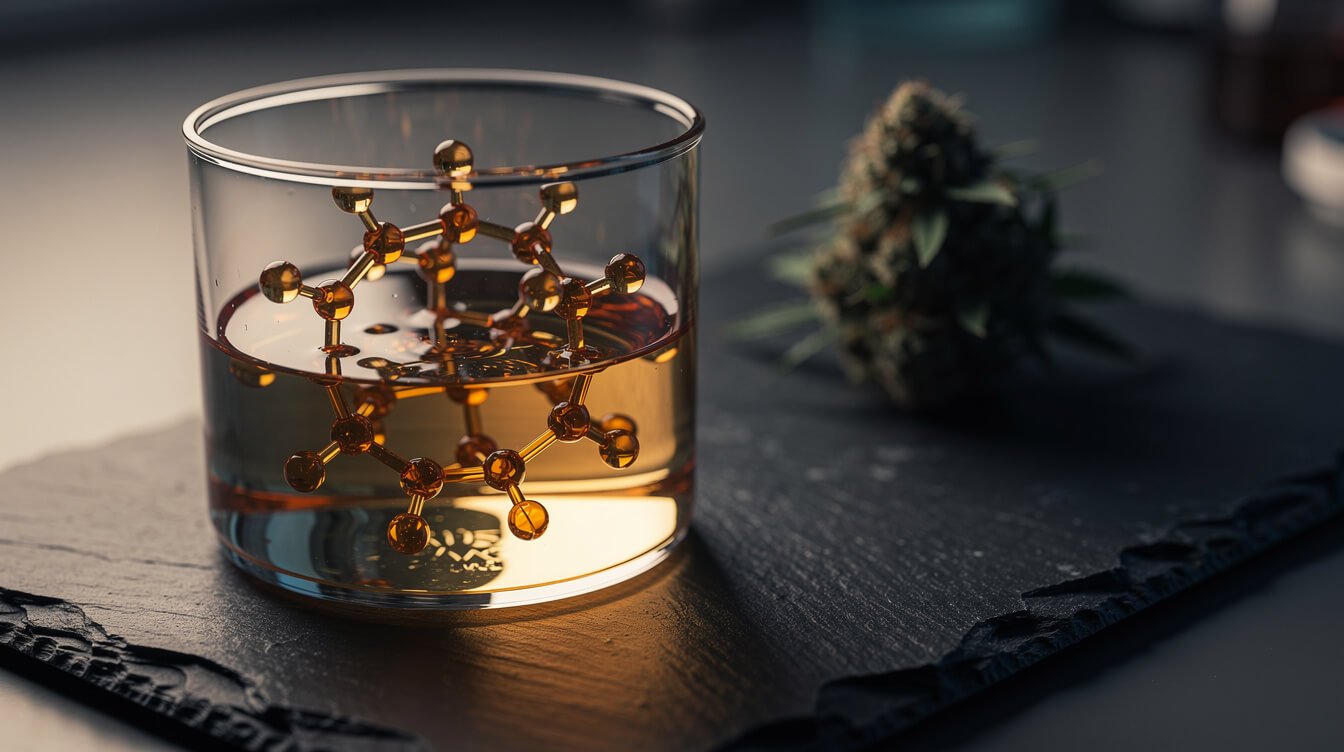
THC = tetrahydrocannabinol (teh-truh-HY-dro-kuh-NAB-ih-nawl). Its fuller name is delta-9-tetrahydrocannabinol, usually written Δ9-THC. Chemists’ fullest everyday version is (−)-trans-Δ9-tetrahydrocannabinol, which pins down exactly which shape of the molecule you mean. That’s the form the plant actually makes, and it’s the one responsible for most of cannabis’s high.
Three quick facts round out the short answer:
- The formula is C21H30O2: 21 carbon atoms, 30 hydrogens, and 2 oxygens (PubChem, CID 16078).
- The word is older than the abbreviation. The Online Etymology Dictionary dates “tetrahydrocannabinol” to 1940 and the short form “THC” to 1968.
- The live plant mostly doesn’t contain THC yet. It makes THCA, an acid form that turns into THC with heat. More on that “A” below.
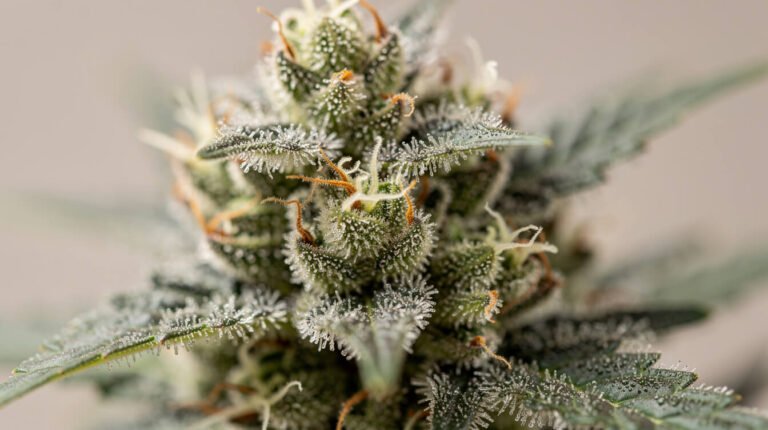
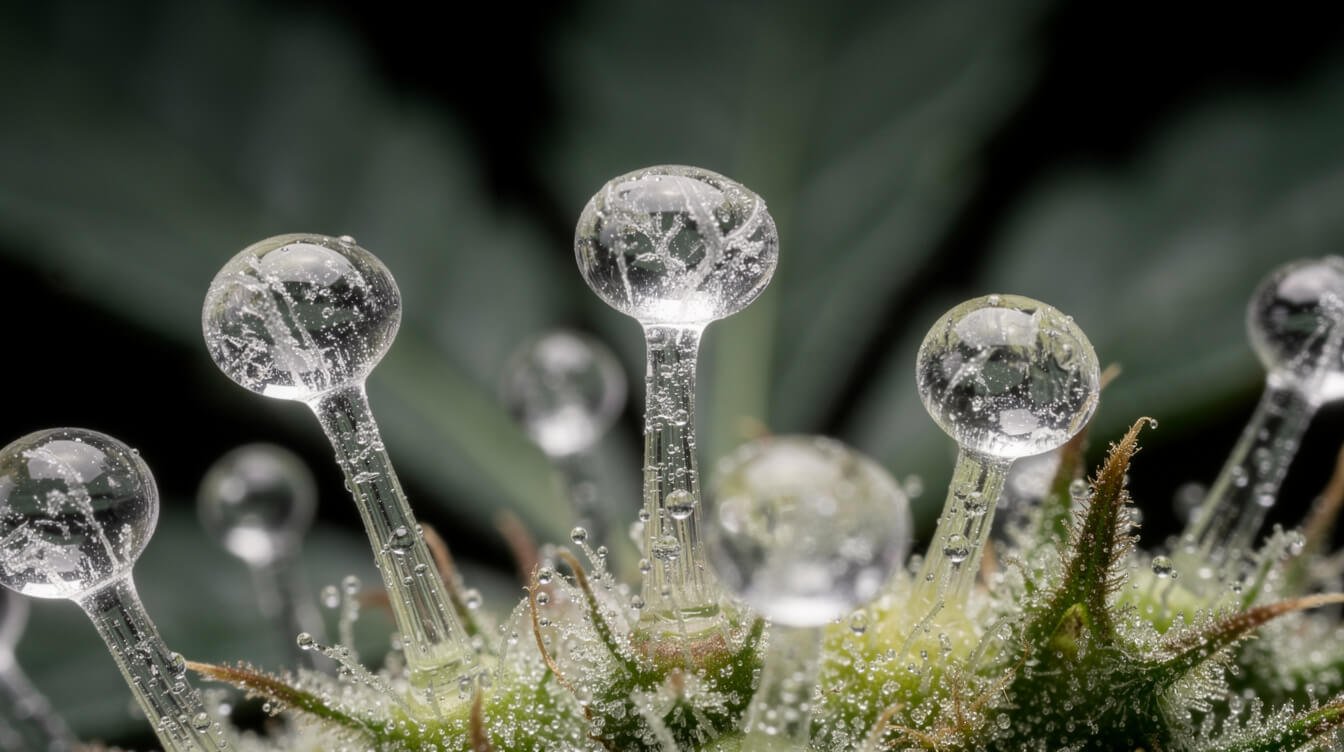
The trichomes in the photo above (the tiny resin glands on the flower, covered in our guide to reading trichomes) are where all of this chemistry happens. Now for the part nobody else spells out: what the word actually means.
Tetrahydrocannabinol, decoded piece by piece

Chemical names look like keyboard accidents, but they’re built from parts, like LEGO. Tetrahydrocannabinol breaks into four:
- tetra- = four (Greek).
- -hydro- = hydrogen. Together, “tetrahydro” means four added hydrogen atoms.
- cannabin- = from Cannabis, the plant’s genus name, plus the chemist’s “-in” suffix.
- -ol = an alcohol-type group, meaning an oxygen bonded to a hydrogen (–OH, a hydroxyl).
Here’s the catch that makes the name click: you don’t split it as “tetrahydro + cannabinol” by accident; that’s literally how it was built. Wiktionary’s etymology parses it as tetrahydro- + cannabinol, and cannabinol as cannabis + -in + -ol. So “tetrahydrocannabinol” means, roughly, “cannabinol with four extra hydrogens.”
Which raises the obvious question: what’s cannabinol, and why is the star of the show named as an add-on to it?
A note on that “-ol”
The “-ol” ending is the same one you see in ethanol and menthol. In THC, the –OH sits directly on a benzene-style ring, which technically makes it a phenol. That small group matters: it’s part of how THC grips its receptor in the brain, and it’s also the spot that THCA’s acid group sits next to (we’ll get there).
And the modern “official” name?
If you look THC up on PubChem, the formal IUPAC name is a mouthful: (6aR,10aR)-6,6,9-trimethyl-3-pentyl-6a,7,8,10a-tetrahydrobenzo[c]chromen-1-ol. Notice that “tetrahydro” and “-ol” survive even in the strict modern version. The “6a,7,8,10a” tells you exactly which four positions carry the added hydrogens. That detail becomes important when we get to delta-8.
Why THC is named after CBN, an older molecule
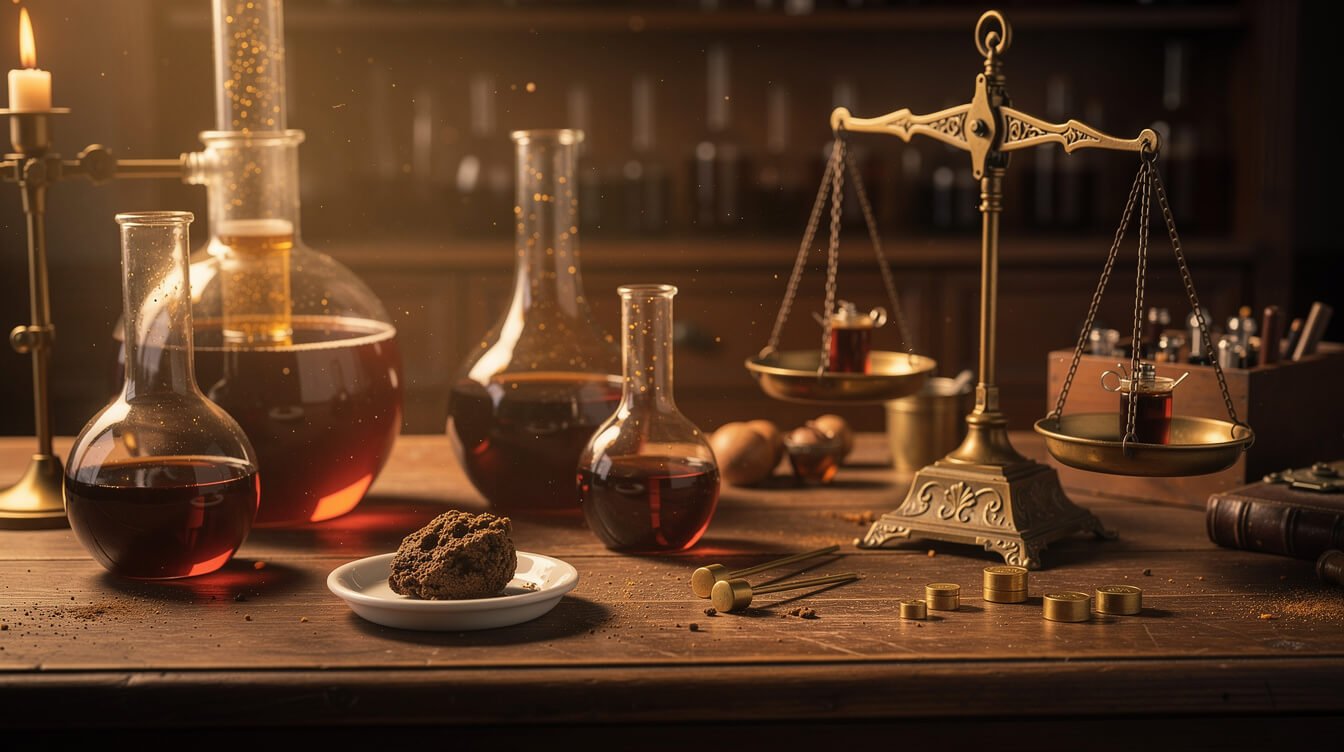
THC is named after cannabinol (CBN) for a simple reason: chemists found CBN first. It was the first cannabinoid ever isolated from the plant, and for decades it was the reference point everyone measured against.
The timeline
- 1896–1899: Chemists Wood, Spivey, and Easterfield worked on charas (hand-rubbed hash resin) and isolated a compound they called cannabinol (1896; “Cannabinol. Part I,” 1899).
- Early 1930s: R.S. Cahn worked out CBN’s structure.
- 1940: Roger Adams’s lab in the US and Alexander Todd’s in the UK synthesized CBN. The same year, Adams published work on turning cannabidiol into “tetrahydrocannabinol”, which matches the dictionary date for the word.
- 1942: THCs were first extracted from cannabis, most likely as a mix of delta-8 and delta-9.
- 1964: Y. Gaoni and Raphael Mechoulam isolated pure Δ9-THC and nailed down its structure (Journal of the American Chemical Society, 1964).
The history above comes from pharmacologist Roger Pertwee’s review, “Cannabinoid pharmacology: the first 66 years” (British Journal of Pharmacology, 2006), which is the best single read on this history if you want to go deeper.
The four hydrogens, made concrete
Line up the two formulas from PubChem and the name explains itself:
Same carbons, same oxygens. THC has exactly four more hydrogens. In CBN, one of the rings is fully “aromatic,” a flat, benzene-like ring. In THC, that ring carries four extra hydrogens and keeps just one double bond, so it’s no longer flat in the same way. The formal names show it too: CBN’s IUPAC name is THC’s name minus the “6a,7,8,10a-tetrahydro” part (and the shape labels that go with it).
The twist: THC turns back into CBN
Here’s the part that makes the naming feel almost poetic. When THC ages, it loses those four hydrogens and becomes CBN. A 1976 storage study found that air oxidation drives this. Light destroyed THC too, but that loss didn’t show up as extra CBN (Fairbairn et al., 1976). And when a chemist analyzed cannabis samples from Oxford’s Pitt-Rivers Museum dating from roughly 1896–1905, most of the cannabinoid content was CBN, described as “the main chemical degradation product” of Δ9-THC (Harvey, 1990).
So the first cannabinoid chemists ever isolated is, largely, what THC turns into over time. That’s part of why old, badly stored weed hits differently: CBN binds the brain’s main cannabinoid receptor more weakly than THC. Store flower cool, dark, and airtight if you want the THC to stay THC.
What “delta-9” means, and why old papers say delta-1
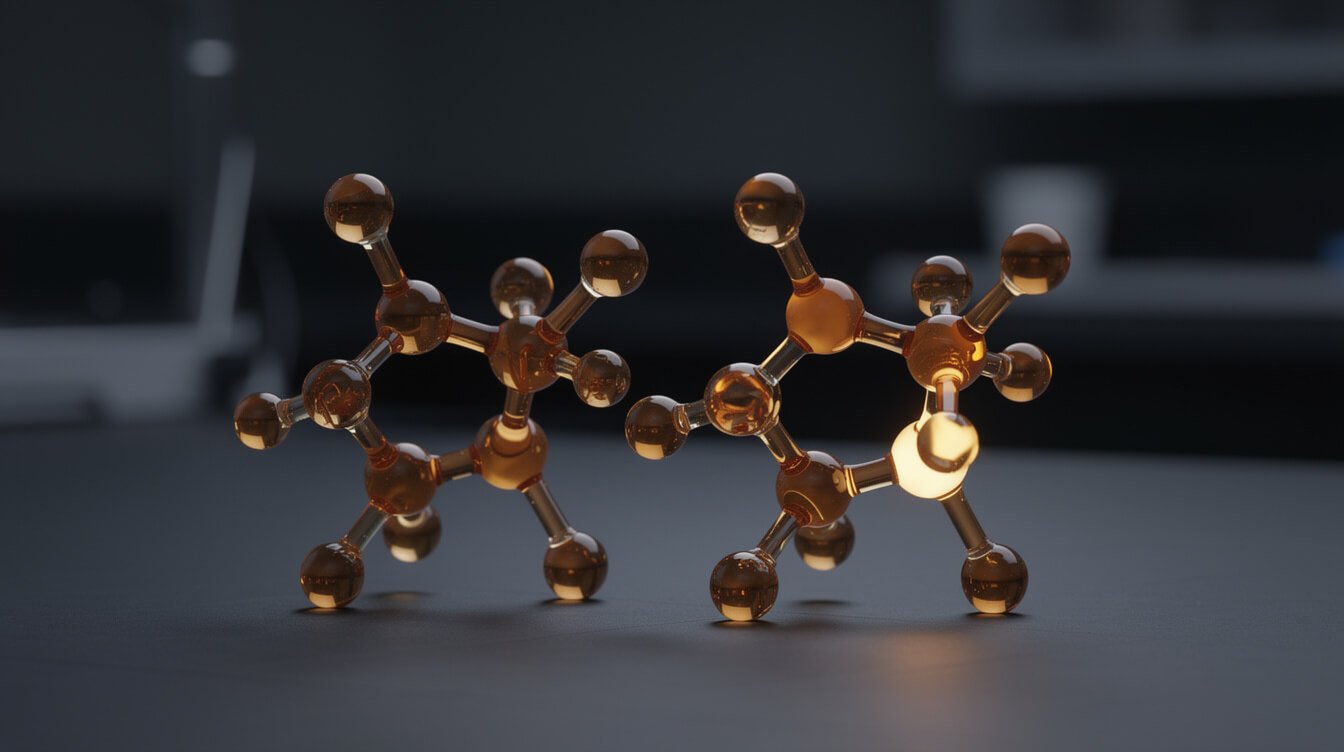
The “delta-9” in delta-9-THC isn’t a version number or a strength rating. In chemistry, Δ (delta) marks where a carbon-to-carbon double bond sits, and the number is the carbon it starts from. THC has one double bond in that non-aromatic ring, and in today’s standard numbering it begins at carbon 9. Hence Δ9.
Same molecule, two numbering systems
If you read cannabis research from the 1960s and ’70s, you’ll keep running into “Δ1-THC.” That’s not a different compound. It’s the same molecule numbered a different way. Pertwee’s review spells it out: the older literature calls Δ9-THC, Δ8-THC, and Δ6a,10a-THC “Δ1-THC, Δ6-THC and Δ3-THC, respectively,” because it used a monoterpenoid numbering system. For THC, the formal “pyran” numbering is what’s most commonly used now.
Once you know this, old paper titles decode easily. A 1974 mouse study on “7-hydroxy-Δ1-tetrahydrocannabinol” is about the metabolite we now call 11-hydroxy-THC, the active compound your liver makes from THC, often cited as part of why edibles feel different (our guide to how long a high lasts covers why that matters). Same atoms, different address system.
One wrinkle: CBD is numbered the old way
Pertwee also notes that the monoterpenoid system is the only one that works for CBD, because CBD’s ring is open. So THC and CBD are numbered differently even though they’re close cousins. If carbon numbers in a CBD paper and a THC paper don’t line up, that’s why. For how the two actually feel different, see our CBD vs THC effects breakdown.
And “trans” and “(−)”?
- trans means the two hydrogens where the rings join (positions 6a and 10a) point to opposite sides of the molecule.
- (−) means the molecule rotates polarized light to the left. THC has a mirror-image twin, and the plant makes the (−) version. Pertwee notes that both CBD and Δ9-THC occur naturally as their (−) forms. PubChem’s “(6aR,10aR)” is just a more precise label for the same shape.
GanjaTech, weekly
Cannabis, explained. In your inbox.
One email a week: the clearest explainers, honest gear picks, and what the science actually says. 21+ only. No spam, unsubscribe anytime.
THC vs THCA: what the “A” stands for
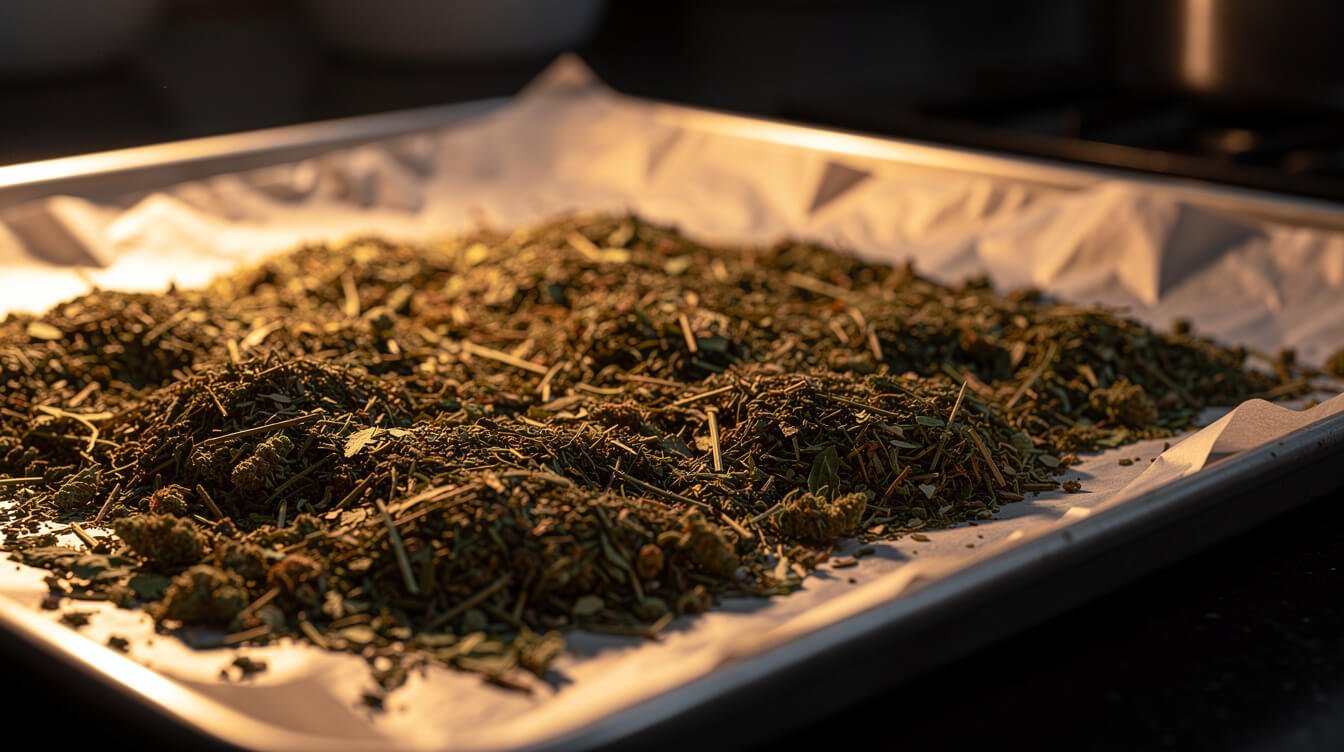
THCA stands for tetrahydrocannabinolic acid, and the “A” is short for acid. It’s what the living plant actually makes. Pertwee’s review puts it plainly: THC and its cousins are “present in cannabis mainly as acids that are decarboxylated when cannabis is heated.”
The math of the “A”
Compare formulas again:
- THCA: C22H30O4
- THC: C21H30O2
Subtract THC from THCA and you’re left with one carbon and two oxygens: CO2. THCA carries an extra carboxyl group (–COOH) sitting right next to that “-ol.” Heat knocks it off as carbon dioxide gas. That’s decarboxylation, or “decarb,” and it’s why raw flower in a smoothie won’t get you high the way the same flower does in a pipe or a properly made edible.
When you smoke or vape, the flame or heating element decarbs most of it on the spot. For cooking, you do it deliberately in the oven first. Our decarb temperature and time guide covers the trade-offs. Kief and hash work the same way: the trichome heads covered in what is kief are packed with THCA, not THC.
Why labels show both
Lab reports in many legal markets list THCA and THC separately, plus a “total THC” figure. That total estimates how much THC you’d get after full decarb (the acid’s extra weight is factored out, so it isn’t simply THC + THCA). Testing rules and label formats vary by state and country, so read your local label conventions rather than assuming.
Delta-8, delta-10, and other THCs
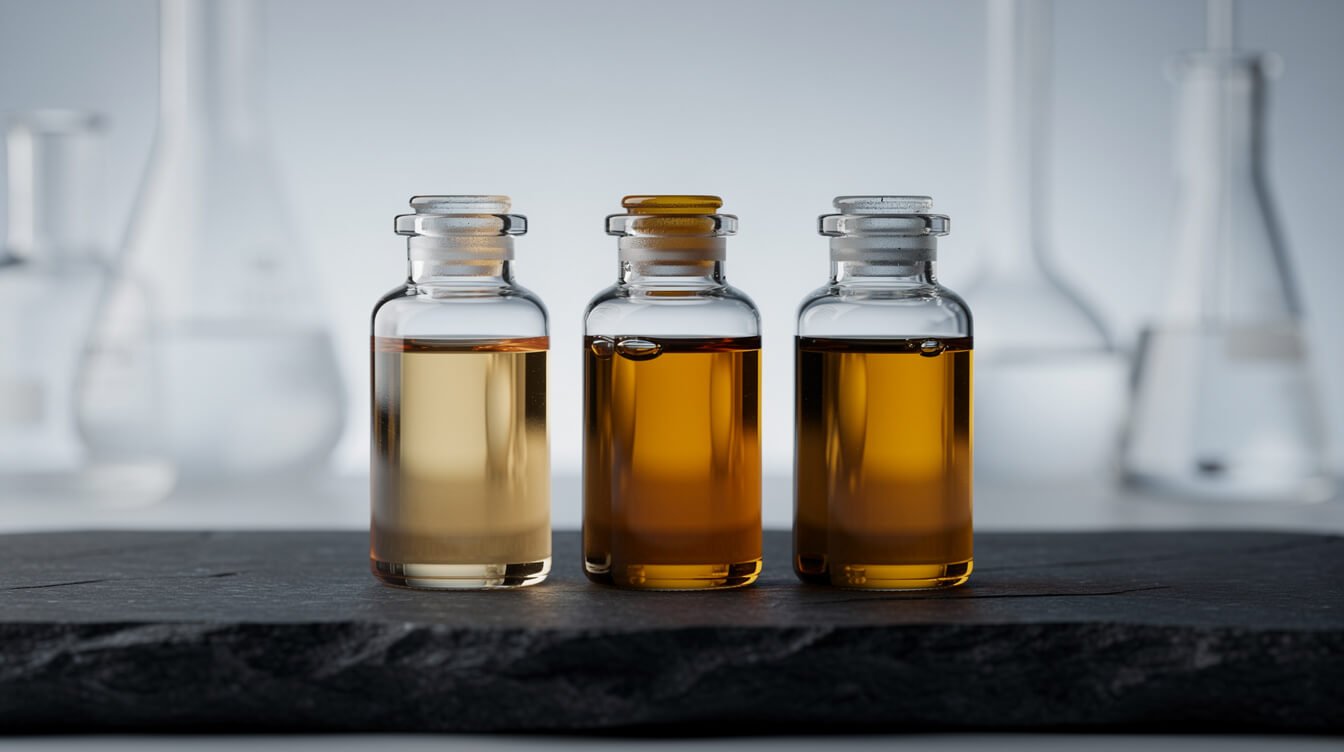
Here’s where the name decoding pays off. Delta-8-THC has the exact same formula as delta-9: C21H30O2 (PubChem, CID 638026). Same atoms, same count. The only difference is where the double bond sits: between carbons 8 and 9 instead of 9 and 10. Its IUPAC name even shows it: delta-9’s added hydrogens sit at “6a,7,8,10a,” while delta-8’s sit at “6a,7,10,10a.” Delta-10 moves the double bond again.
Molecules with the same formula but different arrangements are called isomers. Same parts, different assembly. Because receptors respond to shape, isomers don’t have to act alike, and solid human research on delta-8 and delta-10 is limited. Treat confident claims about how they “compare” with healthy skepticism.
Where delta-8 actually comes from
The plant makes very little delta-8. The FDA says the natural amount in hemp “is very low,” and that additional chemicals are needed to convert other cannabinoids, like CBD, into delta-8 (“synthetic conversion”). The agency also flags that some manufacturers may use potentially unsafe chemicals in that process (FDA, 5 things to know about delta-8 THC). So “it’s a natural cannabinoid” and “this product came from a plant” aren’t the same claim.
On legality: laws on delta-8, THCA, and hemp-derived products differ by state and country, and federal hemp rules are changing in 2026. Don’t assume anything is legal where you live. Check your local law.
THCV, THCP, and the other letters
Not every “THC-something” is an isomer. THCV (tetrahydrocannabivarin) has a shorter side chain, three carbons instead of five, so its formula is C19H26O2, a genuinely different molecule. The “-varin” ending marks that shorter, three-carbon version (see what is CBG for another cannabinoid name, decoded). The shared “THC” letters tell you about the ring system, not about the effect.
What THC does in your body, briefly
THC produces its high mainly by activating CB1 receptors, proteins concentrated in the brain and nervous system. Pharmacologists call THC a partial agonist at CB1, meaning it switches the receptor on, but not all the way (Pertwee, 2006). Some sources online describe THC as an “antagonist,” a receptor blocker. That’s backwards.
The receptor story came after the molecule. Researchers found binding sites for cannabinoids in the late 1980s, the CB1 receptor was cloned in 1990, and in 1992 a team in Mechoulam’s lab isolated the body’s own version of the key, which they named anandamide, from the Sanskrit ananda, “bliss.” In other words, the plant compound was named and understood decades before scientists knew what it was unlocking.
What that feels like varies a lot by dose, route, and person: euphoria and relaxation for some, anxiety or a racing heart for others, plus the munchies. Regular use builds tolerance as receptors adjust. Our tolerance break guide covers how long that takes to reverse. A few responsible basics: start low, go slow (especially with edibles), never drive high, and talk to a doctor about any health question. We describe reported effects here, never medical promises.
An FDA-approved drug made of synthetic THC does exist (dronabinol). That’s chemistry, not an endorsement of any medical use. Health decisions belong with a clinician.
FAQ: what does THC stand for, plus the other name questions

What does THC stand for in weed?
Tetrahydrocannabinol, specifically delta-9-tetrahydrocannabinol, the main compound behind cannabis’s high. When a dispensary menu or lab report says “THC %,” it usually means this molecule, often reported alongside THCA.
What does THC stand for, word by word?
Tetra (four) + hydro (hydrogen) + cannabin (from Cannabis) + ol (an –OH group). Put together: cannabinol with four extra hydrogen atoms.
What does THCA stand for?
Tetrahydrocannabinolic acid, the raw form the plant produces. It carries an extra CO2‘s worth of atoms that heat removes, turning it into THC.
Is THC the same as delta-9?
In everyday use, yes. “THC” almost always means Δ9-THC. Technically, “tetrahydrocannabinol” covers a small family of isomers (delta-8, delta-10, and others) with the same formula and the double bond in different places, which is why the “delta” number is there.
Why do some old studies say “delta-1-THC”?
Different numbering system, same molecule. Research from the 1960s and ’70s often used monoterpenoid numbering, where Δ9-THC is called Δ1-THC.
Who discovered THC?
Y. Gaoni and Raphael Mechoulam isolated pure Δ9-THC and determined its structure in 1964. Earlier chemists had extracted THC mixtures in 1942, and cannabinol, the molecule THC is named after, was isolated in the late 1890s.
When did people start saying “THC”?
The Online Etymology Dictionary dates the abbreviation to 1968, a few years after the structure was solved. The full word dates to 1940.
Is CBN just old THC?
Largely, yes. CBN mostly forms when THC oxidizes during aging and storage. It’s the same skeleton with four hydrogens stripped off, and it’s much weaker at the CB1 receptor.
Final thoughts
So, what does THC stand for? Tetrahydrocannabinol: cannabinol with four extra hydrogens, carrying an –OH group, with a double bond at carbon 9. Every part of the name is doing a job. “Delta-9” tells you where the double bond is. The “A” in THCA is an acid group that heat turns into CO2. Delta-8 is the same atoms in a slightly different arrangement. And CBN, the older molecule THC is named after, is mostly what THC becomes when it sits around too long.
Knowing the name won’t change how a joint feels, but it does make you harder to fool. When a label leans on “delta” numbers or a seller calls something “natural,” you can read what the chemistry actually says. That’s the whole point here: understand the plant, respect it, know your local laws, and enjoy responsibly.
Before you go
Get the next explainer first
We publish a new one every day. The best of the week, plus what's new in the shop, lands in one short email.