Why Does Weed Make You Hungry? The Munchies, Explained by the Newest Research
Why does weed make you hungry? The short version: THC switches on cannabinoid receptors (CB1) in your brain that normally help run appetite, and it nudges them all at once. Food smells stronger, the “I’m full” signal gets muddled, and eating suddenly feels more worth the effort. That’s the munchies. It’s a brain effect, and it shows up whether or not your stomach actually needs anything.
Most explanations stop at one word: ghrelin, the “hunger hormone.” That story is mostly built on animal work and a couple of small human studies, and the newest and largest controlled human experiment points somewhere else. This guide walks through the three layers that are reasonably well understood, what the 2025 human data actually found, where the ghrelin idea comes from, and how to handle the munchies without regretting it. It’s written for adults 21+, and cannabis laws vary by state and country, so know yours.
Why does weed make you hungry? The short answer
Your body already makes its own cannabis-like molecules, called endocannabinoids. One of their day jobs is appetite: they help decide when food seems interesting, how good it smells, and when you’ve had enough. THC, the main intoxicating compound in cannabis, fits the same CB1 receptors those molecules use. The difference is that your own endocannabinoids are released in small, targeted bursts, while THC lands everywhere at once and sticks around for hours.
Researchers have mapped at least three places where that matters:
- Smell. In the olfactory bulb, CB1 activation makes food odors easier to detect, at least in fasted mice.
- The satiety switch. In the hypothalamus, cannabinoids can flip neurons that normally say “stop eating” into releasing a chemical that says “keep going.”
- Reward and motivation. Food becomes more worth working for, even after you’ve eaten.
The best human evidence so far, a 2025 study in PNAS, found that people who vaped cannabis ate more within the first half hour of getting access to snacks. In the matched rat experiments, the effect ran through receptors in the brain, not in the gut. So when you ask why weed makes you hungry, the honest answer is “your brain’s appetite system gets a loud, temporary override.”
One caveat runs through this whole post: most of the detailed mechanism comes from mice and rats. That isn’t a reason to ignore it. Rodent appetite circuitry is similar enough to ours that it’s the standard model. But it’s a reason to say “probably” more often than most munchies articles do.
Layer 1: food really does smell better

If you’ve ever caught the smell of someone’s toast from two rooms away while high, there’s a plausible reason for it. In 2014, a team led by Edgar Soria-Gómez published in Nature Neuroscience that CB1 receptors sit on the nerve endings that carry feedback from the smell-processing cortex back to the olfactory bulb, the brain’s first stop for odors.
Normally that feedback acts like a volume knob, keeping the incoming smell signal in check. When cannabinoids activate those CB1 receptors, they turn the feedback down. With the knob loosened, the bulb responds more strongly to odors. Fasted mice given cannabinoids got better at detecting smells, and they ate more. When the researchers removed CB1 from that specific circuit, the extra eating went away.
Why smell matters so much for appetite
Smell does a lot of the work we credit to taste. Flavor is mostly aroma reaching your nose from the back of your mouth, which is why food tastes flat when you have a cold. So a brain that’s primed to pick up food odors is a brain that finds food more interesting.
The study’s framing is useful: hunger already sharpens smell (that’s normal), and the endocannabinoid system appears to be part of how it does that. THC hijacks the same route, so you get the “starving person’s nose” without being starving.
The catch
This was shown in mice, and specifically in fasted mice. Nobody has run the equivalent experiment on the human olfactory bulb. Interestingly, in the 2025 human study we’ll get to in Layer 3, cannabis didn’t change how people rated the taste of their snacks. So “everything tastes amazing” may be less about the food changing and more about how much you want it. Treat the smell layer as a well-supported piece of the picture, not the whole thing.
Layer 2: the “I’m full” neurons flip sides
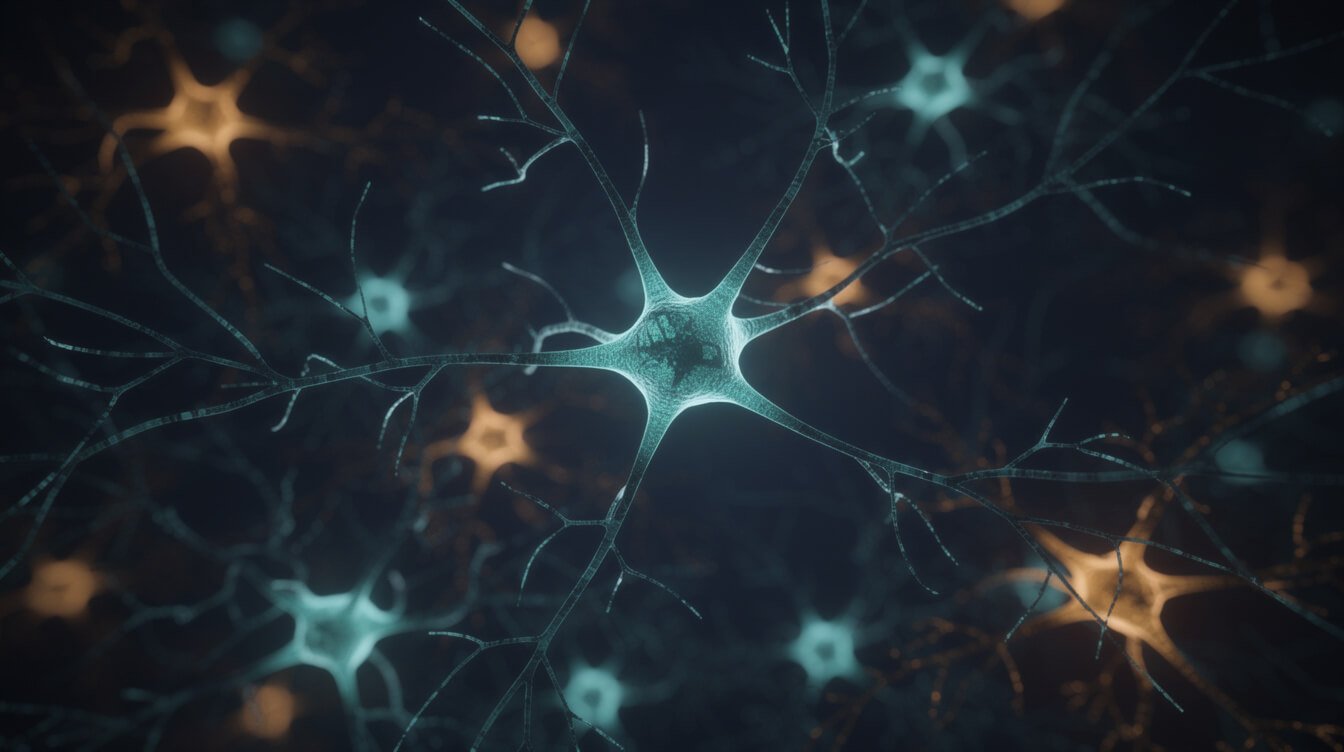
Deep in the hypothalamus, which is your brain’s thermostat for things like hunger, body temperature, and thirst, there’s a group of cells called POMC neurons. Their reputation is simple: when they fire, you feel satisfied and stop eating. You’d expect THC to make you hungry by shutting them down.
A 2015 paper in Nature by Marco Koch and Tamas Horvath’s group found the opposite, which is why it got so much attention. In well-fed mice, activating CB1 receptors actually increased POMC neuron activity, and the mice ate more anyway.
How a “stop eating” neuron ends up saying “keep eating”
The trick is in what the neurons release. The POMC gene makes two different products:
- Alpha-MSH, a signal that suppresses appetite (the “I’m full” message).
- Beta-endorphin, one of the body’s own opioids, which can promote eating.
Under CB1 activation, the neurons selectively ramped up beta-endorphin and not alpha-MSH. When the researchers blocked opioid receptors with naloxone, the cannabinoid-driven eating stopped. Same neurons, opposite message.
And a second hunger circuit, from the WSU lab
A 2023 study in Scientific Reports by Wheeler and colleagues at Washington State University used vaporized cannabis flower on rats and mice, which is closer to how people actually consume it. Cannabis vapor increased meal frequency and food-seeking. CB1 activation reduced the brakes on AgRP neurons, the hypothalamus’s dedicated hunger cells. Quieting those AgRP neurons blunted the cannabis-driven eating.
Put together, the hypothalamus picture is: THC both weakens the “full” message and boosts the “hungry” one. That’s why the munchies can hit an hour after a big dinner. Your stomach knows you’re full, but the part of the brain that tallies it is getting mixed signals.
Layer 3: food becomes more rewarding (the human data)
This is the part most munchies articles skip, and it’s the strongest human evidence we have. In late 2025, Catherine Hume, Carrie Cuttler, Ryan McLaughlin, Matthew Hill, and colleagues at the University of Calgary and Washington State University published a paired human-and-rat study in PNAS.
What they did with people
According to WSU’s summary, 82 volunteers aged 21 to 62 were randomly assigned to vape a low dose (20 mg THC, about 0.17 g of roughly 12% flower), a high dose (40 mg THC), or a placebo. After about an hour of memory tests, they got access to a spread of snacks and drinks, and the researchers measured what they ate.
The results, in plain terms:
- Both doses increased how much people ate in the first 30 minutes, compared with placebo. The high dose didn’t produce more munchies than the low one.
- It happened regardless of gender, and per the researchers, regardless of body mass index or when people had last eaten.
- The mix of what they ate didn’t change. People ate more carbs, more fat, and more protein, but in the same proportions as the placebo group.
- Taste ratings didn’t change, either. The food wasn’t rated as better. People just ate more of it.
The participants were experienced users, averaging about five sessions in the past week and eight to ten years of use. So the munchies clearly don’t vanish with regular use, at least at these doses.
What the rats added
The rat experiments got at the “why.” Cannabis vapor made rats start eating sooner and eat in more bouts, and it worked on plain chow, high-carb food, and high-fat food alike. Rats that had been pre-fed until full still went back to work for food. In lever-press tests they pushed harder for food rewards. As Hill put it in the WSU release, sober full rats “barely work in any capacity to get access to food,” but stoned ones “go right back as if they’re starving.”
Two more findings matter. Blocking CB1 receptors throughout the body stopped the extra eating, but blocking only the peripheral ones (outside the brain) didn’t. And cannabis vapor didn’t change any of the circulating appetite hormones the team measured in the rats: ghrelin, leptin, insulin, GLP-1, PYY, and several more. The authors’ conclusion is that cannabis “may override homeostatic appetite regulation by increasing motivation to eat.”
That’s the real answer to why weed makes you hungry, as best the science can give it today. It’s less “your stomach is empty” and more “food just became much more worth getting up for.”
GanjaTech, weekly
Cannabis, explained. In your inbox.
One email a week: the clearest explainers, honest gear picks, and what the science actually says. 21+ only. No spam, unsubscribe anytime.
What about ghrelin? Where the popular story comes from
Search “why does weed make you hungry” and most pages will tell you THC makes your stomach release ghrelin, the hormone that signals hunger, and that’s the whole explanation. It’s not made up, but it’s a much shakier claim than it sounds.
The evidence for it
The most cited human data is a 2012 pilot study by Riggs and colleagues. It piggybacked on a clinical trial in adult men with HIV and found that smoked cannabis raised blood ghrelin and leptin (an appetite-suppressing hormone) and lowered PYY. That’s a small sample from a specific medical population, and the hormones moved in both directions. A 2018 WSU conference presentation on rats also described a ghrelin surge, and science-news sites picked it up widely.
The evidence against it
- Farokhnia and colleagues, 2020. In a placebo-controlled study of 20 adult cannabis users given about 50 mg of THC by mouth, smoked, or vaped, ghrelin didn’t rise compared with placebo. Total ghrelin was only higher in the oral sessions than the inhaled ones. The clearest changes were elsewhere: cannabis blunted the insulin spike after eating and lowered GLP-1.
- Hume and colleagues, 2025. As covered above, cannabis vapor didn’t change ghrelin or any other measured appetite hormone in their rats, and blocking peripheral CB1 receptors didn’t block the munchies.
The fair verdict
Hormones might play a supporting role, and the route you use (eating vs. inhaling) may change which ones move. But the munchies don’t need a ghrelin spike to happen, and the controlled data increasingly says the brain is doing the heavy lifting. If a page tells you ghrelin is the reason, it’s simplifying past what the evidence supports.
Does strain, dose, or method change the munchies?
This is where a lot of advice turns into folklore, so let’s go one at a time.
Indica vs. sativa
You’ll often read that indicas give you the munchies and sativas don’t. There’s no controlled evidence for that. A 2021 genetic analysis in Nature Plants found that samples labeled “indica” and “sativa” were genetically indistinct overall, and the labels lined up with a handful of terpenes rather than real lineages. We dig into that in what’s stronger, sativa or indica and indica vs. hybrid. The munchies follow THC and CB1, not the name on the jar.
Terpenes and THCV
Terpenes like myrcene or limonene get credited with all sorts of effects. Our terpene reference covers what’s actually known, and for appetite the honest answer is “not much in humans.” The same goes for THCV, a minor cannabinoid marketed as “diet weed.” It’s interesting in early lab research, but there’s no good evidence that a THCV-heavy flower reliably cancels the munchies.
Dose
In the 2025 study, 20 mg and 40 mg of vaped THC produced about the same increase in eating. So more THC doesn’t mean proportionally more munchies. It mostly means more of everything else, including the odds of an uncomfortable high. Our guide to greening out covers what to do if you overshoot.
Smoking vs. vaping vs. edibles
The method mostly changes the timing. Inhaled cannabis acts within minutes, so the munchies can follow quickly. Edibles take 30 minutes to two hours to kick in and last much longer, so the hunger can arrive late and hang around. Our breakdown of how long edibles last has the full timeline. One practical warning: don’t mistake edible munchies for a sign that the edible “isn’t working” and take more.
CBD
You’ll see claims that adding CBD “blocks” the munchies. There’s no solid evidence for that. There is evidence that oral CBD taken with THC can raise THC levels in the blood. A 2023 study by Zamarripa and colleagues gave adults brownies with 20 mg of THC, with or without 640 mg of CBD. The CBD-heavy brownie produced higher blood THC levels and stronger effects than the same THC dose alone. Our CBD vs. THC effects guide covers the differences.
Tolerance
The participants in the 2025 study used cannabis regularly, and they still got the munchies. Rat studies have found the feeding effect holds steady across repeated days. Older residential-lab work suggests that people using several times a day eat more over a full 24 hours, while people using once or twice a day mostly don’t. Tolerance builds to plenty of THC’s effects, but the munchies seem stubborn. If you want to reset your overall sensitivity, our t break guide covers what the brain-scan studies show.
Handling the munchies without the regret

The munchies aren’t a problem to be solved. For a lot of people they’re part of the fun. But if you’ve ever looked down at an empty family-size bag and wondered what happened, a little planning helps. None of this is diet advice. It’s just about eating on purpose.
Prep before, not during
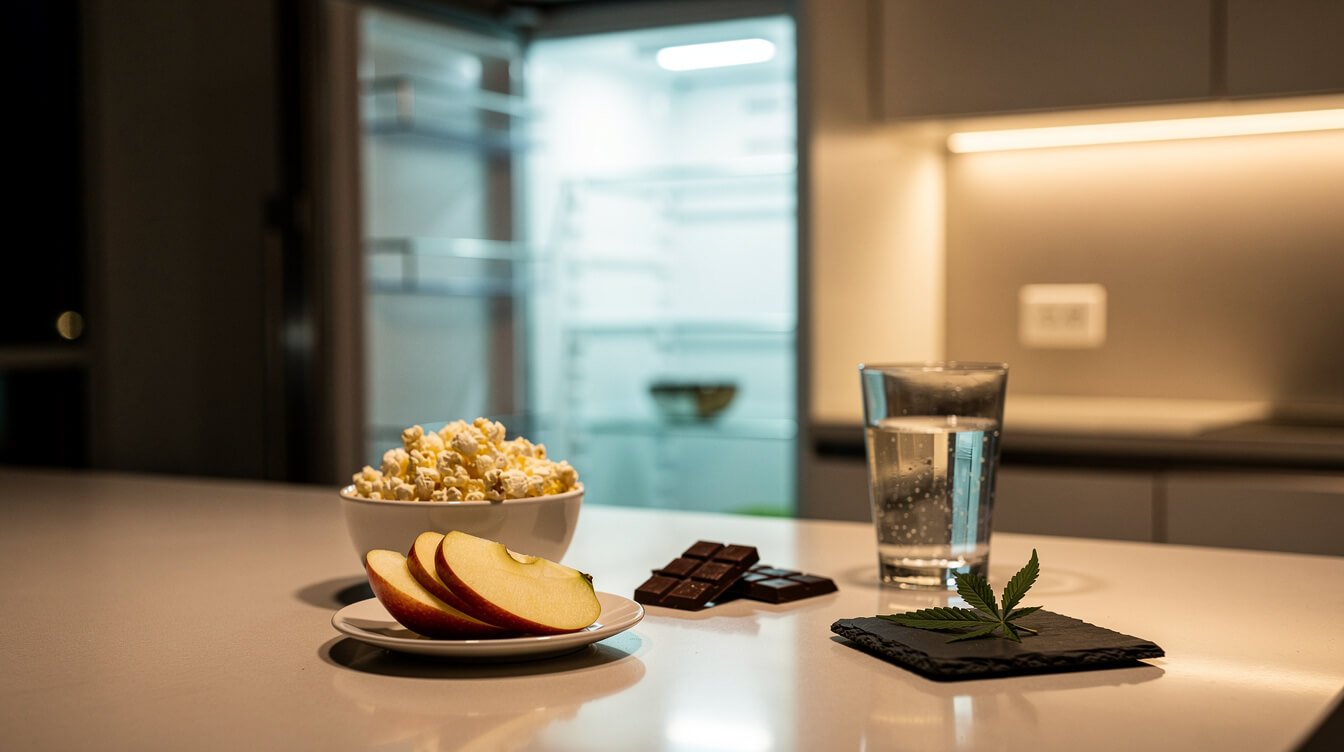
The rat data says cannabis makes food more worth working for, so make the good options the easy ones. Set out portions on a plate rather than eating from the bag. Have something you’ll actually enjoy ready to go: fruit, popcorn, hummus and vegetables, cheese and crackers, or a proper meal you’ve already cooked. If the snack table is only candy, you’ll eat candy. In a classic 1988 residential-lab study, smoked cannabis raised daily calories by about 40%, almost all of it from extra snacking occasions, especially sweet snacks like candy bars. Meals stayed the same size.
Drink water first
Cotton mouth is real, and thirst can feel a lot like hunger. In the WSU study, water was one of the most popular items on the table. Keep a glass nearby and drink some before you reach for food.
Never drive for snacks
This one isn’t optional. The late-night food run is one of the most common ways people end up driving high. Cannabis slows reaction time and impairs judgment, and driving impaired is illegal in every US state. Stock up before, order delivery, or walk if it’s safe.
Mind the edible stack
If your snacks are infused, the munchies can trick you into eating a second dose. Keep infused and regular food in clearly separate containers, label anything homemade, and store edibles locked away from kids and pets. If a child or pet eats cannabis, call Poison Control at 1-800-222-1222 (or 911 if they’re hard to wake or struggling to breathe), and for pets, your vet or the Pet Poison Helpline at 855-764-7661.
If your appetite changes worry you
If you notice big changes in weight or appetite, or you find you can’t eat without cannabis, that’s worth a conversation with a doctor. The same goes for nausea or vomiting with heavy use, which isn’t the munchies and deserves medical attention.
Why does weed make you hungry? FAQ

Why does weed make you hungry even when you just ate?
Because the effect runs through the brain, not your stomach. In the 2025 rat experiments, animals that had been fed to fullness still went back to work for food after cannabis vapor. THC muddles the “full” signal and makes food more rewarding, so being full stops being a reliable brake.
Does everyone get the munchies?
Not everyone, and not every time. In controlled studies the effect is reliable on average, but individuals vary. Setting matters too. Food within reach, boredom, and a social snack table all make it more likely.
Why do I crave sweets when I’m high?
It’s partly what’s available. In the 2025 human study, cannabis increased total eating without changing the proportion of carbs, fat, and protein. In the 1988 residential lab, the extra calories came mostly from sweet snacks. Both can be true: cannabis makes you want more food in general, and sweet snacks are usually the easiest thing to grab.
How long do the munchies last?
For inhaled cannabis, the biggest effect in the 2025 human study showed up in the first 30 minutes of food access. In the rats, the burst of eating was followed by eating less a couple of hours later, with no change over 24 hours. For edibles, expect a later start and a longer tail.
Do the munchies go away with tolerance?
The evidence says they’re stubborn. Regular users in the 2025 study still ate more, and the rat feeding effect held steady across days. A tolerance break might lower your overall sensitivity to THC, but don’t count on regular use making the munchies disappear.
Is there a strain that doesn’t give you the munchies?
Not reliably. Indica/sativa labels don’t predict it, and the “diet weed” claims around THCV aren’t backed by solid human data. A lower dose is the most dependable lever for a milder high overall.
Final thoughts
Why does weed make you hungry? Because THC takes over an appetite system your brain already runs. It sharpens food smells, flips the “I’m full” neurons toward “keep going,” and makes food feel more worth getting. The biggest human study to date found people simply ate more, with no shift in what they chose, and the matched animal work points to the brain rather than to hormones.
The ghrelin story isn’t wrong so much as overstated. It’s one possible supporting player, and the cleanest controlled data doesn’t show it doing the work.
Practically, the munchies are predictable, so plan for them. Put good food within reach, drink water first, keep infused and regular snacks apart, and never drive for a snack run. Great plant, good snacks. Respect it, know your local laws, and enjoy it responsibly.
Before you go
Get the next explainer first
We publish a new one every day. The best of the week, plus what's new in the shop, lands in one short email.