How to Make Cannabis Tincture: Alcohol vs Glycerin, Why Proof Matters, and the Sublingual Myth
Here’s the honest answer to how to make cannabis tincture: decarb your flower, soak it in high-proof food-grade alcohol (or glycerin, if you want it alcohol-free), strain it, and bottle it in a dark dropper bottle with the strength written on the label. That’s it. No special machine, no pressure, no heat beyond your oven.
The recipe isn’t the hard part. What most guides get wrong is everything around it. They tell you 80-proof vodka is fine (it’s a weak solvent), that drops under your tongue “hit in minutes” (the controlled data says otherwise), and they rarely do the math on how strong a dropper actually is. This guide fixes all three, with the studies linked so you can check us. It’s written for adults 21+ in places where home cannabis preparation is legal. Laws vary by state and country, so check yours first.
How to make cannabis tincture: the short answer
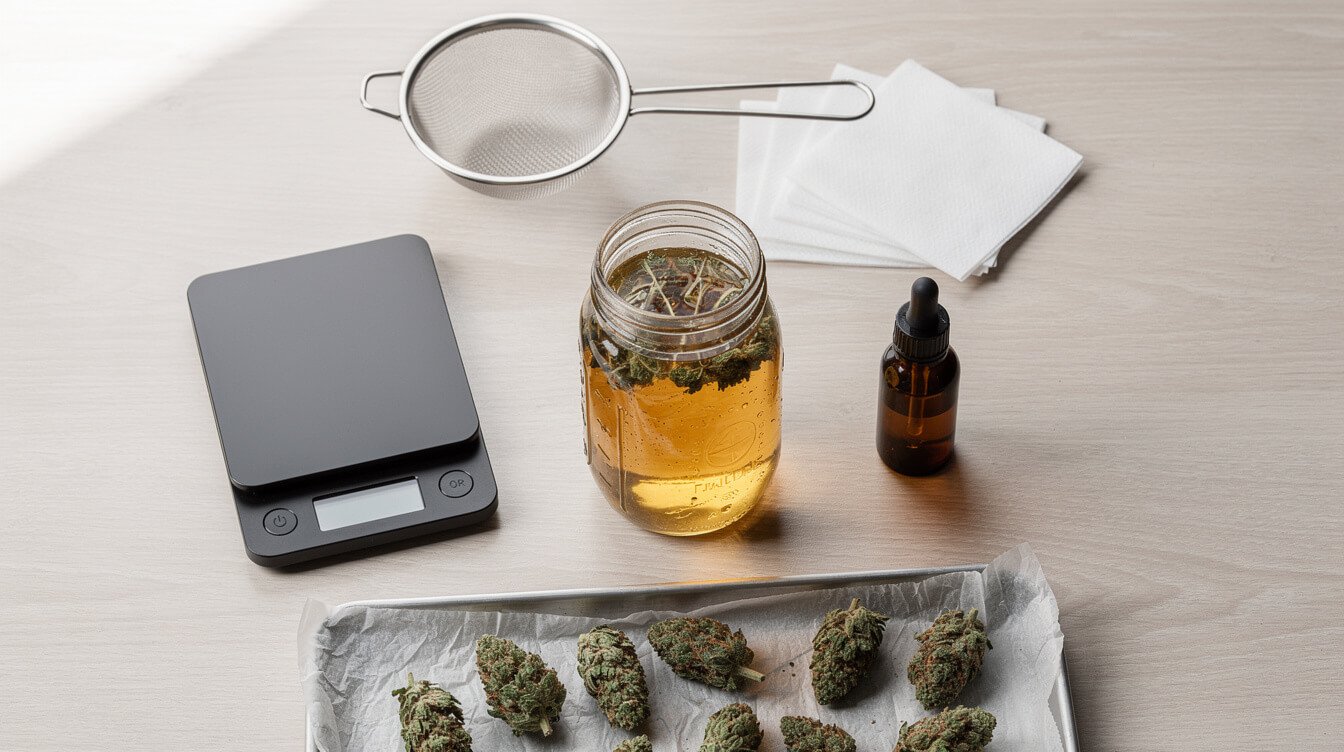
If you just want the method, here it is. The rest of the post explains the why, and the numbers that keep a batch predictable.
What you need
- 7 grams (a quarter ounce) of cannabis flower, or less for a milder tincture.
- About 60 ml (2 fl oz) of 190-proof food-grade grain alcohol. 151-proof works as a fallback. Never use rubbing alcohol, isopropyl, or denatured alcohol. They’re poisonous to drink.
- A baking sheet and parchment paper for the decarb, plus an oven thermometer if you have one.
- A clean glass jar with a tight lid.
- A fine mesh strainer and unbleached coffee filters.
- Amber or cobalt glass dropper bottles, and a marker for the label.
The method
- Decarb. Break the flower up, spread it on parchment, and bake at 240°F for about 40 minutes.
- Chill (optional). Put the decarbed flower and the sealed bottle of alcohol in the freezer for a few hours. Cold alcohol pulls less chlorophyll, so the tincture tastes less like lawn clippings.
- Soak. Combine them in the jar, seal it, and shake. Go short and cold (a few minutes) for a cleaner taste, or long (a few days, shaking daily) to pull more of what’s left.
- Strain. Pour it through the mesh strainer, then through a coffee filter.
- Do the math and label it. Work out the maximum mg of THC per ml (section five), and write it on the bottle with the date.
- Store it. Dark bottle, cool place (the fridge is best), and locked away from kids and pets.
No stovetop step anywhere in that list is deliberate. High-proof alcohol is very flammable, and the vapor can catch from a gas flame. More on that in section four.
Alcohol, glycerin, or oil: which base, and the trade-offs
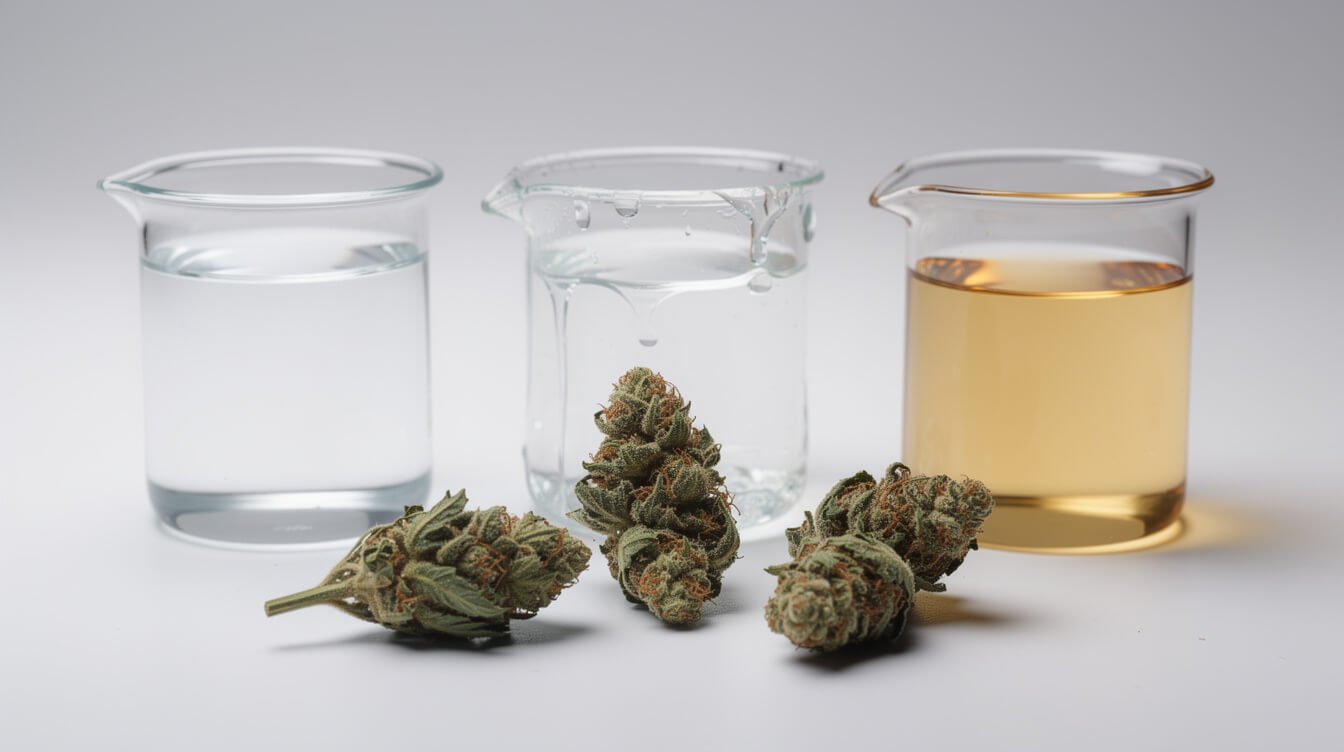
“Tincture” technically means an alcohol extract. In practice, people use the word for three different things, and each one behaves differently.
Alcohol tincture (the classic)
This is what pharmacies sold a century ago, and it’s still the most efficient home option. High-proof ethanol dissolves cannabinoids and terpenes readily, works at room temperature or colder, and keeps for a long time because the alcohol itself preserves it. The downsides: it burns a little on the tongue, it tastes sharp, and some people avoid alcohol entirely, for any reason.
Glycerin tincture (a “glycerite”)
If you’re working out how to make cannabis tincture without alcohol, glycerin is the usual answer. Food-grade vegetable glycerin is sweet, alcohol-free, and gentle on the mouth, which is why it’s popular. Most guides say glycerin is a “weak solvent” for THC. That’s not quite right. Reference data on purified THC lists it as soluble at about 1 part in 3 parts glycerol, compared with 1 part in 1 part alcohol (PubChem, citing Martindale). So it dissolves, just less of it per ml.
The bigger problem is physical. Glycerin is thick, so it soaks into plant material poorly and doesn’t drain out well, and most glycerin recipes need hours of low heat to get anywhere. Home makers consistently report weaker glycerites than alcohol tinctures from the same flower. We couldn’t find a peer-reviewed head-to-head measurement, so treat “weaker” as a well-reported pattern, not a fixed number. If you go this route, a lab test is the only way to know your real strength.
Oil “tincture”
An MCT or olive oil “tincture” in a dropper bottle is really just canna oil in a different container. The method, the time and temperature, and (importantly) the food-safety rules are the same, so follow our guide to making canna oil instead of anything here. One key difference: an alcohol tincture is shelf-stable. A homemade oil isn’t.
| Base | Pulls THC | Taste | Shelf life | Best for |
|---|---|---|---|---|
| 190-proof alcohol | Best | Sharp, boozy | Long, if cool and dark | Most people |
| Glycerin | Weaker, needs heat | Sweet | Shorter; keep it cold | Avoiding alcohol |
| Oil (MCT, olive) | Good, with heat | Mild | Days in the fridge, or freeze | Cooking (it’s canna oil) |
Why proof matters more than the recipe
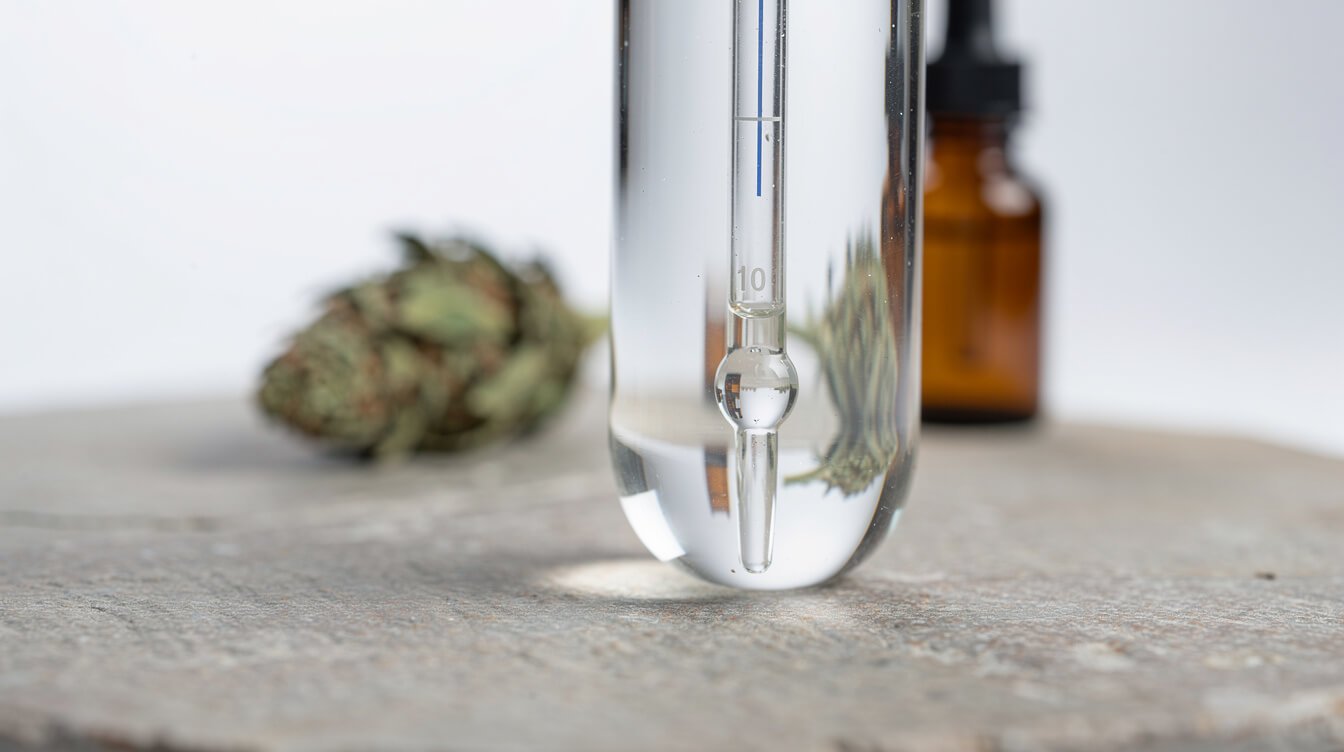
If you change only one thing about the recipe you found online, make it the alcohol. Proof is just double the alcohol percentage: 80-proof vodka is 40% alcohol, 151-proof is about 75%, and 190-proof grain alcohol is 95%.
That percentage decides how much cannabinoid ends up in your bottle. In a quality-control study of traditional cannabis tinctures, tinctures made with 80–90% ethanol contained about ten times more cannabinoids than tinctures made with 40% ethanol (Peschel, 2016). The same flower and the same process, with ten times the yield, just from changing the solvent.
The reason is simple chemistry. THC and its relatives are fat-loving molecules that barely dissolve in water. PubChem lists THC’s water solubility at about 2.8 mg per liter, which is next to nothing. Vodka is 60% water, so most of what’s in the jar isn’t doing the job.
So what should you buy?
- 190-proof (95%) food-grade grain alcohol is the standard. It isn’t sold everywhere, so check what’s available where you live.
- 151-proof (about 75%) is a workable fallback. It pulls a little more chlorophyll and water-soluble plant material, so expect a greener, more bitter tincture.
- 80-proof vodka or brandy technically makes a tincture, but a weak and unpredictable one. Save it for drinking.
- Never isopropyl, rubbing alcohol, or denatured alcohol. Some of these are made poisonous on purpose, and none are safe to swallow.
Step by step: decarb, soak, strain, and bottle
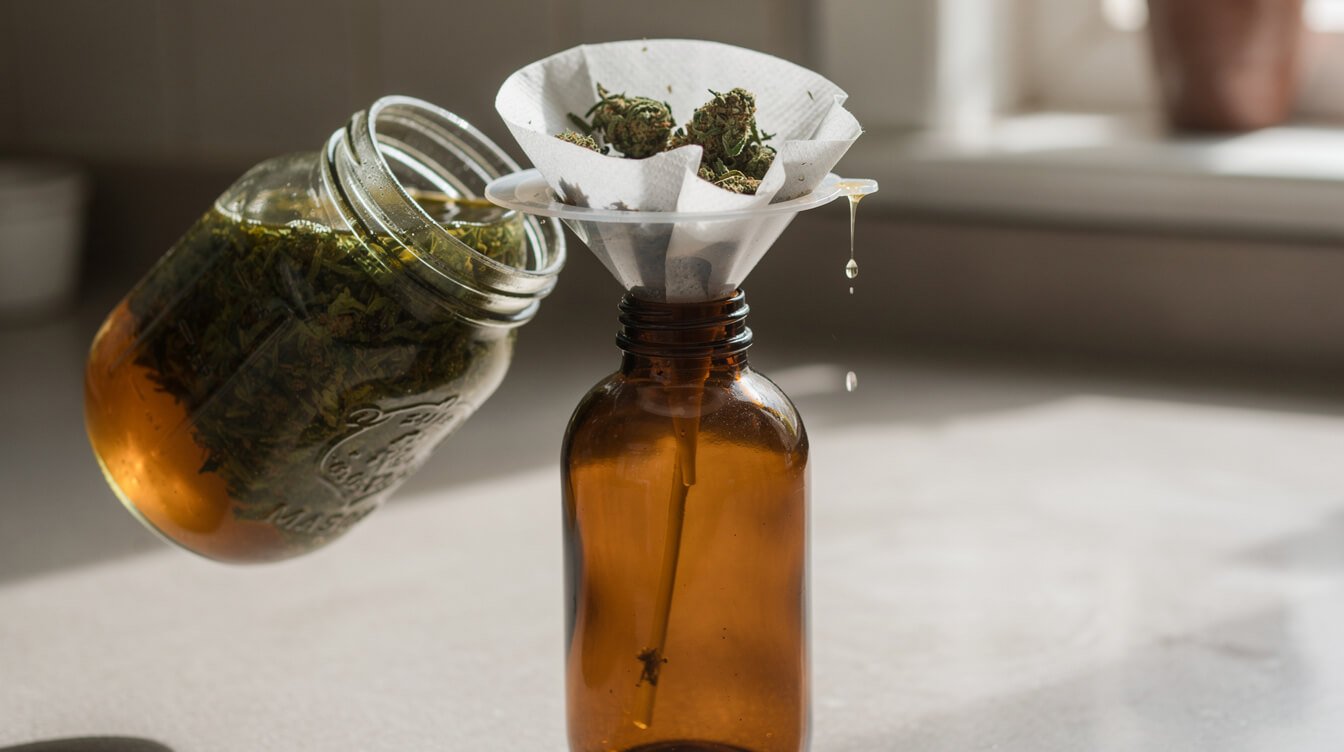
Here’s how to make cannabis tincture step by step, with the reasoning behind each step.
1. Decarb first
Raw flower is mostly THCA, which isn’t intoxicating until heat converts it to THC. Alcohol pulls THCA out just fine, so skipping the decarb gives you a tincture that mostly isn’t psychoactive. Bake the flower at 240°F for about 40 minutes. Our decarb temperature and time guide explains the trade-off between hotter and longer, and why an oven thermometer matters (oven dials drift).
2. Cold soak or long soak
There are two schools, and both work.
- Quick cold wash. Freeze the decarbed flower and the alcohol for a few hours, combine them, and shake for about three minutes before straining. You get a lighter, golden tincture that tastes cleaner, because chlorophyll and plant waxes dissolve less in very cold alcohol. You leave some cannabinoids behind. A second short wash of the same flower recovers more.
- Long soak. Seal the jar and leave it somewhere dark at room temperature for anywhere from a day to a couple of weeks, shaking once a day. You pull more of what’s there, along with more chlorophyll, so it’s greener and more bitter.
Whichever you choose, make sure the alcohol fully covers the flower. Roughly 60 ml for 7 grams works.
3. Strain
Pour through a fine mesh strainer, then through an unbleached coffee filter. Press the plant material gently to get the alcohol out. Don’t wring it hard, since that pushes more plant gunk through. Gravity filtering through paper is slow. Let it take its time.
4. To reduce or not (and the fire warning)
Some recipes tell you to evaporate part of the alcohol to make the tincture stronger. You don’t need to. You can simply use a smaller dose. If you do, know that ethanol’s flash point is about 55°F (13°C), which means it gives off vapor that can ignite at ordinary room temperature. That’s why we keep this whole method off the stove.
- Never heat alcohol over an open flame, a gas burner, or directly on a stovetop element.
- If you reduce it, set the jar in a bowl of hot water from the kettle, off the heat, in a well-ventilated room with no flames or sparks nearby.
- Don’t leave it unattended, and keep the alcohol bottle well away from the bowl.
5. Bottle and label
Transfer the strained tincture to amber or cobalt dropper bottles, which block light. Label each one with the date, the base, and the estimated maximum mg of THC per ml. You’ll forget otherwise, and an unlabeled dropper bottle is how accidents happen.
GanjaTech, weekly
Cannabis, explained. In your inbox.
One email a week: the clearest explainers, honest gear picks, and what the science actually says. 21+ only. No spam, unsubscribe anytime.
How strong is your tincture? One worked example
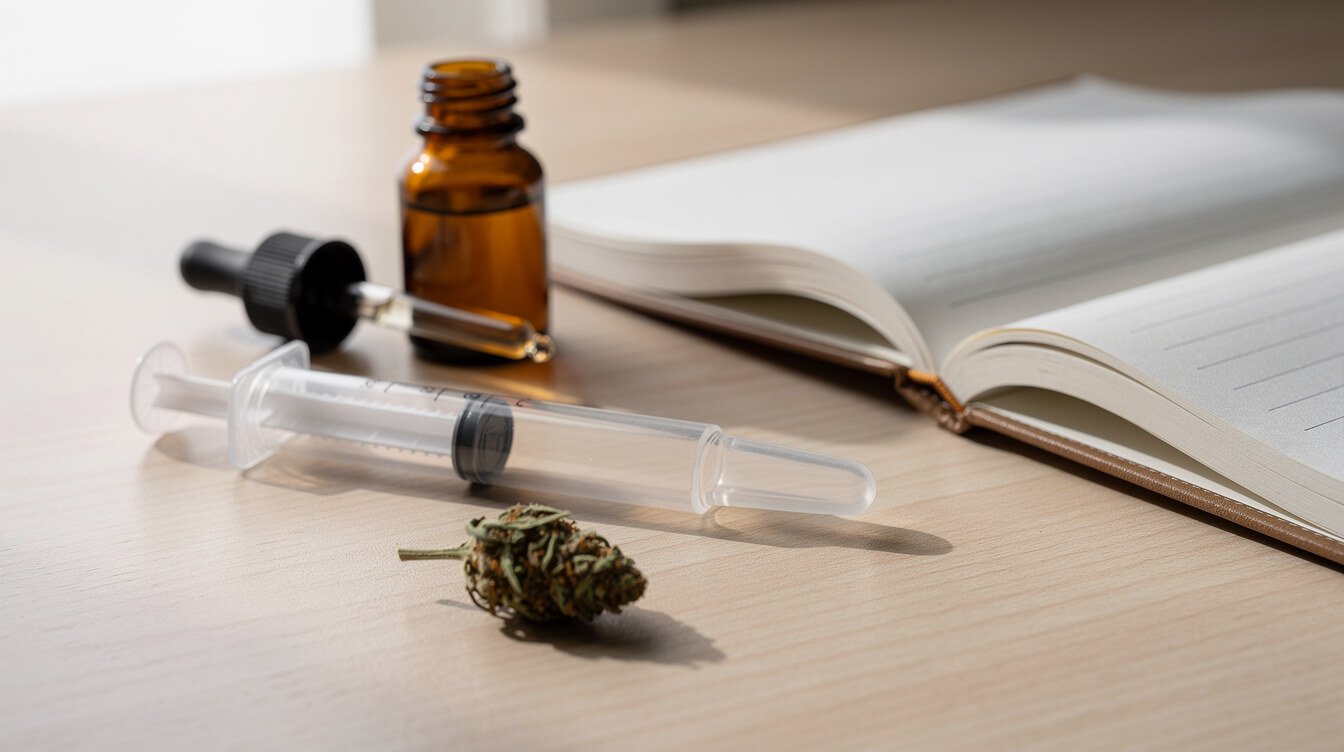
This is the step most recipes skip, and it’s the one that matters most once the bottle’s in your hand. The math is simple: total THC divided by the volume.
The example
- Start with your flower. 7 grams of flower labeled 18% total THC holds about 7,000 mg × 0.18 = 1,260 mg of THCA plus THC.
- Account for the decarb. THCA loses weight when it converts (THC is 314.5 g/mol, THCA is 358.5), so even a perfect decarb leaves about 0.877 of it: 1,260 × 0.877 ≈ 1,105 mg THC. Our how to make edibles guide walks through that conversion in more detail.
- Divide by the volume. If you end up with 60 ml of tincture: 1,105 ÷ 60 ≈ 18 mg per ml.
That’s the ceiling, not the real number. No home decarb is perfect, and no soak pulls every last milligram out of the flower. A quick cold wash leaves more behind than a long soak. Your real tincture will be weaker than the math says, and you don’t know by how much. That’s why you dose as if the ceiling were true.
What that means for a dropper
A standard dropper holds about 1 ml. At a possible 18 mg per ml, a “full dropper” could be close to 18 mg of THC, which is a lot for anyone who isn’t a regular edible user. A quarter of a dropper (0.25 ml) is around 4.5 mg at most. For precise doses, use a small oral syringe marked in tenths of a ml. It’s far more accurate than eyeballing a glass dropper.
If you’re starting with shake or trim, or flower with no label, our cannabutter-with-shake guide covers estimating potency from a mystery bag. The same logic applies here.
The sublingual myth: how fast a tincture really works
Nearly every tincture page on Google says the same thing: hold the drops under your tongue and you’ll feel it “within minutes,” or in 15 to 30 minutes, because it skips the liver. None of them cite a study. We looked for one.
What the controlled data shows
The best head-to-head data comes from a randomized, double-blind study at the National Institute on Drug Abuse. Researchers compared synthetic THC swallowed in a capsule with a cannabis-extract spray (Sativex, a prescription product) applied under the tongue and inside the cheek. The doses were matched. Then they measured blood levels for 10.5 hours.
The result: no significant difference in peak THC levels, time to peak, or total exposure between the swallowed capsule and the under-the-tongue spray (Karschner et al., 2011). Average time to peak THC was 3.2–3.4 hours for the capsule and 3.3–4.0 hours for the spray. The spray didn’t win. If anything, it was a touch slower. The spray also produced similar levels of 11-hydroxy-THC, the metabolite your liver makes from swallowed THC. That suggests much of it got swallowed and went the edible route anyway. The paper’s own discussion notes that “a portion of the drug was inevitably swallowed.” A companion paper concluded that oral and oromucosal THC both absorb more slowly than smoked cannabis (Karschner et al., 2011).
The honest caveats
A pharmaceutical spray isn’t the same as a dropper of homemade alcohol tincture, and nine participants is a small study. Some of a tincture may well be absorbed through the lining of the mouth, and some people say they feel a tincture sooner than an edible. But “you’ll feel it in minutes” is a promise no one has backed with data. The best measurements we have point the other way.
What to do with that
Treat a tincture like an edible for timing. Take a small, measured dose, then wait at least two hours before you even think about more. Our edible timeline guide breaks down the measured kick-in, peak, and comedown. If you’ve taken too much, our guide to what greening out is and what helps covers the useful steps and when to get help. And the same rule applies as for any edible: don’t drive, and plan on hours, not minutes.
Storage and shelf life: what the data says
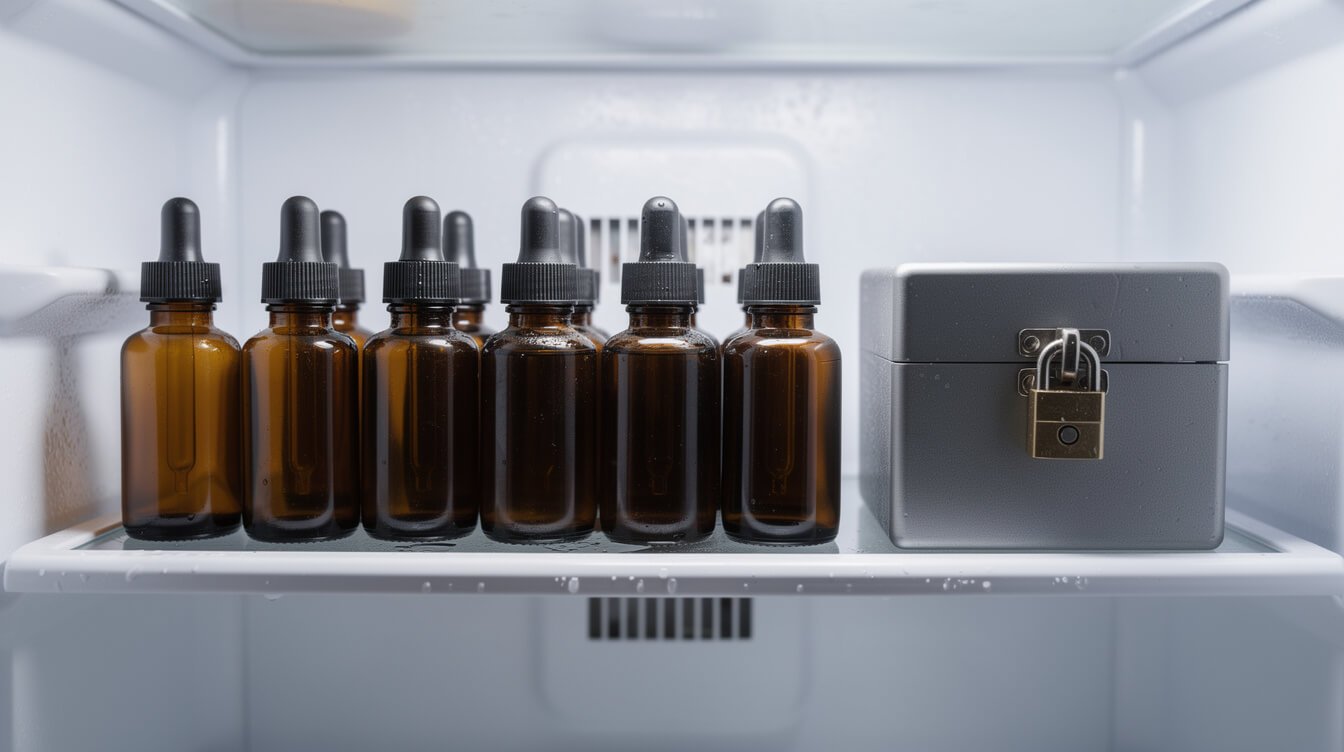
Alcohol tinctures keep well, but they don’t keep forever. Cannabinoids slowly change with heat, light, and air.
The fridge wins, by a lot
The same tincture study tracked samples for up to 15 months on a shelf or in a fridge. Fifteen months in the fridge produced about as much chemical change as three months on the shelf, and total cannabinoids fell by less than 10% after nine months refrigerated (Peschel, 2016). On the shelf, THCA plus THC dropped by up to 15% within three months. The author still cautioned that homemade tinctures have no guaranteed stability, so a consistent strength isn’t promised over time.
In practice:
- Alcohol tincture: amber bottle, tight cap, in the fridge. Expect it to stay close to its starting strength for many months, and use it within about a year.
- Glycerite: refrigerate it and use it sooner. Glycerin doesn’t preserve as reliably as high-proof alcohol, especially if any water got in. Toss anything cloudy, moldy, or off-smelling.
- Oil “tincture”: follow the food-safety rule in our canna oil guide. Fridge for a few days, or freeze it.
Lock it up
A dropper bottle in the fridge door looks a lot like vanilla extract or a children’s medicine. Label it clearly, keep it in a locked box or out of reach, and never store it next to kids’ medicine. If a child swallows some, call Poison Control at 1-800-222-1222, or 911 if they’re hard to wake or having trouble breathing. For pets, call your vet or the Pet Poison Helpline at 855-764-7661.
How to make cannabis tincture: FAQ
Can alcohol tinctures get you drunk?
Not at normal doses. Do the math: 1 ml of 95% alcohol holds about 0.75 grams of ethanol. A US standard drink is about 14 grams (NIAAA). So a full 1 ml dropper is about one-nineteenth of a drink, and a quarter-dropper dose is closer to one-seventy-fifth. What you’ll feel is the THC, not the alcohol. If you avoid alcohol completely, for any reason, make a glycerite instead.
What’s the best alcohol for a tincture?
190-proof (95%) food-grade grain alcohol. 151-proof is a decent fallback. Vodka works, but it’s weak, because about 60% of it is water and THC doesn’t dissolve in water.
Do I have to decarb before making a tincture?
For a psychoactive tincture, yes. Alcohol extracts THCA readily, but THCA isn’t intoxicating. Skip the decarb and you’ll get a mostly non-intoxicating THCA tincture.
How long does a cannabis tincture take to kick in?
Plan for edible timing. Controlled data shows under-the-tongue THC peaking at about the same time as swallowed THC, around three to four hours. Many people feel something sooner, but wait at least two hours before taking more.
Can you make a tincture without alcohol?
Yes, but expect a weaker tincture from the same flower, and usually some gentle heat over several hours. Glycerin dissolves THC, just less per ml than alcohol, and its thickness makes extraction slow. Keep a glycerite in the fridge.
How long does a homemade tincture last?
An alcohol tincture kept cold and dark keeps most of its strength for many months. Use it within a year to be safe. Glycerites and oils have shorter lives, so refrigerate them and watch for spoilage.
Can I cook with a tincture?
Yes. A few measured drops in a drink or a dressing is one of the easiest ways to dose a recipe. For baking, our weed brownies guide covers how to spread a dose evenly through a batch.
Final thoughts
How to make cannabis tincture comes down to three choices: decarb first, use the highest-proof food-grade alcohol you can get, and never put that alcohol near a flame. Everything else, like cold wash versus long soak or glycerin versus alcohol, is about taste and preference.
The part worth remembering is the part most guides leave out. Do the mg-per-ml math, label the bottle with the ceiling, measure with a syringe, and treat every dropper like an edible. Start small, wait two hours or more, and let the first dose show you what the bottle actually does.
Great plant, good kitchen project. Respect it, know your local laws, and keep it away from anyone who didn’t ask for it.
Before you go
Get the next explainer first
We publish a new one every day. The best of the week, plus what's new in the shop, lands in one short email.