How to Make Weed Butter (Cannabutter): The Recipe, the Ratio Table, and the Steep-Time Answer
Here’s how to make weed butter in one breath: decarb your flower at 240°F for about 40 minutes, hold it in melted butter and water between 160°F and 200°F for two to three hours, strain it, chill it, and lift the solid butter off the water. That’s the whole recipe, and it works.
The parts that decide whether your butter turns out good are the ones most guides rush. That means how much flower goes into each stick, why butter behaves differently from oil, how long to steep it (the top recipes disagree by a factor of ten), and what a tablespoon of the finished butter actually contains. We’ll walk through all of it, with the numbers. This guide is for adults 21 and over, and cannabis laws vary by state and country, so know yours before you start.
How to make weed butter: the short answer

This is the recipe card. Every step gets its own section below if you want the why.
What you need
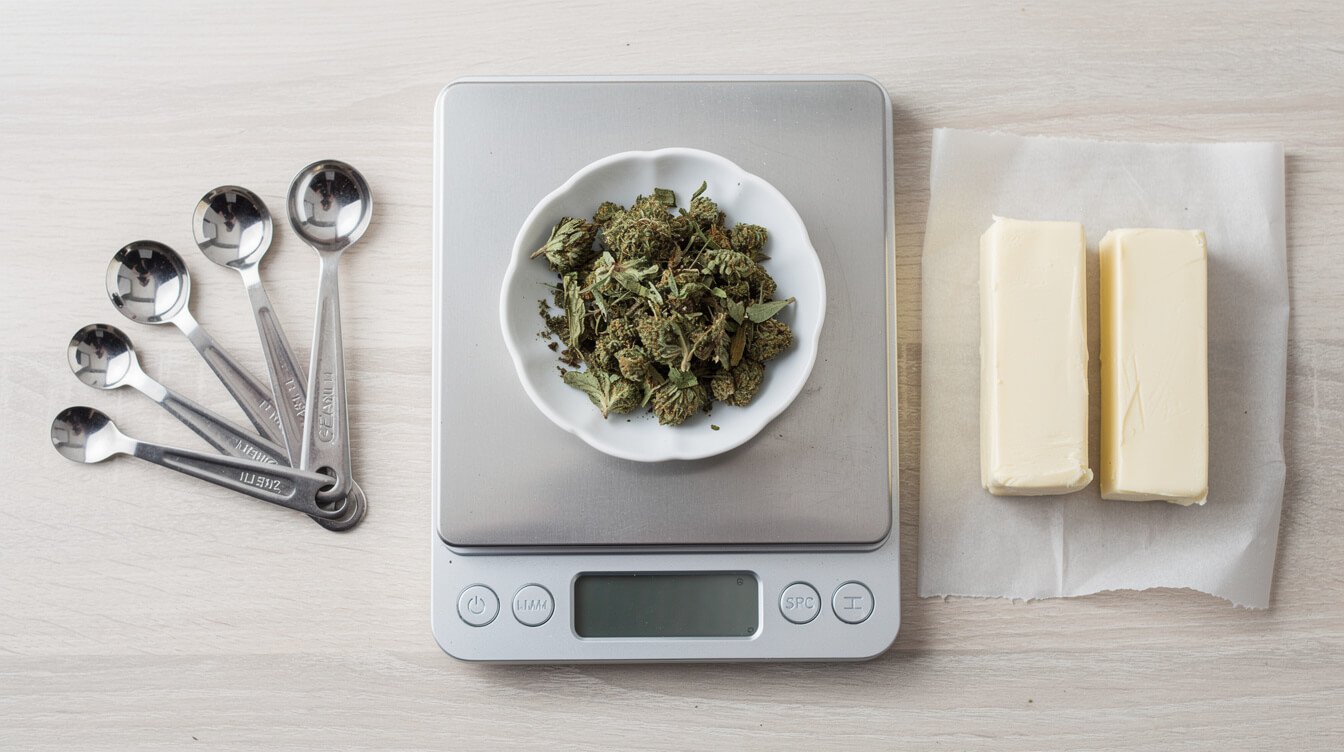
- 1 stick (113 g, 8 tablespoons) of unsalted butter. Start with one stick. You can scale up once you know how strong your flower is.
- 1 to 3.5 grams of cannabis flower. For a first batch, 1 to 2 grams is plenty. The ratio table below shows what each amount means per tablespoon.
- About 1 cup of water. It’s a temperature buffer, not an ingredient. You’ll pour it off at the end.
- A baking sheet, parchment, a small saucepan (or a mason jar in a pot of water), a kitchen thermometer, a fine-mesh strainer, cheesecloth, and a glass container with a lid.
The method
- Decarb. Break the flower into small pieces, not powder. Spread it on parchment and bake at 240°F (115°C) for about 40 minutes, stirring once. Our decarb temperature and time guide covers the trade-offs if you want to go lower or faster.
- Melt. Put the butter and water in a saucepan over low heat, or in a jar set in a pot of steaming water.
- Infuse. Stir in the decarbed flower. Hold the mixture between 160°F and 200°F for 2 to 3 hours, stirring now and then. It should steam gently. It shouldn’t boil hard.
- Strain. Pour it through a fine-mesh strainer lined with cheesecloth into a glass container. Let it drip. Don’t wring the cloth.
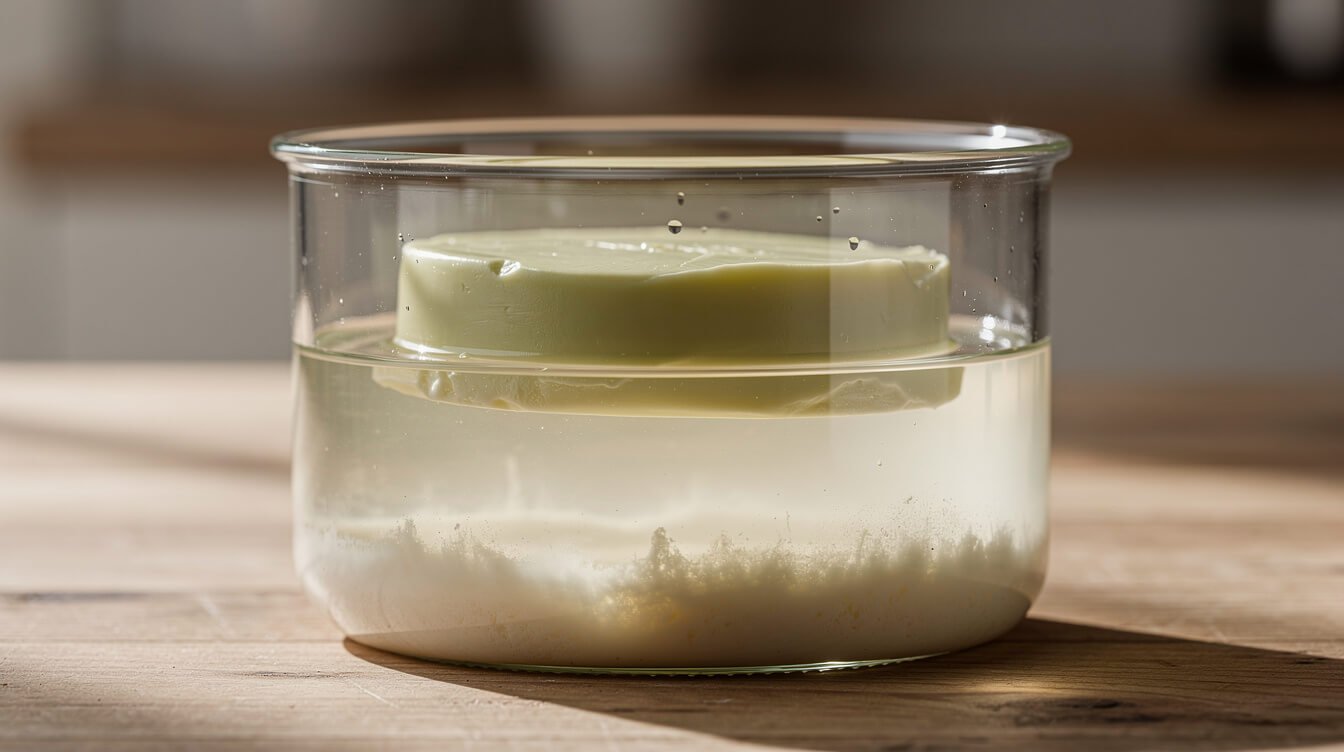
- Chill. Refrigerate until the butter is a solid disk on top of the water, a few hours or overnight.
- Separate. Lift the butter off, pour the water away, and scrape off any soft, cloudy film on the underside.
- Measure and label. Count how many tablespoons you actually ended up with, work out the maximum mg per tablespoon (section seven), and write it on the container with the date.
Then test a small serving before you bake with it.
How much weed per stick of butter? The cannabutter ratio table
The ratio is the one decision you can’t undo, and it’s where most guides on how to make weed butter get vague. You’ll see “one cup of cannabis per cup of butter” (a volume measure that varies wildly with how fluffy the flower is), “7 to 10 grams per cup,” or “an ounce per pound.” Those last two work out to 3.5 to 5 grams and 7 grams per stick, respectively. That’s strong butter, as the table shows.
Here’s the ratio in grams per stick, at three common potencies. Each cell is the maximum mg of THC per tablespoon, assuming a perfect decarb and perfect transfer into the butter. Real butter comes in lower, and section seven explains why we don’t guess by how much.
| Flower per stick (8 tbsp) | 15% Total THC | 20% Total THC | 25% Total THC |
|---|---|---|---|
| 1 gram | 19 mg/tbsp | 25 mg/tbsp | 31 mg/tbsp |
| 2 grams | 38 mg/tbsp | 50 mg/tbsp | 63 mg/tbsp |
| 3.5 grams (an eighth) | 66 mg/tbsp | 88 mg/tbsp | 109 mg/tbsp |
| 7 grams (a quarter ounce) | 131 mg/tbsp | 175 mg/tbsp | 219 mg/tbsp |
The ratio is per stick, so it scales cleanly. Two sticks with 4 grams gives you the same per-tablespoon ceiling as one stick with 2 grams. A pound of butter is four sticks. If you’re converting from eighths and ounces, our grams-in-an-ounce guide has the weights.
Three things to take from the table:
- The popular ratios make strong butter. At 20% flower, “an ounce per pound” is a ceiling of 175 mg in every tablespoon. A common recipe swaps in a full stick of that for regular butter and hands you cookies far beyond a first-timer’s dose.
- Weaker butter is easier to live with. At 1 to 2 grams per stick, a tablespoon lands in a range you can split into sensible servings without doing fractions of a teaspoon.
- You can always dilute later. Cutting infused butter with plain butter in a recipe is the easiest dose control there is. You can’t make butter weaker by wishing, though, so err low on your first batch.
Your flower label should show “Total THC.” Use that number as-is. If it shows only THCA, multiply by 0.877 and add the small THC figure. Our guide to making edibles explains where the 0.877 comes from.
Why butter isn’t just oil: the 20% that isn’t fat
Few recipes explain this, and it changes three things. Butter isn’t pure fat. Federal law defines it as a product made from milk or cream that contains not less than 80% milk fat by weight, a definition Congress wrote in 1923. The University of Wisconsin’s Center for Dairy Research puts typical butter at 80 to 82% fat and 16 to 17.5% water, with about 1% milk solids (plus salt in salted butter).
1. The water carries essentially no THC
THC is fat-soluble. In water, it dissolves to about 2.8 mg per liter, which PubChem summarizes as “essentially insoluble.” Even if your cup of added water were completely saturated, it could hold well under 1 mg. That’s why pouring off the water layer at the end costs you nothing, and why plain-water cannabis tea is so weak.
2. Milk solids are what burn
The milk solids are the part of butter that browns and then scorches in a hot pan. That’s why brown butter exists and why clarified butter takes more heat. Adding water keeps the pot from climbing past water’s boiling point (212°F at sea level, lower at altitude) until the water is gone, so the solids can’t burn while there’s water left. Keep an eye on the level during a long steep, and top it up if it’s getting low.
One popular recipe says to use salted butter because it “has a higher smoke point.” We couldn’t find a source for that, and salt isn’t what burns. The milk solids are. Unsalted is still the better default because it lets you control the salt in whatever you bake later.
3. Your finished butter is smaller than the stick you started with
This is the bit that moves your dose math. Once the water is poured off and the milk solids are scraped away, you’re left with mostly butterfat. One 113-gram stick has roughly 90 grams of fat, and a tablespoon of melted butterfat weighs about 13.5 grams. So a stick tends to come back as roughly 6½ to 7 tablespoons, and a little less after the strained plant matter keeps its share.
The same THC in less fat means more THC per tablespoon. If you divide by the 8 tablespoons you started with, your label understates the batch by something like 15 to 20%. Always measure the finished butter and divide by that.
What about ghee or clarified butter?
Clarified butter and ghee are butter with the water and milk solids removed. University of Maine Extension describes them as nearly pure butterfat. They work well for infusing, can’t scorch the way whole butter does, and give you a tablespoon that’s all fat. Infusing ghee is basically making canna oil with a dairy flavor. Same rules, same numbers.
Steep time: 45 minutes, 4 hours, or 8? What the evidence supports

This is the question that splits every guide on how to make weed butter. Here’s what the top-ranking recipes told us to do with the same stick:
- 45 to 60 minutes, kept under 190°F (Food52)
- 2 to 3 hours between 160°F and 200°F (Leafly and several dispensary blogs)
- 4 hours, kept under 180°F (Bon Appétit)
- 4 to 6 hours in a slow cooker (several pages)
- Up to 8 hours, from the “Team Low and Slow” camp (one baker quoted by Epicurious)
None of them cite a published study. Here’s what we can actually stand behind.
The best data comes from oil, not butter
We haven’t found a published study of home butter infusion times. The closest real data comes from Italian pharmacies, which make cannabis olive oil to standardized protocols. An analysis of thousands of those batches found that methods using a 212°F water bath for 40 minutes, or 1 to 2 hours of heating, captured roughly 58 to 86% of the flower’s THC, depending on method and variety (Dei Cas et al., 2020). Our canna oil guide walks through that dataset. The short version: there’s no published evidence that 8 hours pulls meaningfully more THC than 2.
What about the 45-minute claim?
Food52’s author says a California testing lab found 80 to 90% of the cannabinoids infused within 45 to 60 minutes, and that brown butter infused in about six minutes with no degradation. But the data hasn’t been published, so we can’t check the method, the sample size, or what “80 to 90%” was measured against. Treat it as one interesting test, not a settled answer. Browning butter also means the water is gone and the milk solids are toasting, which is exactly the zone where you lose your safety margin.
And the 8-hour camp?
The argument for very long steeps is usually that the butter “looks greener.” It does. Green is chlorophyll, not THC. A long, hot steep pulls more plant pigment and grassy flavor into the fat, and there’s no measurement showing it pulls more THC.
Our call
Two to three hours, with the butter held between 160°F and 200°F. A home pot runs cooler than a pharmacy’s 212°F bath, so give it a bit longer than the lab’s 40 minutes. Past three hours you’re mostly trading flavor for nothing anyone has measured. If you prefer a cleaner taste, two hours is a perfectly good stopping point.
GanjaTech, weekly
Cannabis, explained. In your inbox.
One email a week: the clearest explainers, honest gear picks, and what the science actually says. 21+ only. No spam, unsubscribe anytime.
Stovetop, crock pot cannabutter, or sous vide: same chemistry, different safety nets
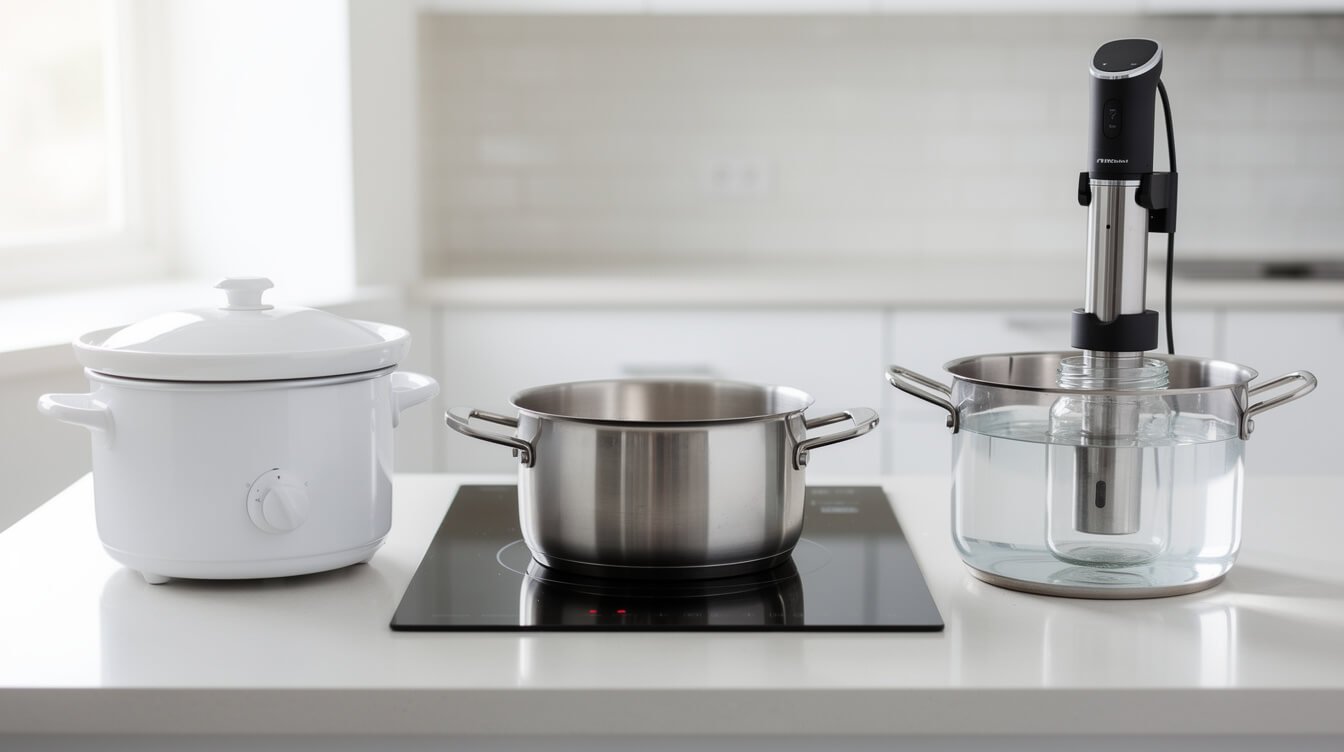
All three methods do the same job: hold fat and decarbed flower at a gentle temperature for a couple of hours. What changes is how easily things go wrong.
Stovetop with water (cheapest, needs the most attention)
Butter, water, and flower in a small saucepan on the lowest setting. The water is your buffer. Stir every 20 to 30 minutes, check the temperature with a thermometer, and add a splash of water if the level drops. A double boiler, or a jar of butter set in a pot of steaming water, is even gentler because the butter never touches direct heat.
Crock pot cannabutter (set-and-forget, but check your model)
Slow cookers are popular because they hold a steady temperature for hours. But “low” isn’t one number. USDA’s food-safety service says slow cookers generally run between 170°F and 280°F, and some models’ low setting gets hotter than you’d want for butter. The fix is simple: put the butter and flower in a lidded mason jar, stand it in water inside the crock, and check the water with a thermometer in the first hour. If it’s holding under a boil, you can leave it. Two to three hours is still enough. The slow cooker doesn’t need the 4 to 6 hours many recipes give it.
Sous vide (most precise)
An immersion circulator holds the water at an exact temperature. Set it around 185°F (85°C), put the butter and flower in a sealed bag or a jar with the lid fingertip-tight, and let it run for 2 to 3 hours. It’s the easiest way to hit the target range, and a sealed container keeps the smell down in the kitchen.
Whichever you choose, don’t walk away from an open flame, and don’t let the pot boil dry. Once the water’s gone, the butter heads past 212°F fast.
Strain, chill, and drain: the food-safety step recipes skip
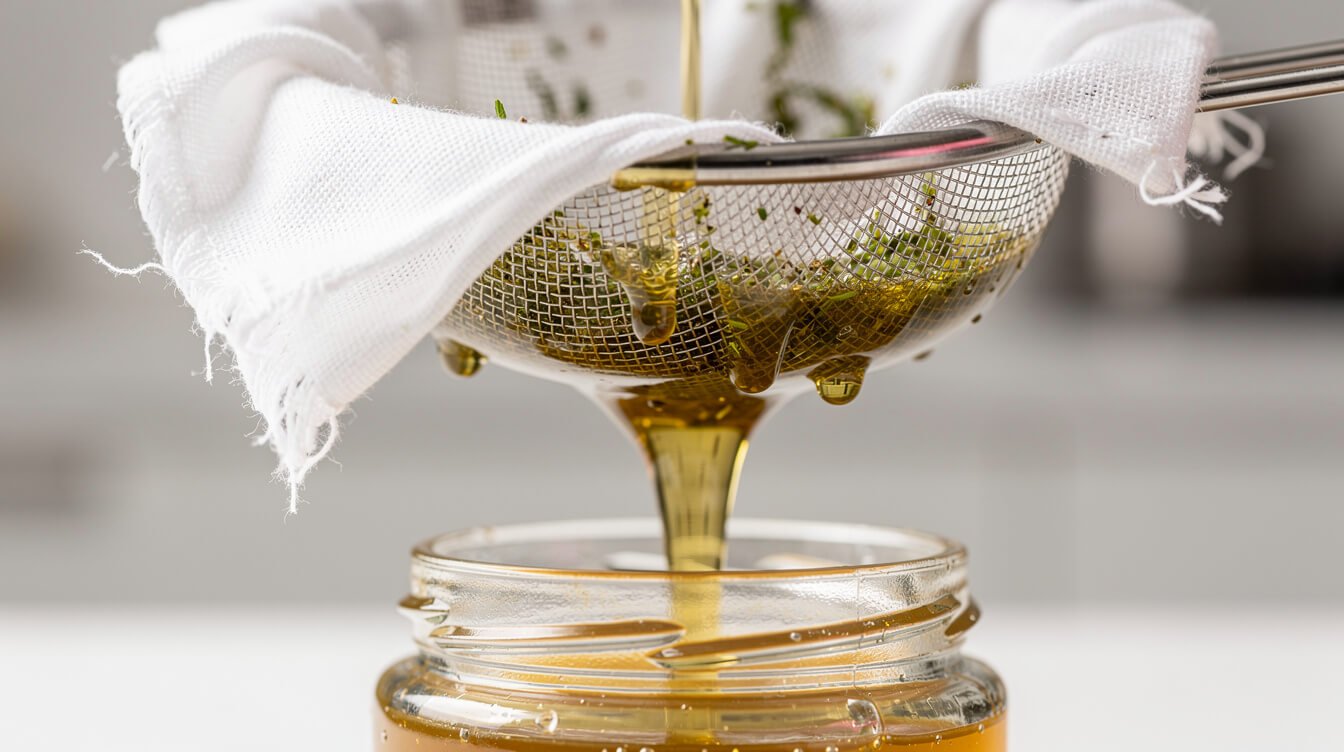
Straining looks like a formality. It’s actually where you set the flavor, the yield, and the shelf life of the batch.
Strain gently
Line a fine-mesh strainer with a double layer of cheesecloth and pour the hot mixture through. Let it drip for a few minutes. Pressing gently with the back of a spoon gets a little more butter out. Wringing the cloth hard pushes chlorophyll and fine plant dust into the butter, which is where the grassy taste comes from. The plant matter will keep some butter. That’s a small, real loss, and it’s another reason the finished yield is less than you started with.
Chill, then lift off the water
Refrigerate the container until the butter sets into a solid disk. Run a knife around the edge, lift it out, and pour the water away. Flip the disk over. If the underside has a soft, pale, cloudy layer, scrape it off. That’s leftover milk solids and water, and it’s the part that spoils first. Pat the butter dry with a paper towel.
How long cannabutter keeps
Plain butter keeps for a month or two in the fridge. That’s USDA’s FoodKeeper guidance, as Michigan State University Extension summarizes it, and it works because butter’s high fat and low water don’t support bacterial growth. Cannabutter isn’t plain butter, though. It’s a compound butter that has been cooked with plant material and extra water. University of Maine Extension says compound butters (butter mixed with herbs, garlic, or other ingredients) should be refrigerated at all times because the added ingredients bring moisture and microbes. And for fats infused with herbs, food-safety extension services set a conservative rule: refrigerate and use within 4 days, or freeze (University of Georgia, Oregon State).
Nobody has tested cannabutter specifically, and well-strained, well-drained butter is probably on the lower-risk end. Recipes online give you anywhere from one week to six months in the fridge, with no source for any of it. We’d rather follow the conservative rule from people who study this. Keep in the fridge only what you’ll use in the next few days, and freeze the rest. Potency isn’t the reason. In tested oils, about 80 to 85% of the cannabinoids were still there after two weeks (Pacifici et al., 2017). Light and heat are what wear THC down, as our guide to whether weed goes bad explains.
Freezing in tablespoon portions is the move. A silicone ice-cube tray filled a tablespoon per cube gives you a known ceiling dose in every cube, and you only thaw what you need.
The dose math: from grams of flower to mg per tablespoon
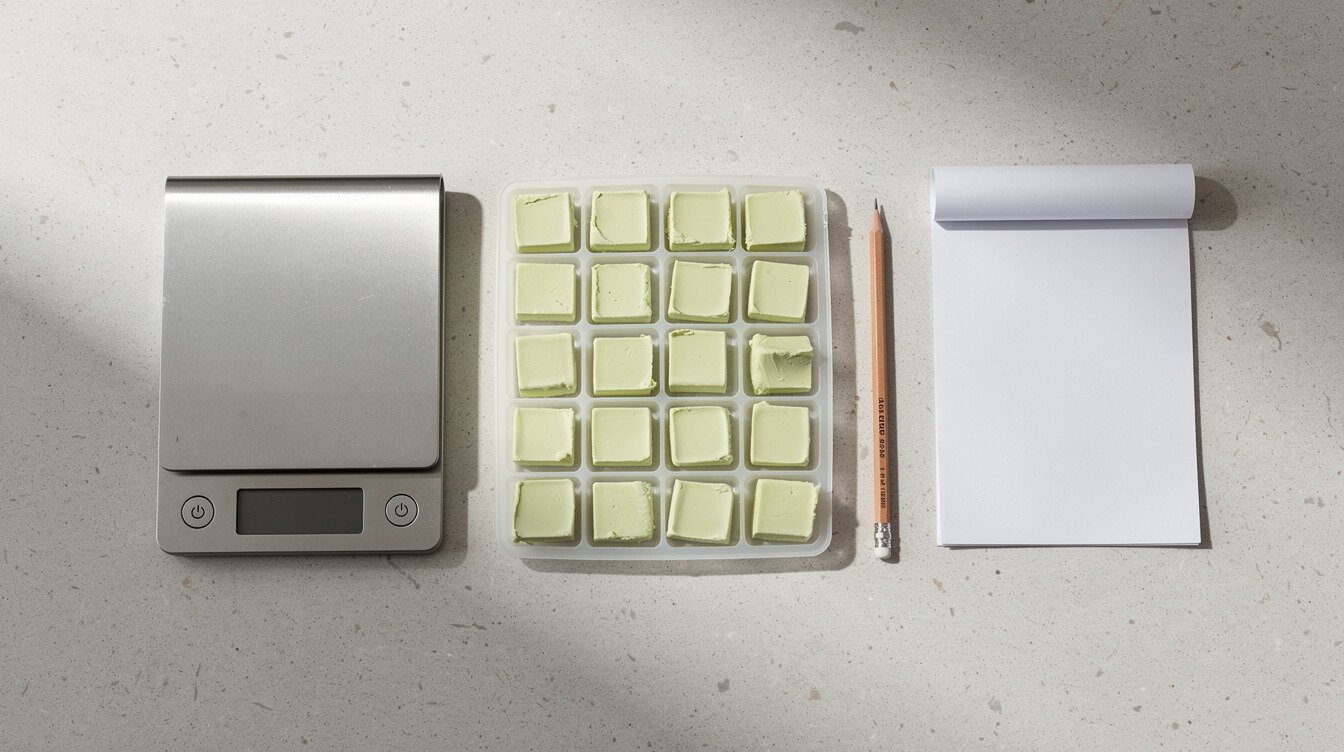
Here’s the formula, then a worked example that includes the yield correction from section three.
Grams of flower × 1,000 × Total THC fraction = maximum mg of THC in the batch. Divide by the number of tablespoons you finished with to get the maximum mg per tablespoon.
A worked example
Say you infused 2 grams of 20% flower into one stick:
- 2 × 1,000 × 0.20 = 400 mg maximum in the batch.
- Counted as the 8 tablespoons you started with, that’s 50 mg per tablespoon.
- Measured as the 6½ tablespoons you actually got back, it’s about 62 mg per tablespoon. Write that one on the jar.
Why it’s a ceiling, not a dose
Decarb never converts everything, and infusion leaves some THC in the strained plant and the cheesecloth. Your label also describes a tested sample, not every bud in your jar. Some guides apply a flat “extraction efficiency” percentage to fix this. We don’t, because we haven’t seen a primary source that supports one figure for home kitchens. The real number is lower than the ceiling by an amount you can’t measure at home. So use the ceiling to keep yourself out of trouble, then let a test serving tell you the rest.
Turning tablespoons into servings
Even a mild butter is strong by the spoonful. At 62 mg per tablespoon, a single teaspoon has a ceiling of about 20 mg. In Johns Hopkins dosing trials, infrequent users who ate a brownie with 10 mg of THC felt clear effects without measurable impairment on the tests, while 25 mg produced pronounced effects and marked impairment (Schlienz et al., 2020). That’s why most recipes should use a little infused butter plus plain butter, not a full swap.
Example: you want 12 cookies at a 5 mg ceiling each. That’s 60 mg total, or roughly 1 tablespoon of the 62 mg butter, with the rest of the recipe’s butter plain. Our weed brownies guide has a full dose table by pan size, and it also covers why baking at 350°F doesn’t burn off the THC in the batter.
Test before you trust the batch
Start with 2.5 to 5 mg if you’re new or it’s been a while. Wait at least two hours before taking more. Edibles can take that long to kick in and last much longer than smoking, as our edible timeline shows. Don’t drive or operate anything after eating it. If you overdo it, our guide to greening out covers what helps.
Cannabutter looks exactly like regular butter, and that’s the biggest household risk with this recipe. Label every container with “CANNABIS,” the date, and the mg ceiling per tablespoon, and store it where kids, guests, and pets can’t reach it, ideally locked. If a child eats some, call Poison Control at 1-800-222-1222, or 911 if they’re very drowsy, hard to wake, or struggling to breathe. Dogs are especially sensitive to THC. The Pet Poison Helpline is 855-764-7661.
How to make weed butter: FAQ
How to make weed butter without decarbing?
You can skip the oven, but the butter will be much weaker. A butter steep at 160 to 200°F isn’t hot enough to finish converting THCA to THC in a couple of hours, so most of what’s in the flower stays in the inactive acid form. The 40-minute decarb is the cheapest potency you’ll ever get. Our edibles guide goes into what happens when you skip it.
How much butter for 10 grams of weed?
It depends on how strong you want it. At 20% Total THC, 10 grams is a 2,000 mg ceiling. In one pound (four sticks), that’s about 63 mg per starting tablespoon, before the yield correction. That’s roughly the 2-grams-per-stick row in the table. For milder butter, use 1½ to 2 pounds, or simply use less flower.
How long does weed butter last?
In the fridge, we’d use it within a few days, following the conservative herb-in-fat rule above. In the freezer, it keeps well for months. Portion it into tablespoon cubes, label the date and the mg ceiling, and thaw only what you need.
Why is my cannabutter green or weak?
Green, grassy butter usually comes from flower ground to powder, a very long steep, or a hard squeeze through the cloth. Weak butter usually means an under-done decarb, lower-THC flower than you thought, or impatience. Edibles can take two hours to land, and people often call a batch “weak” at the 45-minute mark and then eat more. If you’re working with leftover trim, our guide to making cannabutter with shake covers why it’s less predictable.
How to make weed butter taste less like grass?
Break the flower up by hand or with a coarse grinder setting instead of grinding it to dust. Keep the steep to about two hours, use the water method, and let the strainer drip instead of wringing it. Then bake it into something with strong flavors of its own, like chocolate, coffee, or warm spices. Some people also infuse kief instead of flower for less plant flavor. It’s far stronger by weight, so redo the math before you try it.
Final thoughts
That’s really all there is to how to make weed butter well. Decarb first, keep the infusion gentle and short-ish, and let water protect the milk solids. Measure what you end up with, not what you started with, and treat every number as a ceiling.
The hardest part was never the recipe. It’s the patience afterward: a small test serving, two hours of waiting, and a clearly labeled container that nobody else in the house can mistake for breakfast. Get that right and a single stick of butter will last you through a lot of holiday baking. Enjoy it responsibly, and know your local laws.
Before you go
Get the next explainer first
We publish a new one every day. The best of the week, plus what's new in the shop, lands in one short email.