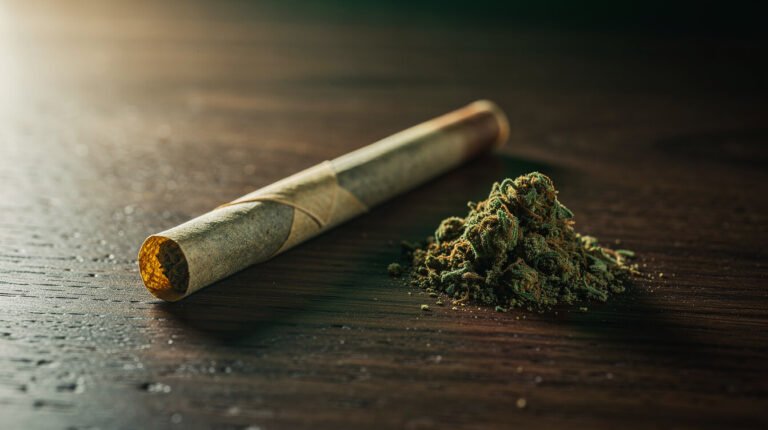
Blunt vs Spliff vs Joint: What’s Actually Different (Tobacco, Nicotine, and the Hit)
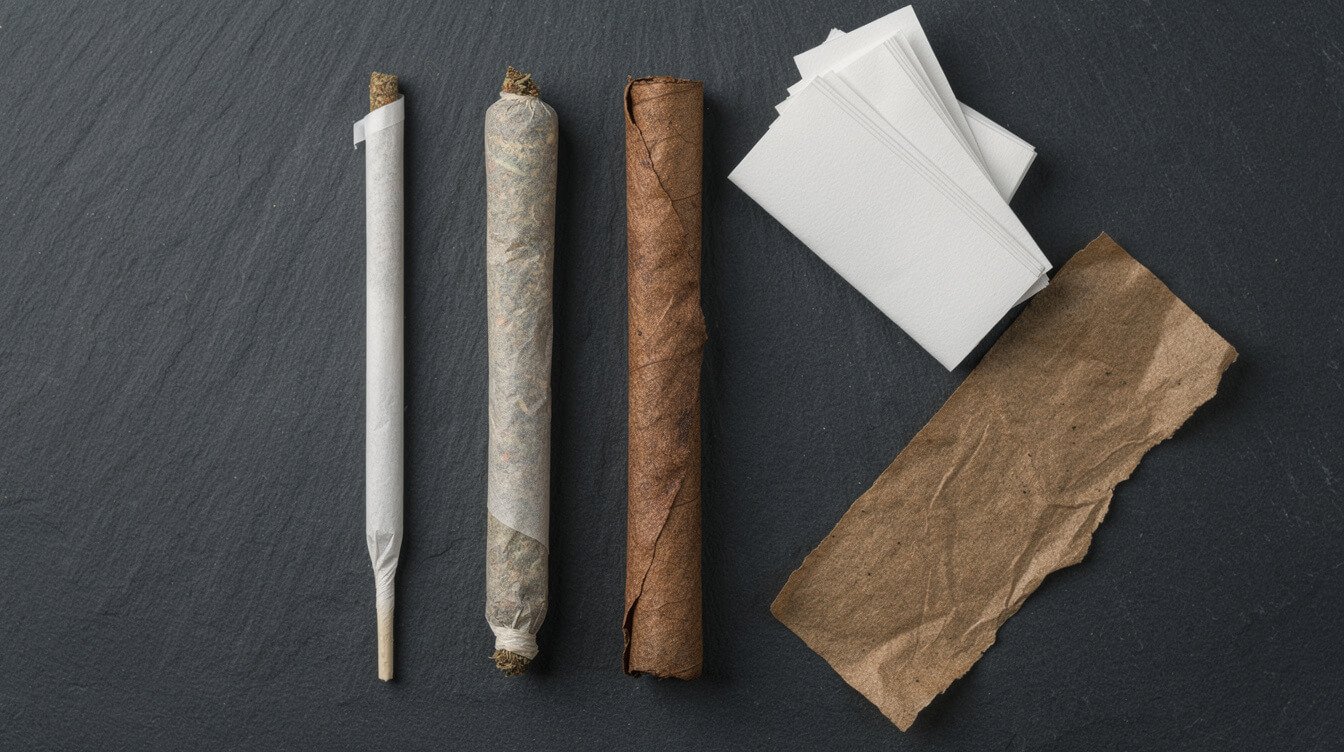
Blunt vs spliff vs joint comes down to one question: what’s wrapped around the weed, and is there tobacco in it? A joint is cannabis in a thin rolling paper, no tobacco anywhere. A spliff is cannabis mixed with loose tobacco, rolled in that same kind of paper. A blunt is cannabis rolled in a wrap made of tobacco leaf, so there’s no tobacco inside, but the whole outside is tobacco.
That’s the answer most guides stop at. The more useful part is what the wrapper actually changes. There’s a controlled study that put joints and blunts head to head, and its result runs opposite to the “blunts hit harder” line you’ll read almost everywhere. There’s also the nicotine and carbon monoxide that come along with the tobacco, which plenty of people don’t realize they’re getting. Same weed, three wrappers. Here’s what changes and what doesn’t.
Blunt vs spliff vs joint: the short answer
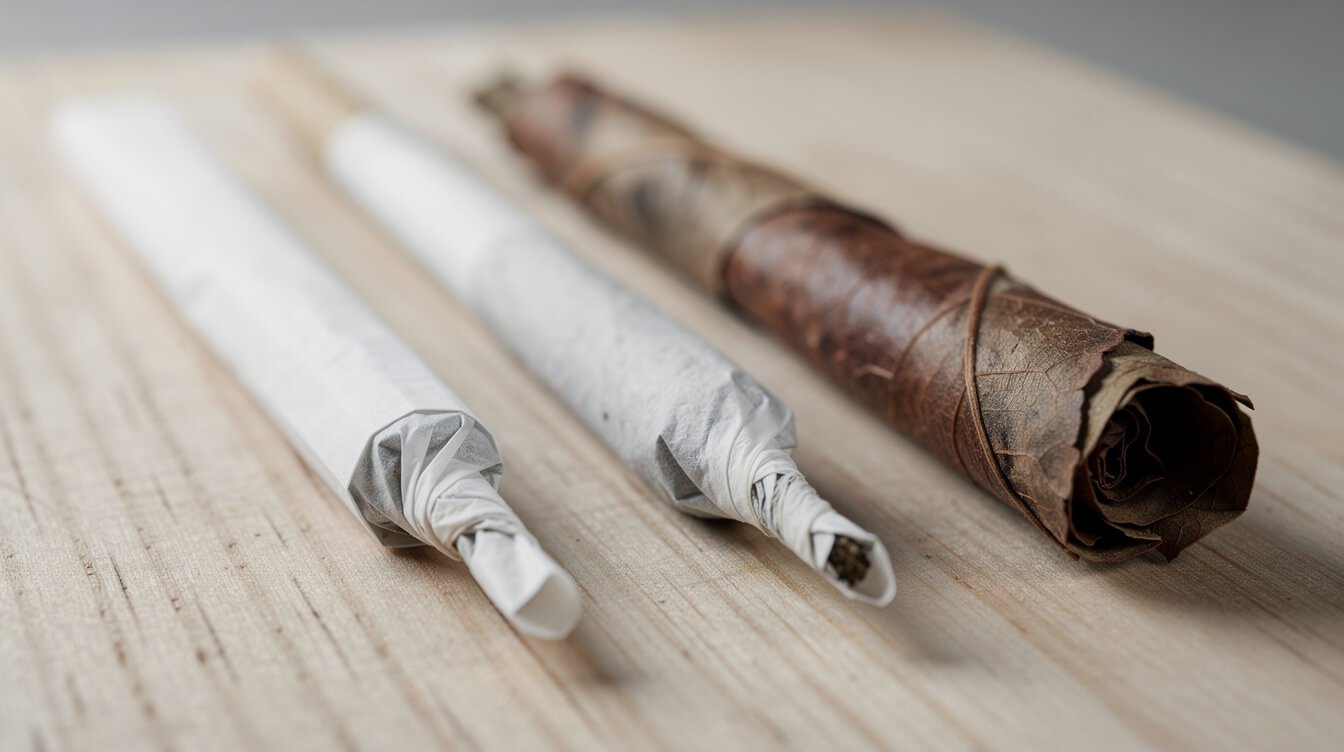
If you only read one section, make it this one. The differences come down to wrapper, filler, and what that does to the smoke.
| Joint | Spliff | Blunt | |
|---|---|---|---|
| Wrapper | Thin rolling paper | Thin rolling paper | Tobacco-leaf wrap or hollowed cigar |
| Filler | Cannabis only | Cannabis + loose tobacco | Cannabis only |
| Tobacco / nicotine? | No | Yes, depends on the mix | Yes, from the wrap |
| Burn | Fastest | Steadier than a joint | Slowest |
| Typical size | About 0.5–1 g | Similar to a joint, part tobacco | About 1–2 g |
| Flavor | Closest to the flower | Flower plus tobacco | Sweet, earthy, tobacco-forward |
The two things to take away from any blunt vs spliff comparison: only a joint is tobacco-free, and a blunt still contains tobacco even though you never added any. Everything else, from burn time to taste to how long the session runs, follows from the wrapper.
One naming wrinkle explains why the internet argues about this. In the US, “joint” means cannabis-only. In much of the UK and Europe, where mixing tobacco in is the norm, people often just call a tobacco-mixed roll a joint, and “spliff” gets used for the same thing. So when someone overseas says “joint,” they may well mean what an American calls a spliff. We’ll use the American definitions here, since they’re the ones that keep the tobacco question clear.
What makes a blunt a blunt
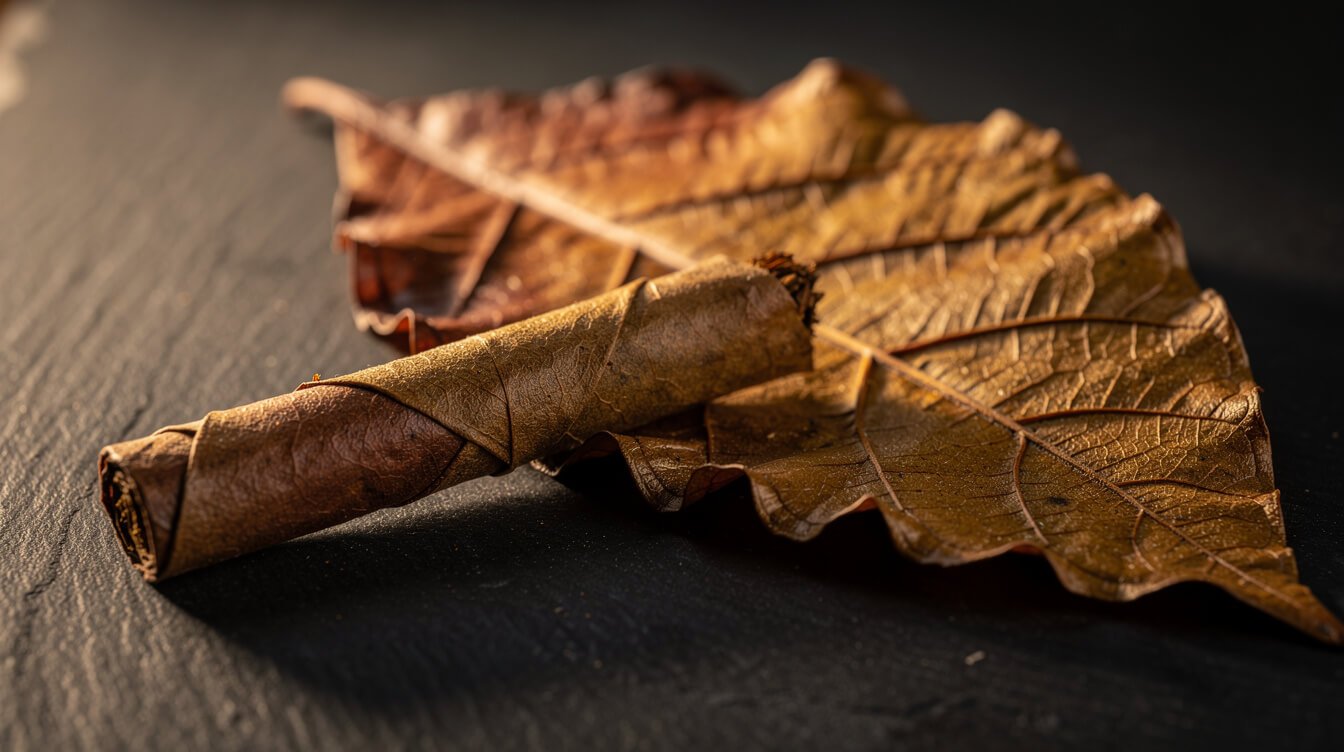
A blunt is cannabis rolled in a tobacco-leaf wrapper. Traditionally that meant buying a cheap cigar or cigarillo, splitting it open, dumping out the tobacco filler, and refilling the leaf shell with weed. Today a lot of people skip the gutting and use pre-made blunt wraps, which are sheets of the same kind of tobacco leaf sold flat for rolling.
Either way, the defining feature is the leaf. It’s thicker, oilier, and less porous than paper. That’s why a blunt burns slowly, holds more flower, and tastes noticeably sweeter and earthier than a joint. It’s also why blunts became a group-session format. They last long enough to pass around a circle.
Where the name comes from
The word is borrowed from a cigar. The Online Etymology Dictionary dates “blunt” as slang for a cannabis-filled cigar to around 1993, takes it from a cigar brand’s “Blunt” line, and notes the practice is said to have started among Jamaican communities in New York City in the early 1980s. Hip-hop culture is widely credited with spreading it from there.
Shells, wraps, and “tobacco-free” wraps
Three versions get called a blunt today:
- Gutted cigar or cigarillo: the original method. The wrapper is tobacco leaf, and some tobacco residue usually stays inside.
- Tobacco-leaf blunt wrap: same leaf, sold flat. No filler to dump.
- Tobacco-free wrap: made from hemp, palm leaf, banana leaf, or even rose petals. Yale researchers writing in Tobacco Control describe these as containing no tobacco or nicotine. Purists will tell you that makes it a fat joint, not a blunt. We’ll let them argue.
If the tobacco question matters to you (and the next sections suggest it should), the wrap material is the whole ballgame. Read the label, and don’t assume a flavored wrap is tobacco-free because it looks like one. Our step-by-step guide to rolling a blunt covers wrap sizes, moistening, and sealing if you want the technique side.
What makes a spliff a spliff
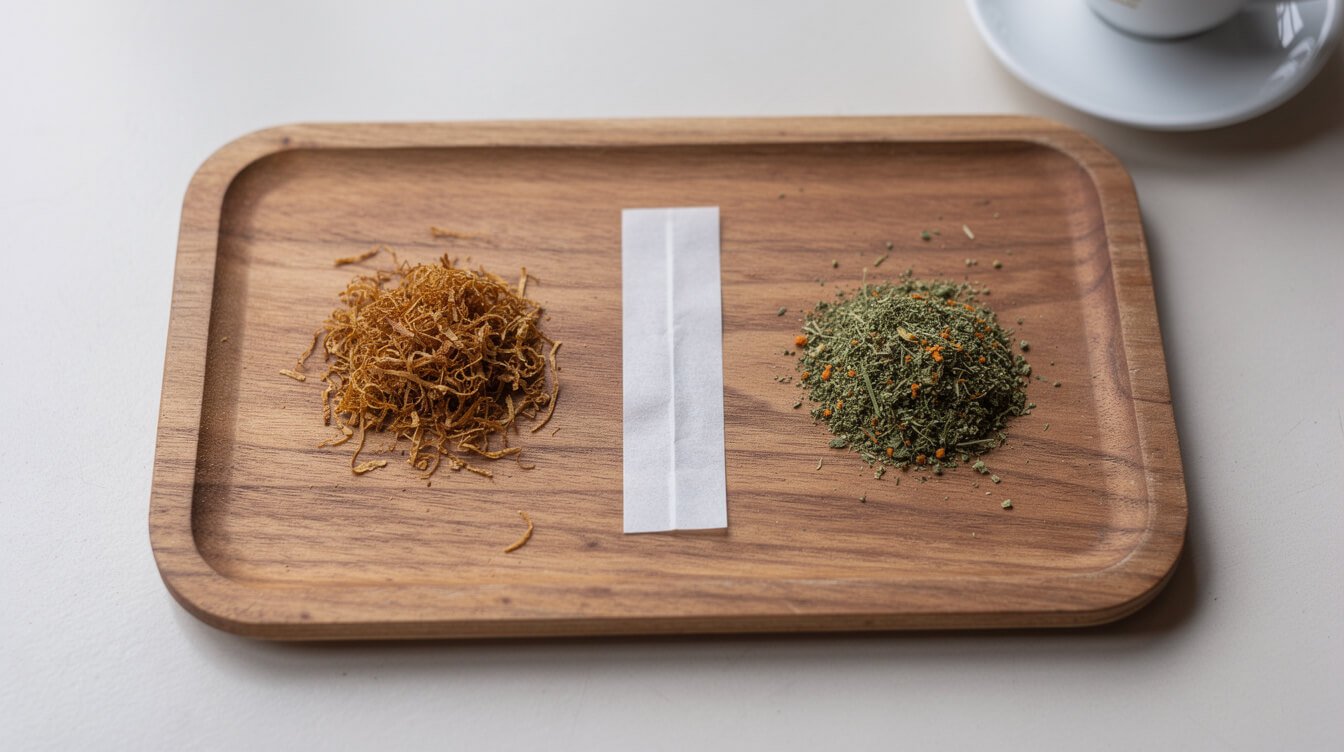
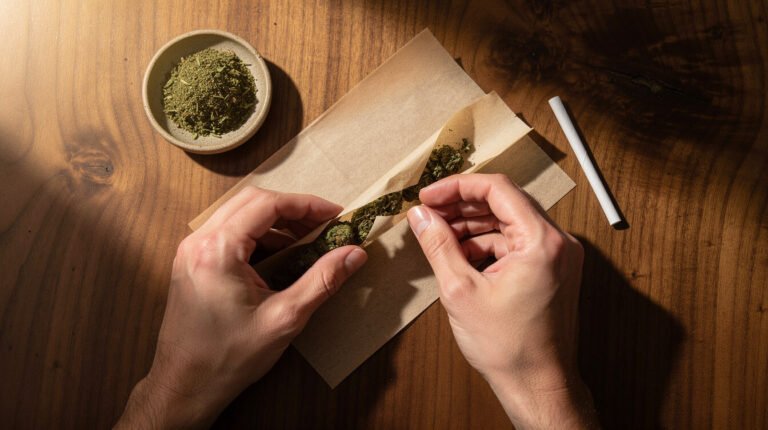
A spliff is cannabis mixed with loose tobacco and rolled in a regular rolling paper. It looks like a joint, often with a filter tip, and the only way to tell from the outside is usually the smell when it’s lit. Inside, it’s a blend.
That blend is the variable that matters, and it’s where blunt vs spliff gets slippery. A spliff can be mostly cannabis with a pinch of tobacco, or mostly tobacco with a little cannabis. There’s no standard. That’s why competing guides contradict each other on whether spliffs or blunts carry “more nicotine.” The honest answer is that it depends on the ratio, and nobody can tell you your ratio but you.
Why spliffs are the default in much of the world
This is a big regional split, and it’s measurable. The Global Drug Survey 2014 asked more than 33,000 people who’d smoked cannabis in the past year how they usually took it. Tobacco-based methods, mostly what the researchers call “joints with tobacco,” were used by 77–91% of respondents in European countries and only 4–16% in the Americas. Americans who travel are often surprised to be handed a “joint” with tobacco in it.
Two reasons usually get cited for the habit: tobacco makes a roll burn more evenly, and it stretches the cannabis further. The second one is easy to see, since you’re using less weed per roll.
Does the tobacco make you higher?
This is where blunt vs spliff stops being a matter of taste and gets interesting. A 2009 lab study ran cannabis-tobacco mixes through a smoking machine and found that tobacco raised the amount of THC delivered per gram of cannabis by as much as 45%. Some sites turn that into “spliffs get you higher.” Read it carefully, though. It’s a machine, and it’s per gram of cannabis. A spliff that’s 25% weed contains a quarter as much weed, so being more efficient per gram doesn’t mean more THC overall.
When researchers tested actual people, the effect didn’t show up. In a placebo-controlled UCL trial with 24 people who smoked both cannabis and tobacco, adding tobacco did not change how “stoned” people felt. It did sharpen performance on a working-memory task, which the authors flagged as a possible reason the combination keeps people coming back. If you’ve rolled spliffs on the idea that they hit harder, the human data doesn’t back you up.
Spliffs roll on the same papers as joints, so if you want to compare paper materials, our honest guide to rolling papers covers hemp vs rice vs wood pulp.
Do blunts hit harder? What the research actually found

Here’s the claim you’ll find on nearly every dispensary blog: blunts hit harder. Usually the reasoning is that the tobacco wrap “enhances” the high. It’s the most repeated line in blunt vs spliff vs joint content, and it’s the one with an actual controlled study behind it. The study says no, at least per puff.
The joint-vs-blunt study
In 2009, researchers at Columbia University published a randomized, double-blind, placebo-controlled comparison in Drug and Alcohol Dependence. They recruited 24 regular blunt smokers, 12 women and 12 men. That detail matters: these were people who preferred blunts. Over six sessions, each participant was blindfolded and took three puffs from either a blunt or a joint, filled with cannabis at 0%, 1.8%, or 3.6% THC. The researchers then tracked blood THC, heart rate, blood pressure, carbon monoxide, and how high people said they felt for three hours.
The results:
- Joints produced higher blood THC than blunts.
- Joints got higher ratings for intoxication, strength, and quality, even from people who usually smoke blunts. The effect was more pronounced in women.
- Blunts produced more carbon monoxide than joints.
- Blunts raised heart rate just as much as joints, despite delivering less THC.
The authors’ conclusion is worth quoting directly: smoking cannabis in a tobacco leaf “may increase the risks of marijuana use by enhancing carbon monoxide exposure and increasing heart rate compared to joints.” Puff for puff, the blunt delivered less of what people were after and more of what they weren’t.
The honest caveats
This is one study, and it has real limits. Twenty-four people is a small sample. Three puffs in a lab isn’t a real session. And 1.8–3.6% THC research cannabis is far weaker than most modern flower. Bigger studies with today’s potency would be welcome. What the study does do is put a controlled result where the internet has only had vibes, and that result points the other way.
So why do blunts feel bigger?
Mostly because a blunt is bigger. A typical joint holds half a gram to a gram. A blunt holds one to two grams or more, burns slower, and usually gets passed around for longer. More flower, more time, more puffs.
A 2019 study backs that up from a different angle. Looking at 377 adults seeking treatment for cannabis use, researchers found that more days of blunt smoking predicted more grams of cannabis per using day and more intense withdrawal. That held even after controlling for nicotine dependence. Two caveats: this was a treatment-seeking group, not casual users, and it shows an association, not cause and effect. Still, it fits the simple explanation. Blunt sessions tend to be bigger sessions.
GanjaTech, weekly
Cannabis, explained. In your inbox.
One email a week: the clearest explainers, honest gear picks, and what the science actually says. 21+ only. No spam, unsubscribe anytime.
The tobacco question: nicotine and carbon monoxide you might not be counting
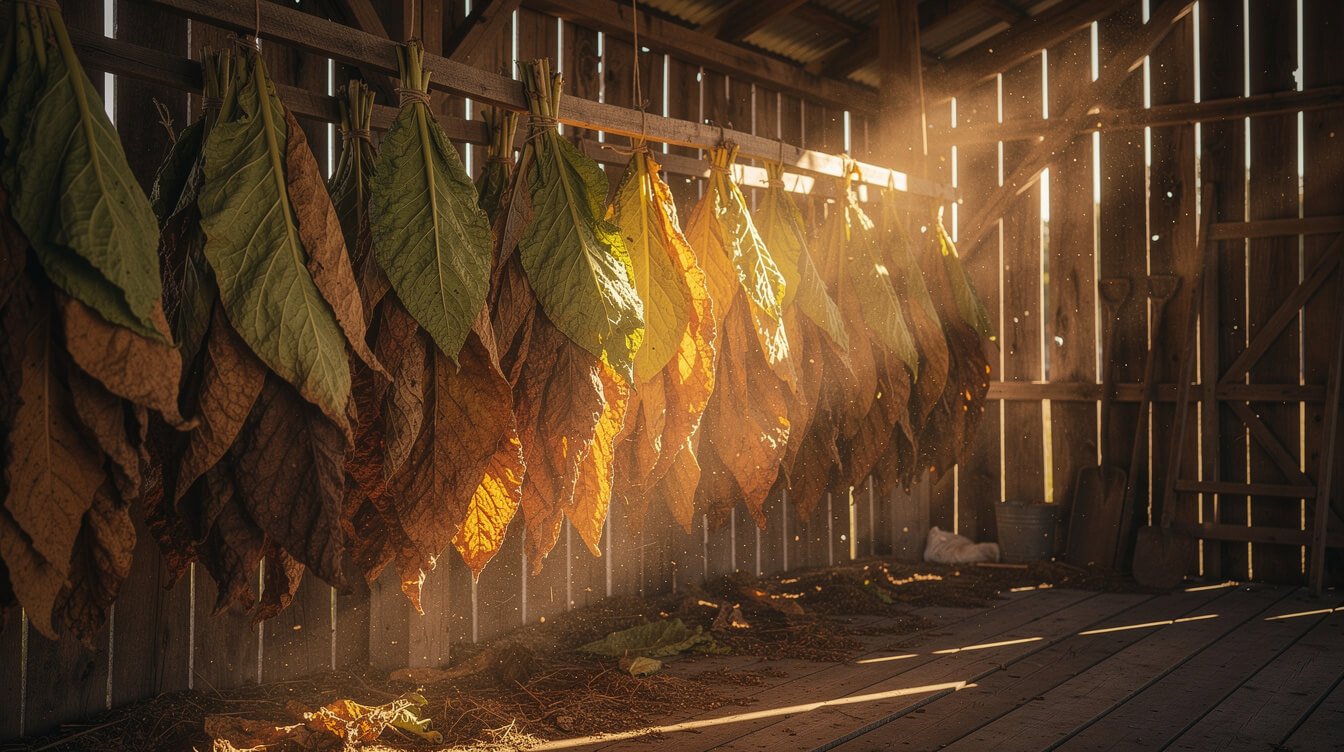
This is the section most comparison guides wave off with “tobacco is bad for you.” Here’s the specific version.
A blunt has nicotine even with no tobacco inside
A lot of people assume that once you’ve dumped the filler out of a cigar, the tobacco is gone. It isn’t. The wrapper is tobacco. When researchers tested the wrappers of five cigar products commonly used for blunts, every one contained measurable nicotine, between 1.2 and 6.0 mg per cigar in the wrapper alone. How much of that you actually absorb depends on how you smoke, and the authors called their testing preliminary. But “none” isn’t on the menu.
The misunderstanding is common. In a 2023 focus-group study of US adults who smoke little cigars and cigarillos, participants generally didn’t think of nicotine as part of those products. Using them for cannabis was one of the reasons people gave for not worrying about nicotine at all.
A spliff’s nicotine depends on your mix
A spliff’s nicotine is whatever tobacco you put in it. A light pinch means less nicotine than a blunt wrap. A half-and-half mix can easily mean more. When the blunt vs spliff nicotine question comes up, that’s the real answer: it’s the ratio, not the format.
Why this matters even if you don’t smoke cigarettes
Nicotine is addictive in a way that doesn’t care what format it comes in. If you don’t otherwise use tobacco, regular blunts or spliffs are a tobacco habit, whether or not you think of them that way. Two practical notes:
- Carbon monoxide comes with burning leaf. The Columbia study above measured more CO from blunts than from joints. Burning any plant material produces smoke, so a joint isn’t harmless either. It just leaves the tobacco out.
- Tobacco is a 21+ product in the US, the same as cannabis in legal states. Cannabis laws vary widely by state and country, so know yours before you roll anything.
If you have a heart condition, are pregnant, or take medications, smoking anything is a conversation to have with your doctor, not a blog. We’re describing study results here, not giving health advice.
Burn, taste, and session length
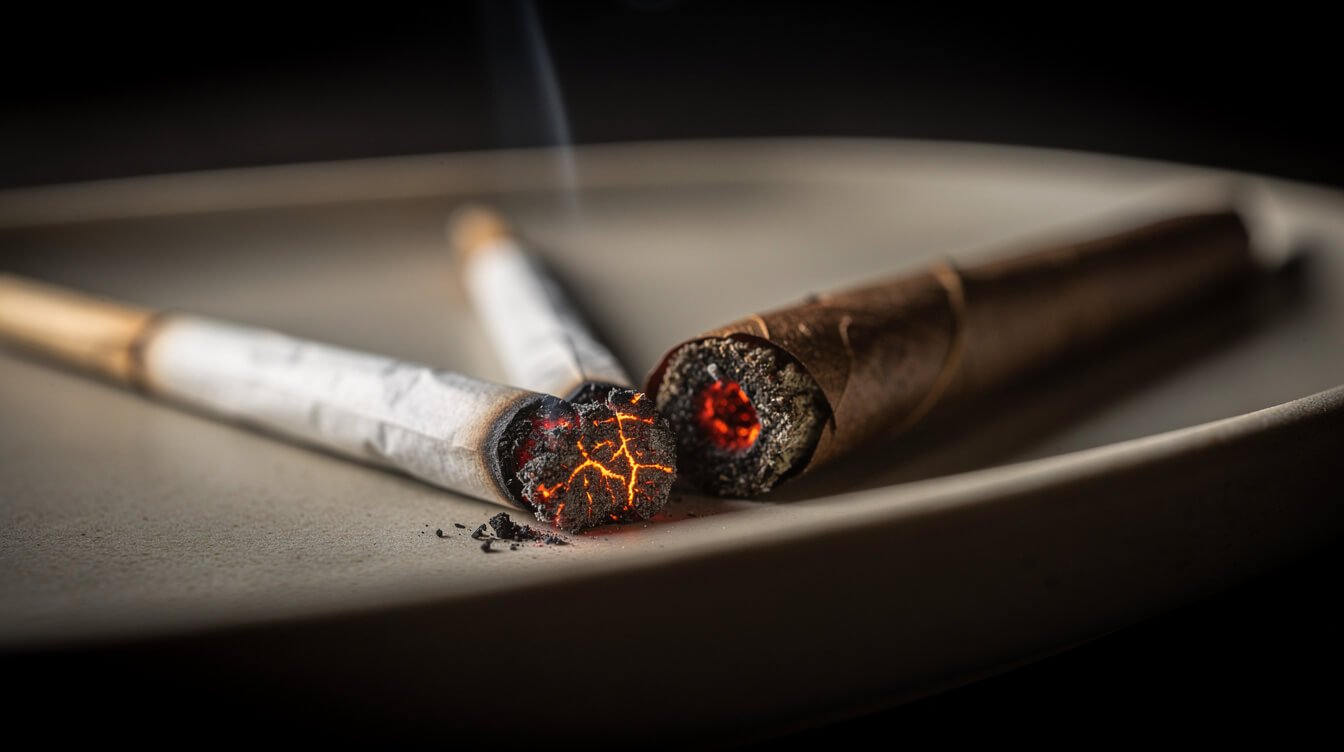
Set the tobacco question aside and the three formats still smoke very differently. Most of that comes from the wrapper.
Burn speed
Thin paper is porous. It draws air along its whole length and burns quickly, so a joint usually goes fast and needs attention to stay even. Tobacco in a spliff burns steadily and helps keep the cherry lit, which is one reason spliff smokers say theirs “smoke better.” A blunt wrap is thick and slightly oily, so it smolders slowly and can stay lit through long gaps between hits.
Taste
- Joint: the closest you’ll get to tasting the actual flower, especially with thin, unbleached papers. If you care about terpenes, this is the format that shows them off.
- Spliff: flower plus tobacco. The more tobacco, the more it tastes like a cigarette.
- Blunt: sweet, earthy, and heavy on the leaf. Many blunt smokers love that flavor. It also covers up a lot of the strain’s own character.
Size and grind
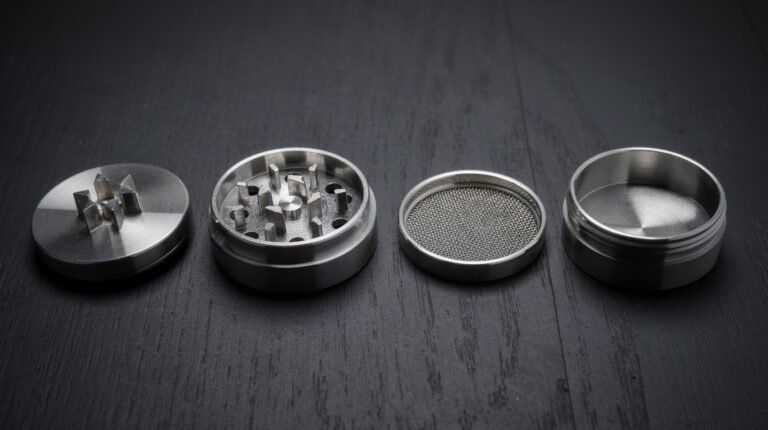
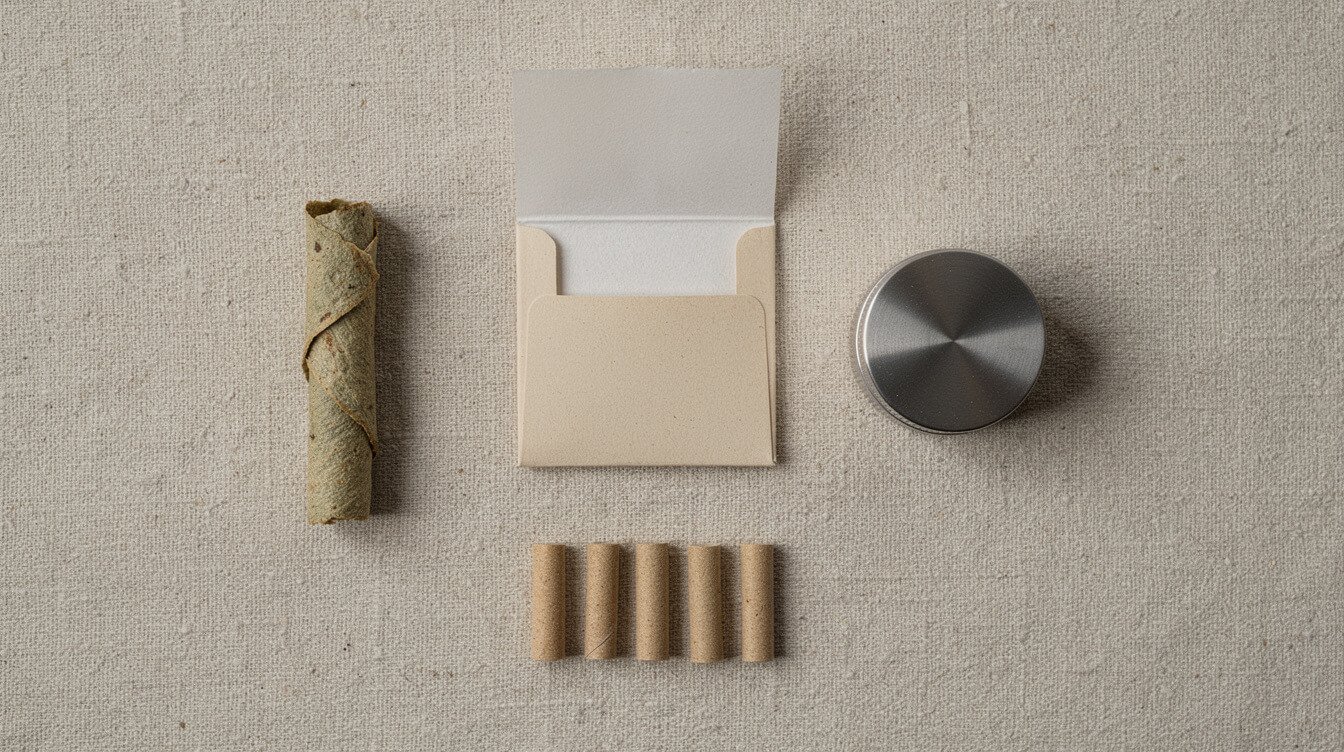
All three roll better with an even, medium grind. Too fine and it burns hot and fast; too chunky and it canoes. A decent grinder helps more than most people expect (here’s what actually matters in a grinder). Blunts need the most flower, joints the least, and spliffs stretch the cannabis furthest because tobacco takes up part of the volume. Some people pack extra kick into any of them with a sprinkle of kief. If you do, pace yourself.
Blunt vs spliff vs joint: which one fits what you want

We’re not going to rank these on health. Smoke is smoke, and no format makes smoking safe. But the factual differences point fairly clearly to which one suits what.
- You want to taste the flower: a joint. Nothing else is in the way.
- You want to skip tobacco and nicotine: a joint, or a blunt-style roll in a wrap you’ve confirmed is tobacco-free. Joints skip tobacco entirely. That’s a fact about what’s in them, not a health claim.
- You’re sharing with a group over a long session: a blunt is the traditional choice because it burns slowly and holds more. A big joint or a tobacco-free wrap does the same job without the leaf.
- You already smoke tobacco and like the combination: that’s a spliff, and you know the trade-off. Just be honest with yourself about the ratio.
- You’re new: start with a small joint, take a couple of puffs, and wait. Even the low-potency research cannabis in that Columbia study produced measurable effects in three puffs. Today’s flower is much stronger.
If a joint is your pick, our guide to rolling a joint without a filter walks through it step by step. Whatever you roll, don’t drive after smoking, and keep it out of reach of anyone under 21.
Frequently asked questions
Is a spliff just a joint with tobacco?
Yes, by the American definition. A spliff is cannabis and loose tobacco rolled in a regular paper. In much of Europe, people call that same thing a joint, because mixing in tobacco is the default there. That’s why the terms get swapped so often.
Blunt vs joint: which is stronger?
Per puff, the one controlled study found joints delivered more THC and felt stronger, even to regular blunt smokers. Blunts feel bigger mainly because they hold more flower and the sessions run longer. If you mean “which gets you higher,” the honest answer is whichever one you smoke more of.
Blunt vs spliff: which has more nicotine?
It depends on the spliff. A blunt’s nicotine comes from the tobacco-leaf wrap; testing of common cigar wrappers found 1.2–6.0 mg each. A spliff’s nicotine depends entirely on how much tobacco you mix in. A light spliff can have less than a blunt, and a heavy one can have more.
Is a doobie a blunt or a joint?
A joint. “Doobie” is just another word for a cannabis cigarette, rolled in paper. Etymologists date it to the 1960s, origin unknown. It refers to a paper roll, not a cigar wrap.
Why is a spliff called a spliff?
Nobody actually knows. You’ll see “split plus whiff” repeated online, but the Online Etymology Dictionary lists “spliff” as a West Indian word from 1936, of unknown origin. “Joint” is a bit clearer: it shows up as cannabis slang by 1938, perhaps because it’s something shared.
Joint vs spliff: what’s the difference?
Only the filler. Both use rolling paper. A joint is cannabis only, while a spliff mixes in tobacco, which adds nicotine, changes the taste, and steadies the burn.
Can you get a blunt without tobacco?
Yes. Hemp, palm-leaf, and other tobacco-free wraps give you the blunt size and slow burn with no tobacco leaf. Check the label to confirm it actually says tobacco-free. A gutted cigar or a standard blunt wrap still has tobacco in the leaf itself.
Final thoughts
Blunt vs spliff vs joint isn’t really a debate about weed. The cannabis can be identical in all three. It’s a choice about the wrapper and the tobacco that comes with it. A joint is just the flower. A spliff adds as much tobacco as you choose. A blunt adds tobacco whether you meant to or not, and the one controlled comparison we have found it delivered less THC and more carbon monoxide per puff than a joint.
None of that makes any format “safe.” But the blunt vs spliff choice can now rest on facts instead of folklore: taste, session size, and whether you want nicotine in the mix. Great plant. Know your laws, keep it 21+, and enjoy it responsibly.
Before you go
Get the next explainer first
We publish a new one every day. The best of the week, plus what's new in the shop, lands in one short email.