Weed Plant Growth Stages: How to Tell Where Your Plant Is (and What Each Stage Needs)
Most guides to weed plant growth stages hand you a calendar: germination this many days, veg that many weeks, flower for eight. Calendars are fine. But your plant doesn’t read them. It moves from one stage to the next on its own signals, and those signals are things you can see and control. This guide covers the other half: how to tell which stage you’re in, what the plant needs there, and what the research says where growers usually guess.
Quick note before we start: home growing is legal in some places and not in others, and where it is legal there are usually plant-count and age limits (21+ in most US states that allow it). Check the rules where you live before you plant anything.
Weed plant growth stages: the short answer
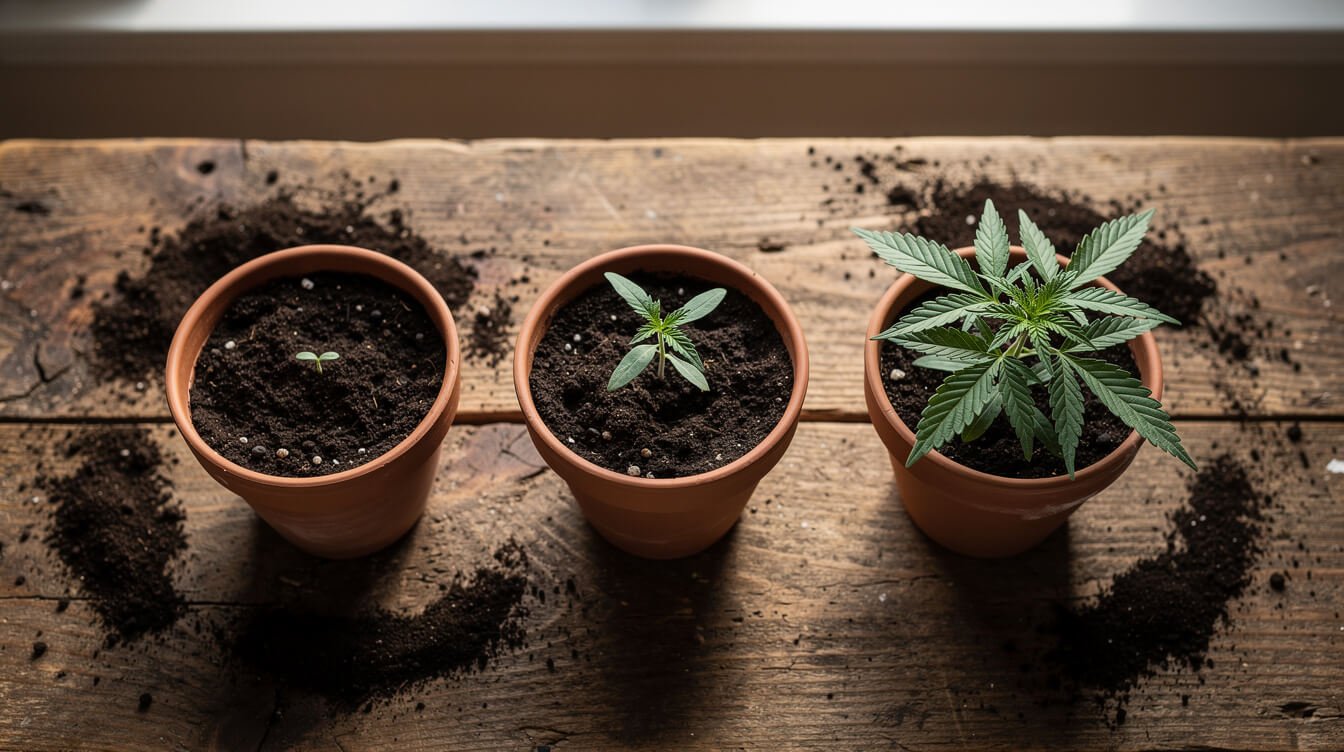
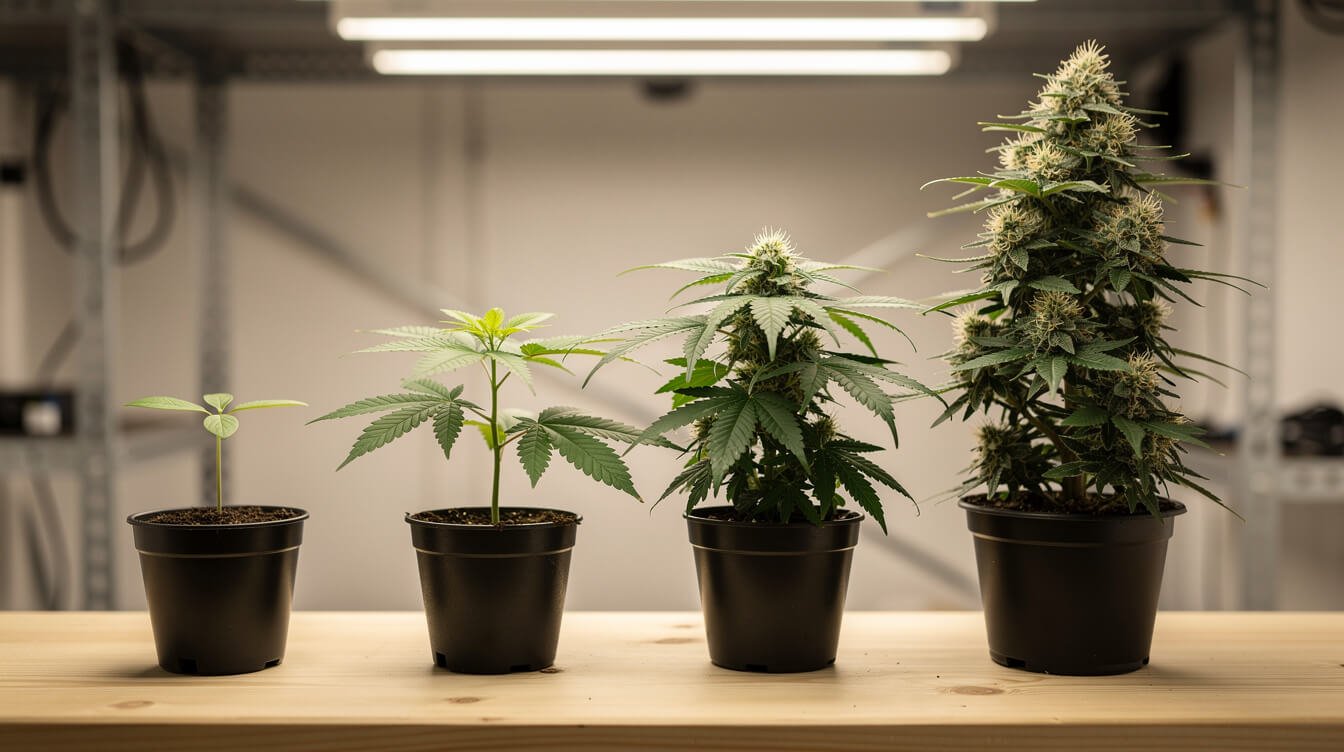
A photoperiod cannabis plant goes through four growth stages: germination, seedling, vegetative, and flowering. Harvest, drying, and curing come after that, but those are things you do to the plant. They aren’t stages the plant grows through.
- Germination starts when the seed takes on water and ends when the sprout is above the soil with its first two round leaves open.
- Seedling runs until the plant is putting out full-size serrated leaves with the classic multi-fingered shape, usually around the third or fourth set.
- Vegetative is the build-out: new leaves, new branches, and roots filling the pot, for as long as the nights stay short.
- Flowering begins when the plant gets long, uninterrupted nights. Then it stops building and starts making buds.
Those are the textbook boundaries. Two details most guides skip: “vegetative” isn’t strictly vegetative (plants make tiny flowers at their nodes even under long days), and the famous 12/12 light switch is a convention, not a law of botany. Both change how you read the weed plant growth stages on your own plant.
For week ranges per stage, plus the drying and curing time most people forget, see our honest grow timeline.
Germination: seed to sprout
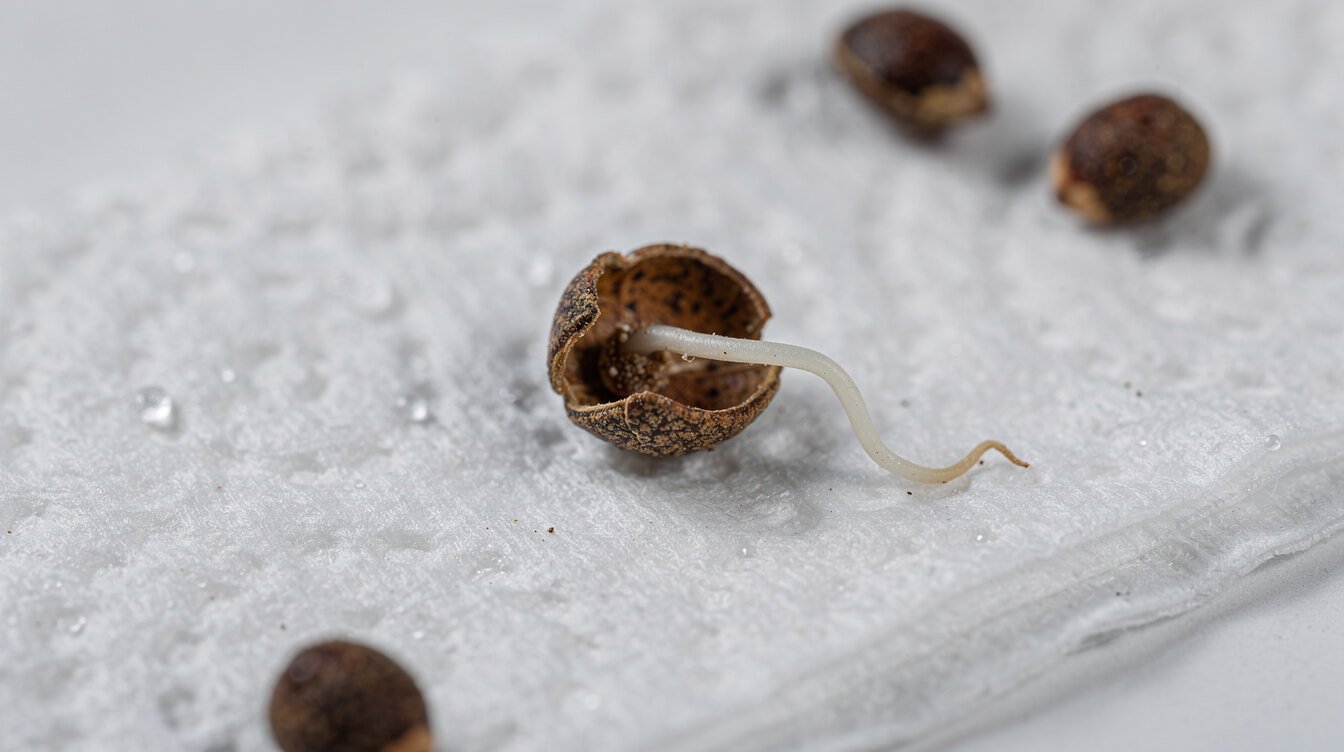
Germination is the quiet stage. A dry cannabis seed is a dormant embryo with a food supply, sealed in a hard shell. Give it water, warmth, and air and it wakes up. The seed swells, the shell splits along its seam, and a single white root (the taproot) pushes out first. The shoot follows, carrying the two seed leaves up through the soil.
How to tell you’re in it
- The shell has cracked and a pale root tip is visible, if you germinated in a paper towel or water.
- In soil you see nothing for a few days, then a little hook of stem breaks the surface, often still wearing the seed shell like a hat.
- It’s over when the two cotyledons (the smooth, rounded seed leaves) open flat and turn green.
What it needs
Moisture without waterlogging, warmth, and no fertilizer, since the seed carries its own food. The classic ways to lose a seed are drowning it (a soaked seed can’t get oxygen) and planting it too deep. Root tip down, about a knuckle deep, is the usual advice. If you want the step-by-step, with paper towel, direct-to-soil, and the troubleshooting, we wrote a full guide to germinating cannabis seeds.
Most viable seeds show a root within a few days. A seed that has done nothing after a week or so in good conditions usually isn’t going to.
Seedling stage: from seed leaves to real fan leaves
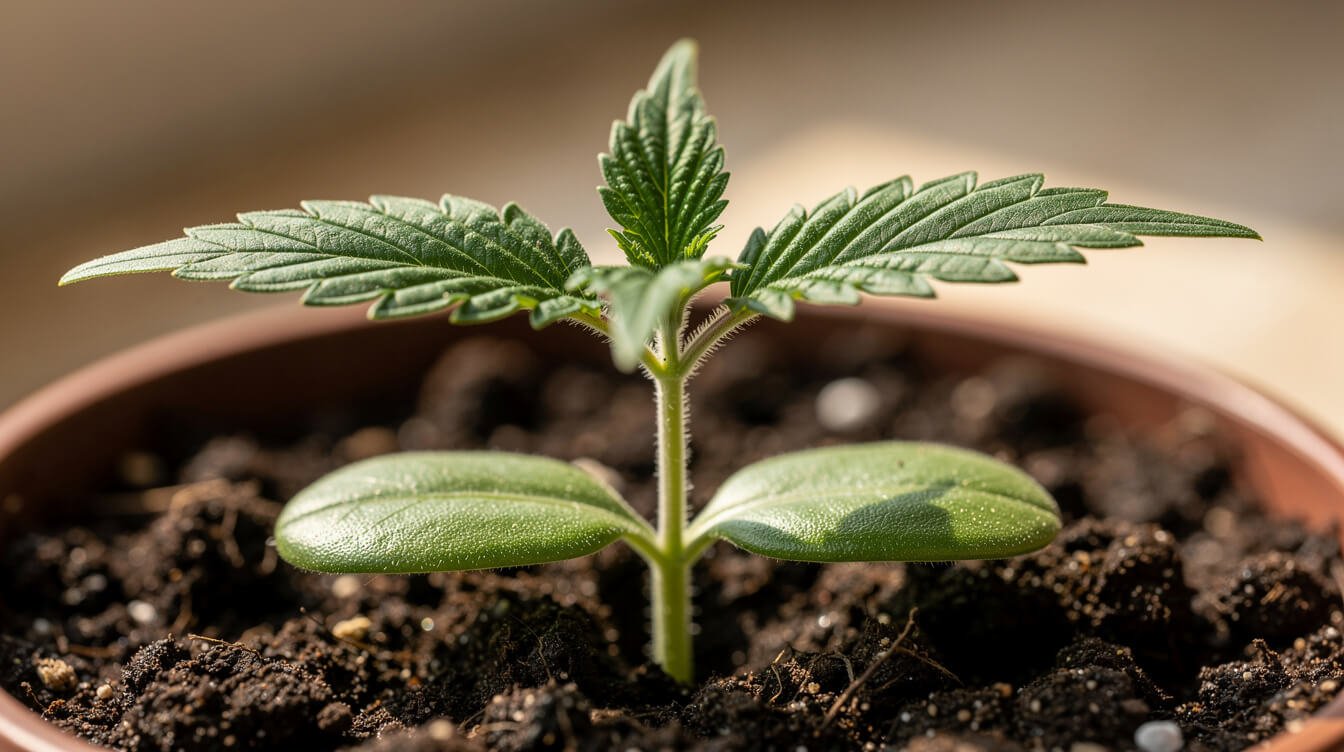
Here the plant switches from the seed’s stored food to feeding itself through photosynthesis, and you can watch it happen leaf by leaf.
How to tell you’re in it
Above the round cotyledons comes the first pair of true leaves. They’re serrated, and usually each one is a single leaflet. The next pair typically has three leaflets, then five, and so on as the plant matures. Once new leaves come in full-size with five or more fingers and the plant adds nodes (where leaves and branches meet the stem) at a steady pace, you’re in veg. Counts vary by genetics, so read the trend, not an exact number.
What it needs
- Gentle light, but enough of it. A light-starved seedling stretches into a tall, floppy stem (the “leggy seedling” problem). The fix is more or closer light, not a stake. Too intense and too close, though, and leaves pale or curl, so start a grow light farther away than its flowering height and close the distance gradually.
- Light watering. Seedling roots are tiny, and waterlogged soil cuts off their oxygen. Water a small circle around the stem and let the top of the soil dry a little between waterings.
- Little or no feeding. Most potting mixes carry enough for the first couple of weeks, and strong fertilizer on a seedling burns leaf tips. If you’ve already seen that, here’s how to fix nutrient burn.
- Stable, mild conditions. Seedlings dry out fast, so many growers keep humidity a bit higher here than they will later.
This is the most fragile point in the grow. Damping-off (a fungal collapse at the soil line), one hot afternoon, or a cat can end it.
Vegetative stage: the build-out (and why it isn’t purely “vegetative”)
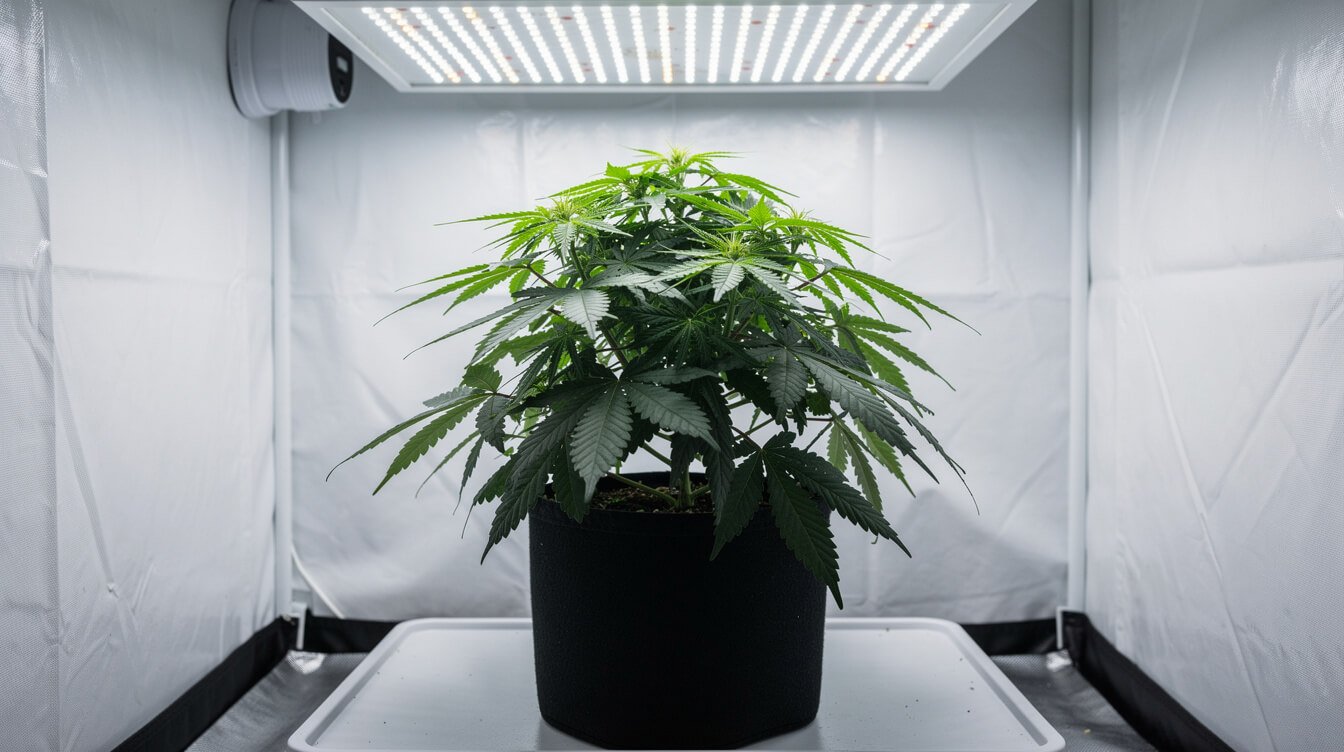
Veg is when the plant looks like the leaf on a T-shirt. It puts out big serrated fan leaves, adds nodes every few days, thickens its stalk, and fills the pot with roots. The branches buds will grow on, and the leaves that feed them, get built here.
How to tell you’re in it
- New growth at the tips is all leaves and stems. There are no clustered white hairs at the tops.
- Side branches are growing from the nodes, and the plant is visibly bigger every few days.
- The plant is getting long days and short nights: typically 18 hours of light to 6 of dark, or 16 to 8, indoors. Outdoors it’s late spring and early summer.
The part most guides get wrong: pre-flowers show up in veg
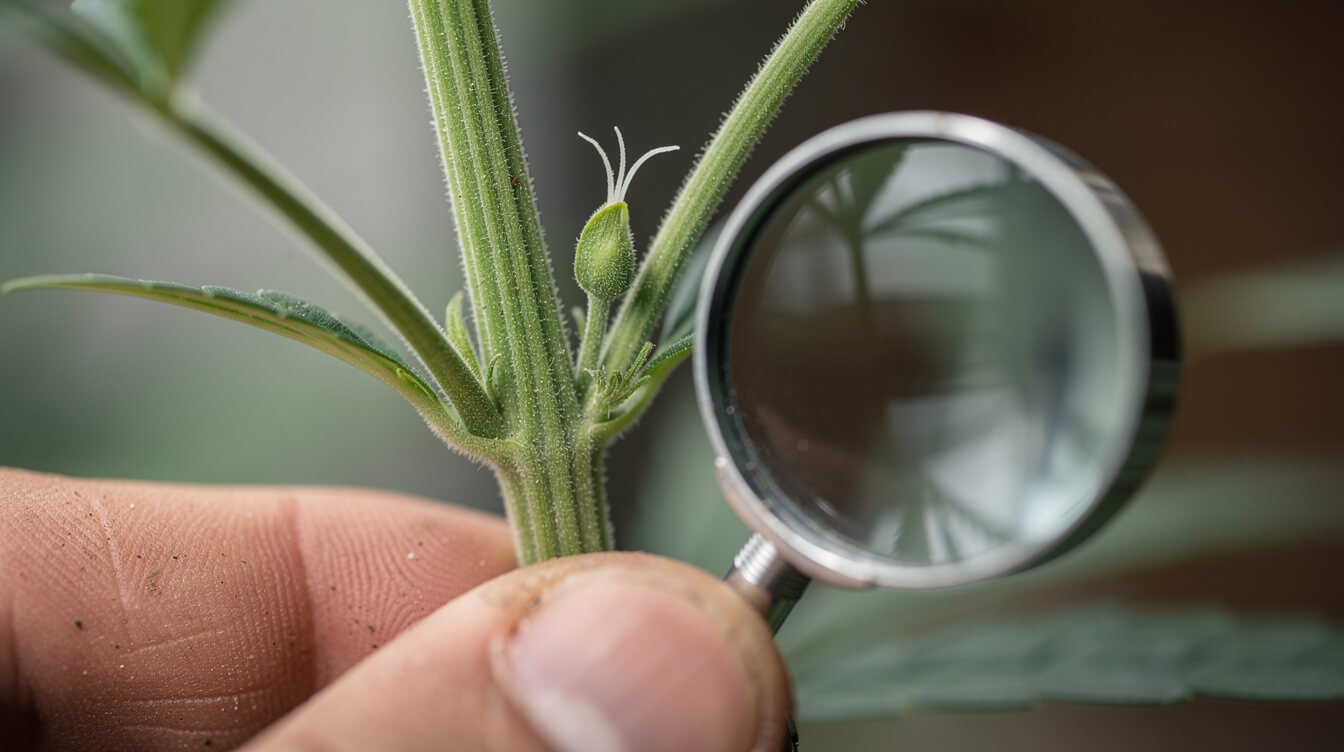
A few weeks into veg, under the same long days, tiny structures start appearing at the nodes, right where a leaf stem meets the main stalk. On a female it’s a small teardrop-shaped calyx, often with one or two thin white hairs. On a male it’s a little round ball on a short stalk. These are pre-flowers, and they’re real flowers, not a sign that something went wrong.
Plant scientists at Israel’s Volcani Center looked at this closely in a 2019 study of female cannabis development. They found that under long, supposedly “non-inductive” days, plants still developed solitary flowers and bracts at the nodes. The authors concluded the plant “cannot be defined as vegetative” in the classical sense. Their reading was that these solitary flowers are probably triggered by the plant’s age and internal signals, not by day length. What long nights actually change, in their account, is the plant’s architecture. The growing tips switch from making leaves and branches to making the dense, branched flower clusters we call buds.
That has two practical consequences:
- You can sex your plants during veg. Once pre-flowers appear, you can spot males and pull them before they shed pollen on your females. Our male vs female cannabis guide has the photos and the timing.
- Pre-flowers alone don’t mean your plant has started flowering. Lots of growers see white hairs at a node in week four of veg and panic. If the tops are still all leaf and the light schedule hasn’t changed, you’re still in veg.
What it needs
Light. Veg is when light pays off most, because it builds the frame. A 2022 study grew clones of one cultivar under a 16-hour day at a wide range of intensities. Plants under about 900 µmol/m²/s came out compact and robust. Plants under about 600 were taller and more open, with longer gaps between nodes. That’s one cultivar in a growth chamber, so treat it as a direction, but it explains where gappy veg plants come from. Our LED grow light guide covers how to pick a light for the space you actually have. You also don’t need 24-hour light for veg. Long days with a short dark period are standard, and the plant uses the night.
Nitrogen-forward feeding, but not a firehose. Growing plants use a lot of nitrogen to make leaves. A 2024 McGill study tested different nutrient mixes on vegetative cannabis in hydroponics. It recommended roughly 160 to 200 mg/L nitrogen with relatively modest phosphorus (30 mg/L) and potassium (60 mg/L). You don’t need lab numbers in soil. The point is that veg is nitrogen-heavy and moderate on everything else.
A plan for shape. Veg is when you train, because shaping a flowering plant is much harder. For an even canopy without cutting anything, start with low stress training. Veg is also when you take clones, since flowering plants root cuttings poorly.
How long veg lasts
As long as you want, indoors. A photoperiod plant under long days will keep vegging for months. The usual rule is to stop when the plant is somewhere around a third to half of the final height your space allows, because it keeps growing taller after the switch. More on that next.
GanjaTech, weekly
Cannabis, explained. In your inbox.
One email a week: the clearest explainers, honest gear picks, and what the science actually says. 21+ only. No spam, unsubscribe anytime.
The switch: what actually triggers flowering
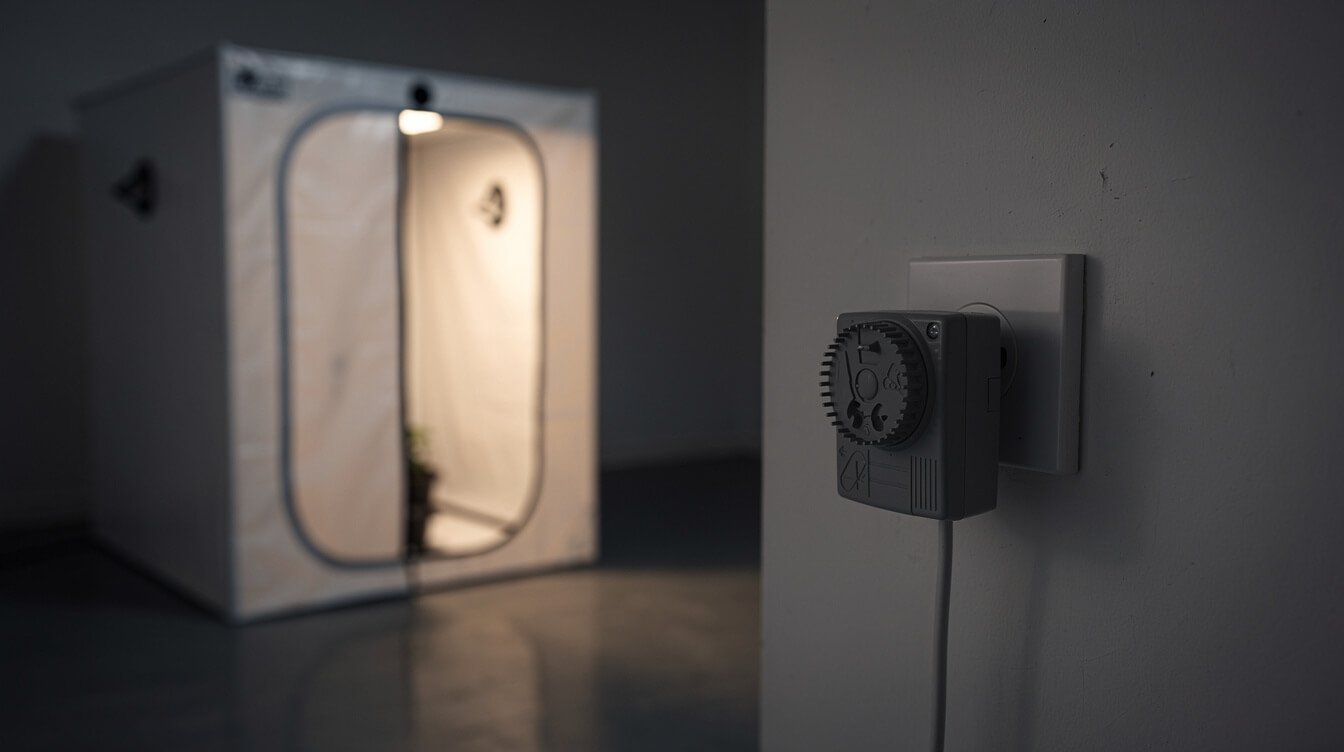
Most cannabis is a short-day plant. A more accurate name would be long-night plant. It flowers when the uninterrupted dark period each day gets long enough. Outdoors that happens as summer turns to fall. Indoors you do it with a timer.
How long the night has to be
A 2025 University of Connecticut paper puts the threshold plainly: cannabis produces flowers when the daily dark period “exceeds approximately 10 h of length”. That’s why the classic indoor flip goes to 12 hours of light and 12 of dark. It gives a comfortable margin past the threshold for nearly every photoperiod cultivar.
The exact cutoff varies by genetics, and it can be sharp. A 2021 University of Florida study tested hemp cultivars under 11 different day lengths. Some had a critical day length between 13 hours 45 minutes and 14 hours. Most of the essential-oil cultivars flowered 5 to 13 days later at 14 hours than at 13 hours 45 minutes. A quarter-hour of extra light made a measurable difference.
Is 12/12 actually the best flowering schedule?
Not necessarily, and this is one of the newer findings in cannabis horticulture. The Guelph group grew ten drug-type cultivars under days from 12 to 15 hours. All of them started flowering under every photoperiod up to 14 hours, with delays of zero to about four days compared with 12 hours, depending on the cultivar. A follow-up grew two THC-dominant cultivars to harvest under 12 versus 13 hours. Flower yields under 13 hours were 1.35 and 1.50 times higher, with cannabinoid levels the same or higher. An Australian trial on three varieties also found the biggest yields when flowering started at 14 hours of light, but in the two THC lines, a fixed 14-hour day lowered THC concentration.
The honest takeaway: 12/12 is the safe default and works for basically everything. Longer days can boost yield in some cultivars and cost potency in others, and these trials covered only a handful of cultivars each. If you experiment, keep notes.
Why light leaks matter so much
The plant is measuring the length of the uninterrupted dark period, so a break in the middle can reset the count. That’s not a hunch. The same Connecticut team tested the “night break” trick on purpose: a 12-hour day with one hour of light in the middle of the night. It kept plants vegetative, though the plants were shorter and less vigorous and yielded about 22% less floral biomass than the controls. One hour of light at the wrong time overrode a 12-hour night.
A brief flash from opening the tent probably isn’t a disaster. A failed timer, a hallway light leaking through a seam every night, or a status LED on the canopy can delay flowering or confuse the plant. Environmental stress is also one of the factors a 2026 review of hermaphroditism in cannabis links to sex instability. So check your tent in a dark room with the grow light off and fix any pinholes.
The exception: autoflowers
Autoflowering plants don’t wait for long nights. They move from veg to flower on age, usually a few weeks after sprouting, whatever the light schedule. That’s why autos are often run at 18 or 20 hours of light start to finish. Our ruderalis explainer covers where it came from and the genes behind it. The stages still happen in order; you just don’t decide when.
Flowering stage, phase by phase
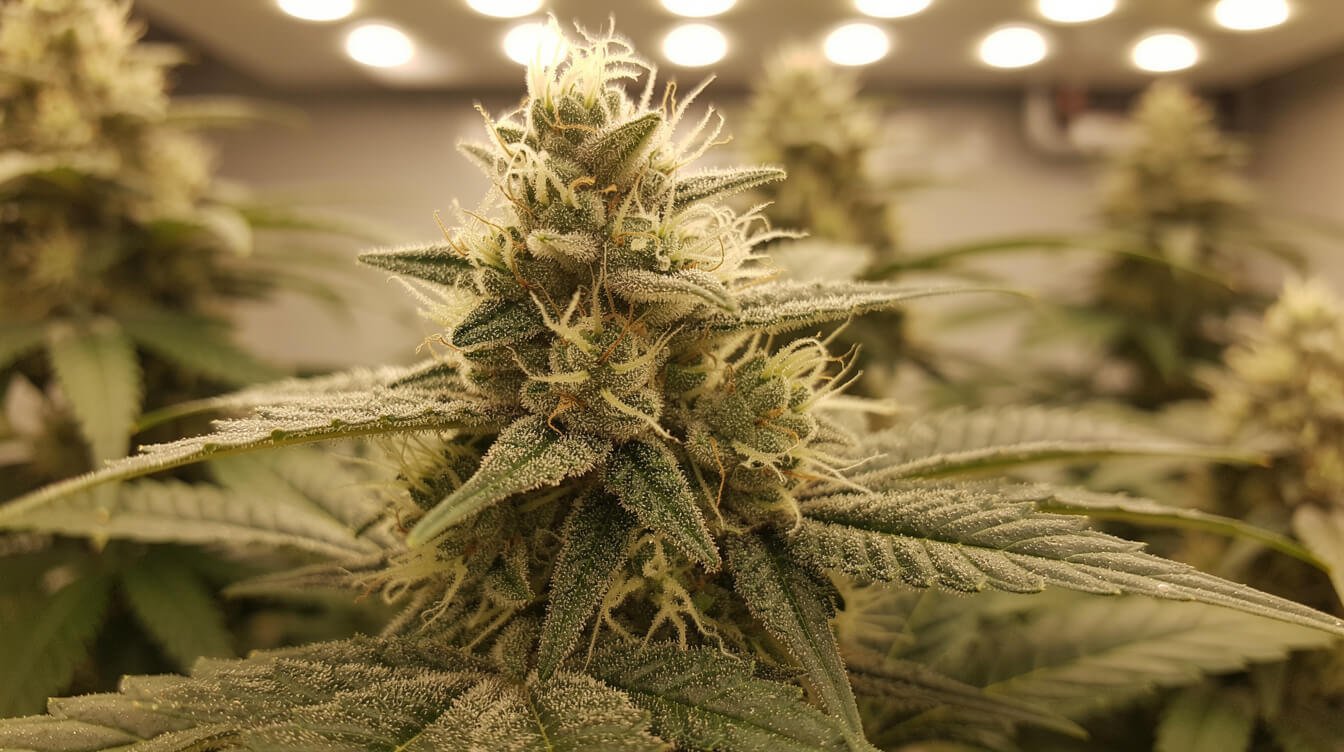
Flowering has distinct phases you can read on the plant. The weeks below are typical for a photoperiod plant flipped to 12/12; fast and slow cultivars shift them either way.
Phase 1: transition and stretch (roughly weeks 1 to 3)
The first thing you’ll notice is that the plant gets taller, sometimes a lot taller. Growers call this the stretch. Stems elongate and the gaps between nodes open up as the plant builds the framework its flower clusters will sit on. Then clusters of white hairs (pistils, the female flowers’ stigmas) appear at the tops of the stem and branches, not just at single nodes. That clustering at the tips means the plant has truly changed gear.
Stretch varies widely by cultivar. Some barely grow, and others are commonly reported to nearly double. We couldn’t find controlled data that pins it down, so leave headroom under the light. This is the last window for gentle training like tucking branches.
Phase 2: bud set (roughly weeks 3 to 5)
Vertical growth slows and then stops. The hair clusters multiply and start knitting into recognizable buds along each branch. Resin glands (trichomes) begin to frost the small sugar leaves around the buds, and the smell ramps up hard. That’s when odor control becomes a real consideration if you live with neighbors.
Phase 3: bulking (roughly weeks 5 to 7+)
Buds fatten and stack, trichome coverage thickens, and colas can get heavy enough to need support. Some yellowing of the lower fan leaves is normal from here on.
Phase 4: ripening (the last 1 to 3 weeks)
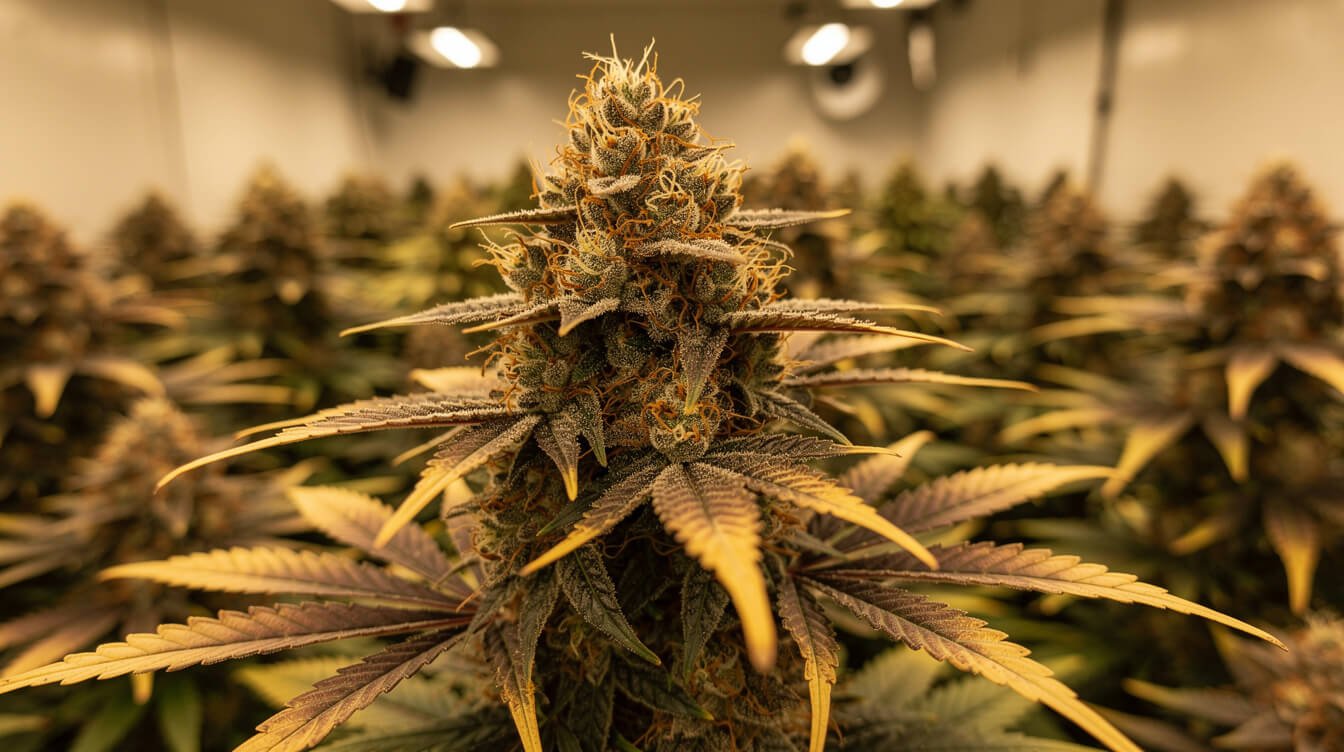
New pistils stop appearing, and most of the existing ones darken and curl from white to orange or brown. Trichome heads turn from clear to cloudy, with some going amber. Fan leaves fade further. Ripening also responds to the light schedule. In the Guelph 12-versus-13-hour trial, stigma browning and trichome ambering came earlier and progressed faster under 12 hours. Harvest timing is best read from trichomes, not from a calendar or hair color alone. Our trichome guide shows you exactly what to look for under a loupe.
What flowering plants need
Don’t swing to a “bloom booster.” The standard advice is to cut nitrogen and pile on phosphorus once flowering starts, and nearly every grow guide repeats some version of it. The research is less excited. A 2021 Guelph study tested a range of nutrient mixes on plants in flower. Yield was best at about 194 mg/L nitrogen and 59 mg/L phosphorus, with no yield response to potassium across the levels tested. That’s still plenty of nitrogen in flower, not a cut to zero. A 2025 Utah State study went further, testing phosphorus from 15 to 90 mg/L. It found no difference in yield or quality, and doubling overall nutrient strength didn’t help either. Both are hydroponic studies on few cultivars, so they aren’t a soil recipe, but the direction is clear: balanced feeding through flower, no phosphorus megadose.
Drier air. Dense buds plus humid air is how you get bud rot. A 2025 study grew a CBD cultivar at high humidity (78 to 98%) versus low (37 to 58%). The humid plants flowered later and produced about 71% less flower biomass, with lower cannabinoid concentrations. That’s an extreme comparison with ten plants per group, but it matches grower experience. Many indoor growers aim for roughly 40 to 50% humidity in late flower and keep air moving through the canopy. If you’ve already spotted grey fuzz or browning inside a cola, read our bud rot guide today, not tomorrow.
Steady nights. Everything from the light-leak section applies double here. Keep the dark period dark through the whole flowering stage.
How to tell which of the weed plant growth stages you’re in
Lost track of the weeks, or not sure where your plant is? Reading weed plant growth stages comes down to three checks, in this order: the newest growth at the top, the nodes, then the light schedule.
| Stage | What you see | Typical light (photoperiod plants) | Main risk |
|---|---|---|---|
| Germination | Cracked seed, white taproot, a stem hook breaking the soil | None needed until the sprout surfaces | Drowning the seed, planting too deep |
| Seedling | Round seed leaves plus small serrated true leaves with 1, 3, then 5 leaflets | Long days, gentle intensity | Overwatering, legginess, damping-off |
| Vegetative | Full-size fan leaves, fast new nodes and branches, maybe single pre-flowers at nodes | 18/6 or 16/8 indoors | Too little light (gappy growth), late sexing |
| Flowering: transition | Rapid stretch, clusters of white hairs at the tops | 12/12 standard (long, unbroken nights) | Light leaks, running out of headroom |
| Flowering: bud set and bulking | Vertical growth stops, buds form and swell, frost and smell build | 12/12 | Humidity, bud rot, heavy colas snapping |
| Flowering: ripening | Most hairs darkened and curled, cloudy or amber trichomes, fading leaves | 12/12 | Harvesting by calendar instead of trichomes |
Three common misreads
- “White hairs at a node, so it’s flowering.” Not if they’re single and the tops are still leafy. Those are pre-flowers, and the plant is still in veg.
- “Yellow lower leaves in late flower, so it’s sick.” Some fading in the last weeks is normal. Yellowing that climbs fast in veg is different and worth diagnosing.
- “It’s been eight weeks, so it’s done.” Breeder flowering times are estimates. Your plant’s trichomes are the actual answer.
For a broader visual walk-through of leaves, nodes, flowers, and the plants people mistake for cannabis, see what a weed plant looks like. And if this is your first time running through all of this, our first indoor grow walkthrough strings the stages together into one plan.
Weed plant growth stages: common questions
How many growth stages does a weed plant have?
Four that the plant grows through: germination, seedling, vegetative, and flowering. Some guides list five or six by adding harvest, drying, and curing. Those matter enormously for the final product (here’s how to cure properly), but they happen after the plant is cut.
What are the weed plant growth stages for an autoflower?
The same four, in the same order, triggered by age instead of night length. Autos tend to spend only a few weeks in veg before flowering on their own, which is why they’re harder to fix if something goes wrong early. There’s less time to recover.
Can a plant go back from flowering to veg?
Yes. Putting a flowering photoperiod plant back on long days can push it into vegetative growth again (re-vegging). It’s slow, the new growth often looks odd for a while (rounded, single-bladed leaves), and it’s mostly used to save a prized plant after harvest.
When can I tell if my plant is male or female?
Usually a few weeks into veg, once pre-flowers form at the nodes. That timing depends on the plant’s age, not the light schedule, which fits the research described above. Males show small round sacs, and females show a teardrop calyx with white hairs.
Do I need to change nutrients between weed plant growth stages?
Lightly, yes. Seedlings need little to nothing, veg leans on nitrogen, and flowering wants a balanced feed that still includes nitrogen. The research above doesn’t support the idea that flowering plants need a big phosphorus “bloom boost”. Read your plant, not the bottle’s marketing.
Final thoughts
Weed plant growth stages are less a schedule than a set of signals. The seed cracks and roots. Leaflet counts climb. Nodes stack up and pre-flowers appear. Long nights turn the tips into buds, and the hairs and trichomes tell you when it’s done. Learn to read those signals and you stop needing someone else’s calendar, which is good, because your plant was never going to follow one.
The research also earns grow-forum rules a little skepticism. The night really is the trigger, and light leaks really matter. But 12/12 isn’t the only schedule that works, pre-flowers in veg are normal, and the phosphorus-heavy bloom feed looks more like tradition than science.
And as always, know your local laws, keep your grow away from kids and pets, and if you’re harvesting your first plant, start low and go slow when you try it.
Before you go
Get the next explainer first
We publish a new one every day. The best of the week, plus what's new in the shop, lands in one short email.