Low Stress Training Cannabis: How to LST Without Hurting the Plant
Low stress training cannabis is the cheapest upgrade in growing: you bend the plant instead of letting it grow straight up, and the same light produces more bud. No new gear, no new tent, no new nutrients. A loop of soft wire and ten minutes a week.
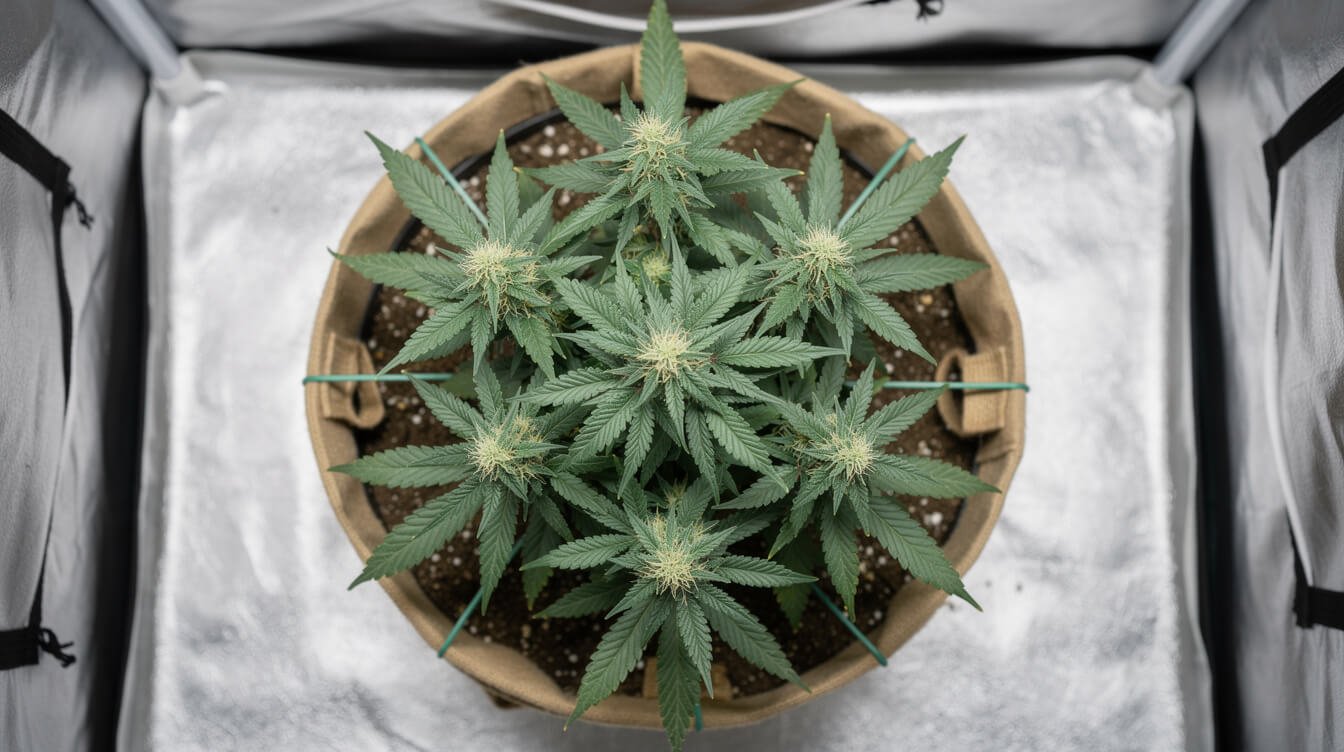
Here’s the honest version of why it works, and it has nothing to do with the plant “trying harder.” An untrained cannabis plant builds one dominant cola up top and a lot of sad, shaded popcorn underneath, because light intensity falls off fast with distance. Low stress training fixes a geometry problem: you flatten the plant so twelve bud sites sit at the same height in the same bright zone, instead of one sitting in it and eleven sitting in the dark.
That’s the whole trick. Everything below is detail: when to start, when to stop, what to actually buy (spoiler: about five dollars of wire), how to bend without snapping a branch, how autoflowers change the math, and what to do the first time you hear a crack.
One note before we get into it: growing cannabis at home is legal in some states and a crime in others, with plant counts and licensing rules that differ even between legal states. This is a horticulture guide for adults 21 and over in places where home cultivation is already lawful. Check your own state and local rules before you germinate anything.
What low stress training cannabis actually does (and what it doesn’t)
LST does two things, and they’re both mechanical.
It redistributes light. Grow light intensity drops off roughly with the square of the distance — move a bud site from 12 inches under the light to 24 inches and it’s getting about a quarter of the photons. Your light has a usable band, maybe 12 to 24 inches under an LED panel depending on the fixture, where buds actually get dense. An untrained plant puts one cola in that band. A trained plant puts the whole canopy in it.
It breaks apical dominance — partially. A cannabis plant sends growth hormones (auxins) to its highest point, which is why the top grows fastest. Bend the main stem sideways so it’s no longer the highest thing on the plant, and the side branches now on top start getting that signal instead. They stand up and compete, and you end up with several co-equal colas rather than one boss and a pile of subordinates.
Now the part the seed banks skip. LST does not create energy. It doesn’t make a plant photosynthesize more per square inch of leaf, and it doesn’t raise your ceiling past what your light and your pot can support. If you’re running a 100-watt light over a two-gallon pot, training will get you a better-shaped plant and a real but modest bump — not double. The gains are biggest when you have more light footprint than your plant is currently filling, which is the situation most first-time indoor growers are actually in. If your plant is already filling the footprint and the light is already close, you’ve mostly run out of room for training to help.
Anyone promising a doubled harvest from bending stems is selling something. What LST reliably delivers: a shorter plant that fits your space, an even canopy that’s easier to water and inspect, less larf at the bottom, and a meaningfully better yield from the light you already own. Great deal for five dollars. Not magic.
When to start LST — and the week you need to stop
Timing is where most guides on low stress training cannabis go vague, so here are actual numbers.
Start: around the fourth to sixth node
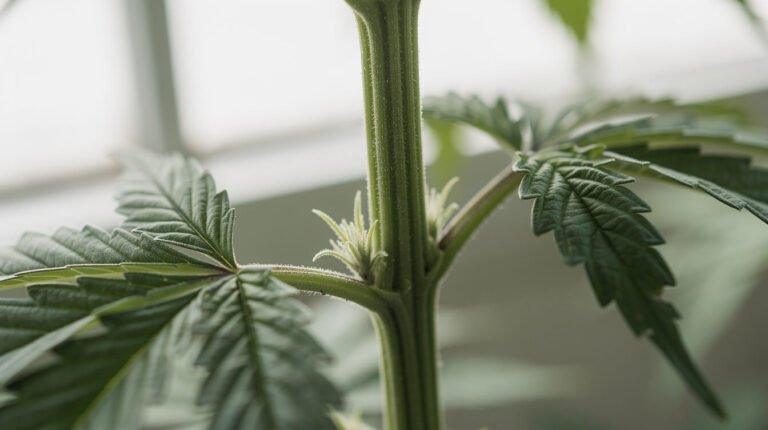
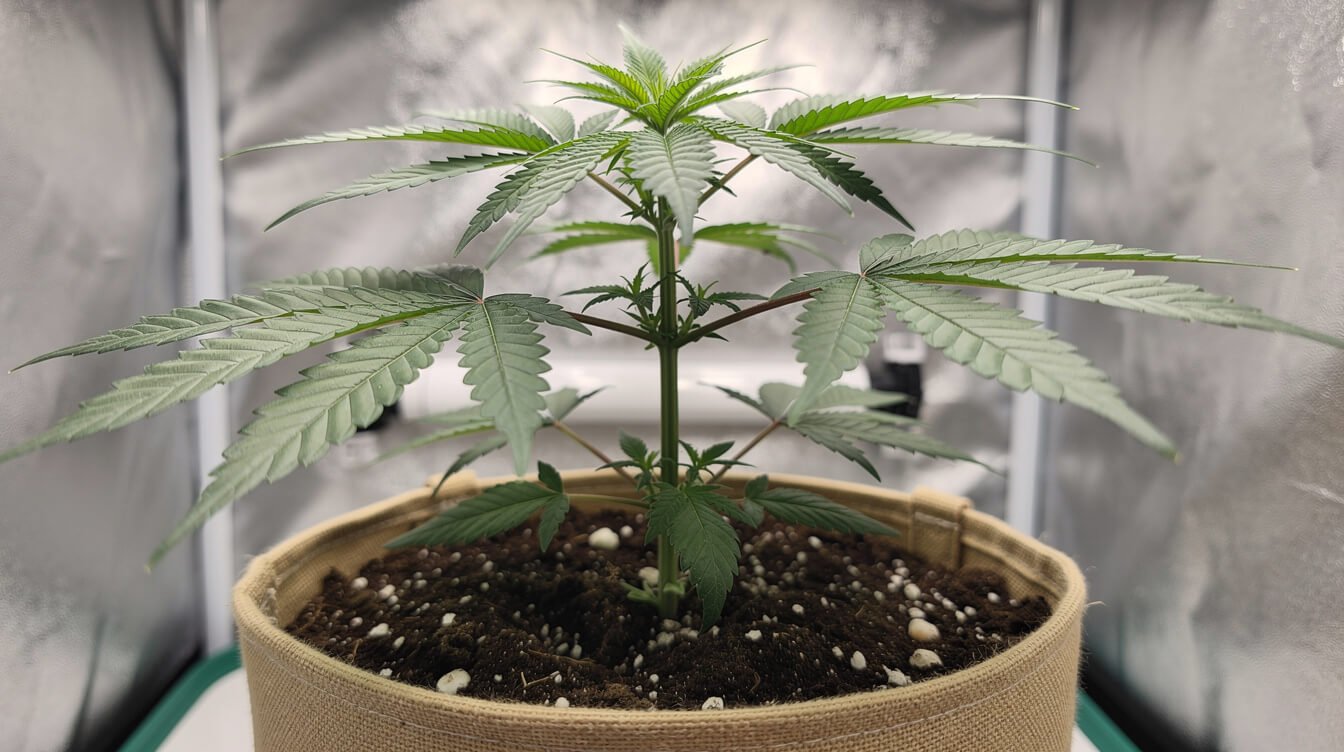
Wait until the plant has four to six node sets — usually two to four weeks from sprout, when it’s six to ten inches tall. (If you’re not there yet, start with how to germinate cannabis seeds and come back.) Before that the stem is too short to give you any leverage and too delicate to bend without creasing. Much after that and the lower stem starts turning woody, which means it wants to snap rather than flex.
Simpler than counting nodes: hold the main stem between two fingers and push gently sideways. If it moves like a green garden hose and springs back, it’s ready. If it feels like a twig, you waited too long and you’re into supercropping territory — a different, higher-stress technique.
Keep going through the whole stretch
One housekeeping note if you’re growing from regular seed: sort out male versus female plants before you invest weeks of training into something you’re going to pull. Otherwise, LST isn’t a one-time event, it’s a weekly habit. Through veg and into early flower, check the canopy every few days and tie down whatever has climbed above the rest. The most important stretch of this is the two to three weeks right after you flip to 12/12, when the plant shoots up dramatically and tries to undo all your work in about ten days. That’s the period where staying on top of it matters most.
Stop: around week three of flower
Here’s the hard stop nobody states plainly. Stop bending new growth once the stretch finishes, roughly week three of flower. After that point branches have lignified, buds are putting on weight, and bending does three bad things: it snaps brittle stems, it stresses a plant that has no veg time left to recover, and it can damage the vascular tissue feeding a cola you’re about to harvest.
From week three onward your job changes from training to supporting. Same soft ties, opposite purpose: you’re holding heavy colas up so they don’t fold over, not pulling them down. Trellis netting, a tomato cage, or a few stakes all work. If you’re not sure where you are in the cycle, our breakdown of how long it takes to grow weed from seed to jar maps the stages out week by week.
What you actually need for low stress training cannabis (the $5 answer)
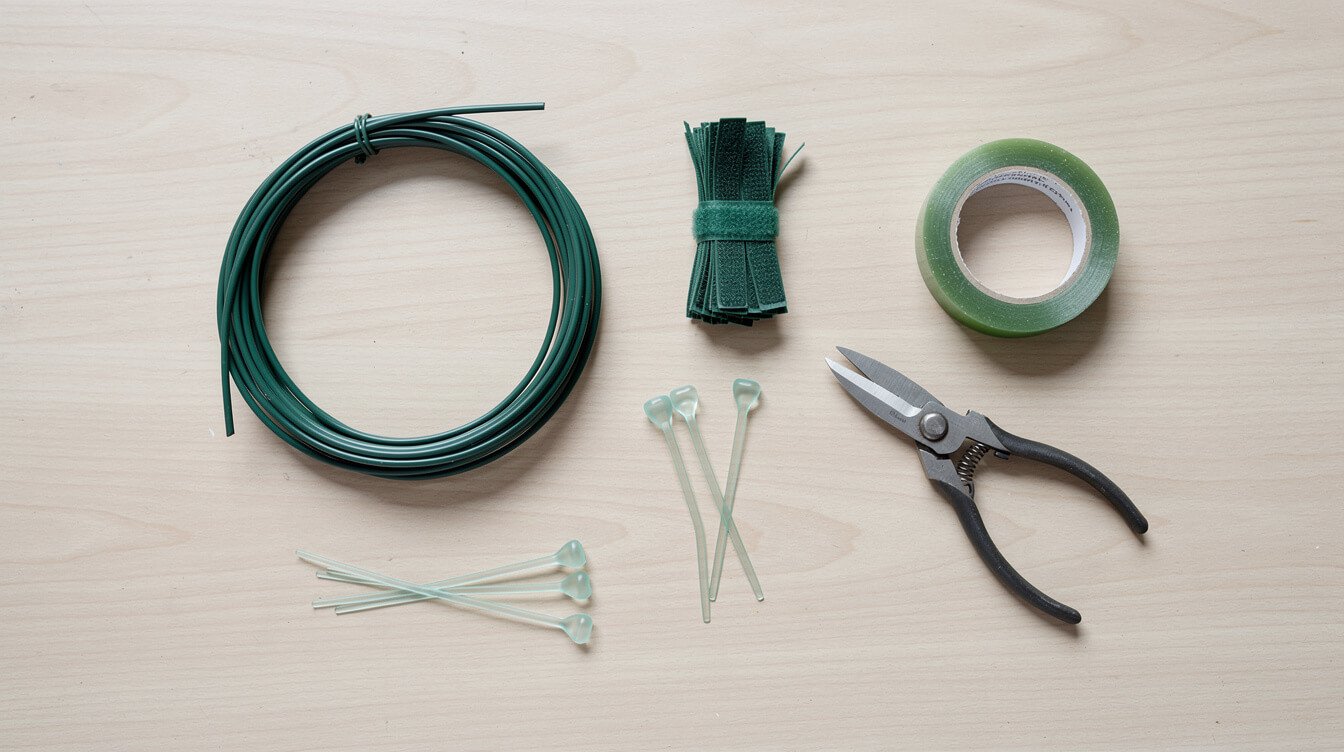
Every page that ranks for this keyword has training clips, seeds, lights, or garden products to move, so the gear sections tend to grow. Let’s be blunt instead.
What you need: something soft that won’t cut the stem, and something to anchor it to.
That’s a roll of plastic-coated garden twist wire — the green stuff, usually three to five dollars for more than you’ll use in a year. Cut it into six-inch lengths. Done. It bends to any shape, holds position, doesn’t bite into a stem, and is infinitely reusable.
Honest notes on the alternatives:
- Soft velcro plant ties — genuinely nice, gentler than anything, slightly more expensive. A real option, not a necessity.
- Purpose-made training clips — plastic hooks that clip onto the pot rim. Fast and effective. They also cost ten to twenty times what wire costs to solve the same problem, and they’re the product most top-ranking LST guides exist to sell. Buy them because you like them, not because a guide implied you need them.
- Bread-bag twist ties — free, in your kitchen drawer, and fine for thin branches. The paper ones go soggy; the plastic ones last.
- Bare wire, fishing line, zip ties, string — no. Anything thin and hard will girdle a stem as it thickens, strangling the branch above it. This is the single most common way growers hurt a plant while “being gentle.”
Anchor points, cheapest first: holes punched around the rim of a fabric pot (free, and fabric pots are ideal for this), bamboo stakes pushed into the soil at the edges, a tomato cage, or trellis netting across the tent. One trick worth stealing from the grow forums: plant your seedling slightly off-center, toward one edge of the pot. It gives you more room to bend the main stem across the full soil surface.
Optional but handy: clean snips, and plant tape for repairs. The one thing worth saying about tools is that none of them matter nearly as much as showing up every few days. A grower with kitchen twist ties and a habit beats a grower with a fifty-dollar clip kit and good intentions.
How to LST a cannabis plant, step by step
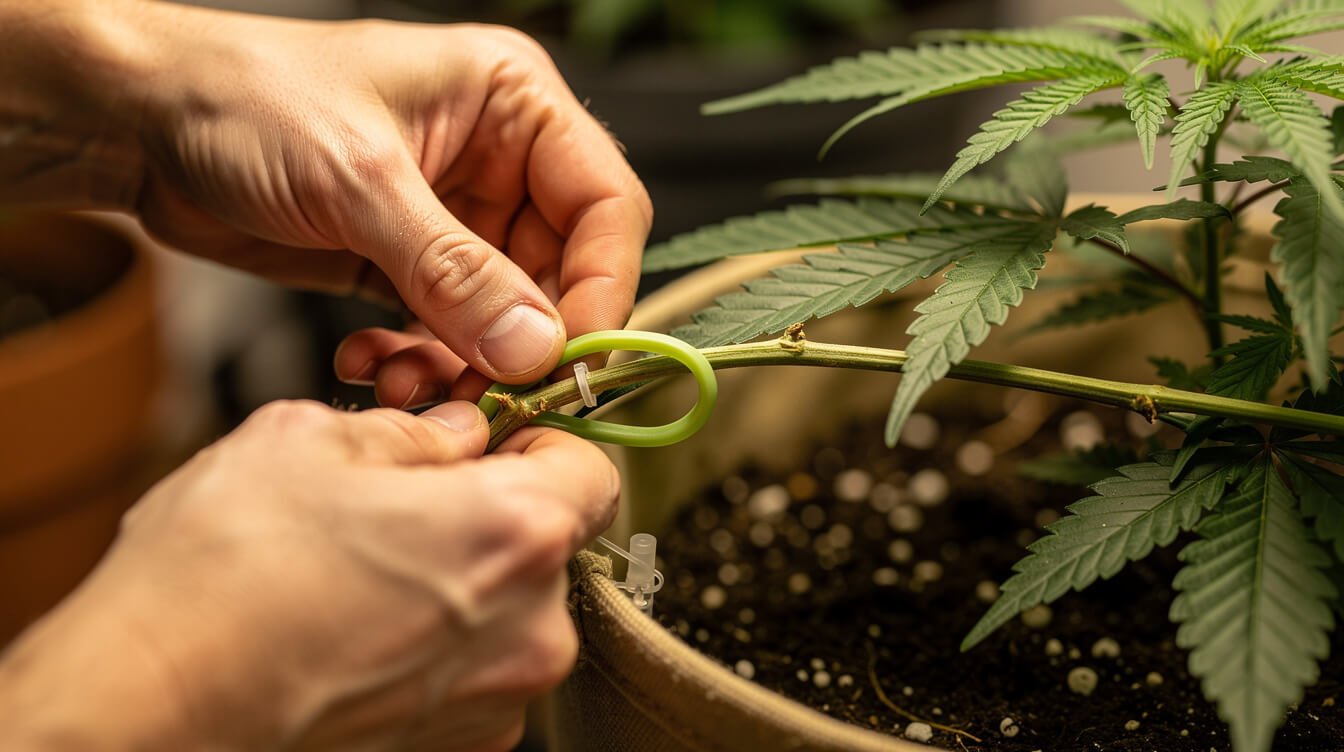
The mental model for low stress training cannabis: you are trying to make the plant look like a star when seen from above. Everything pulled outward from the center, nothing tall in the middle.
1. Water the day before, not the hour before
A slightly thirsty plant is noticeably more flexible — turgid, fully hydrated stems are stiffer and crack more easily. Train a few hours before a watering, not right after one. Small thing, real difference.
2. Bend the main stem down and sideways
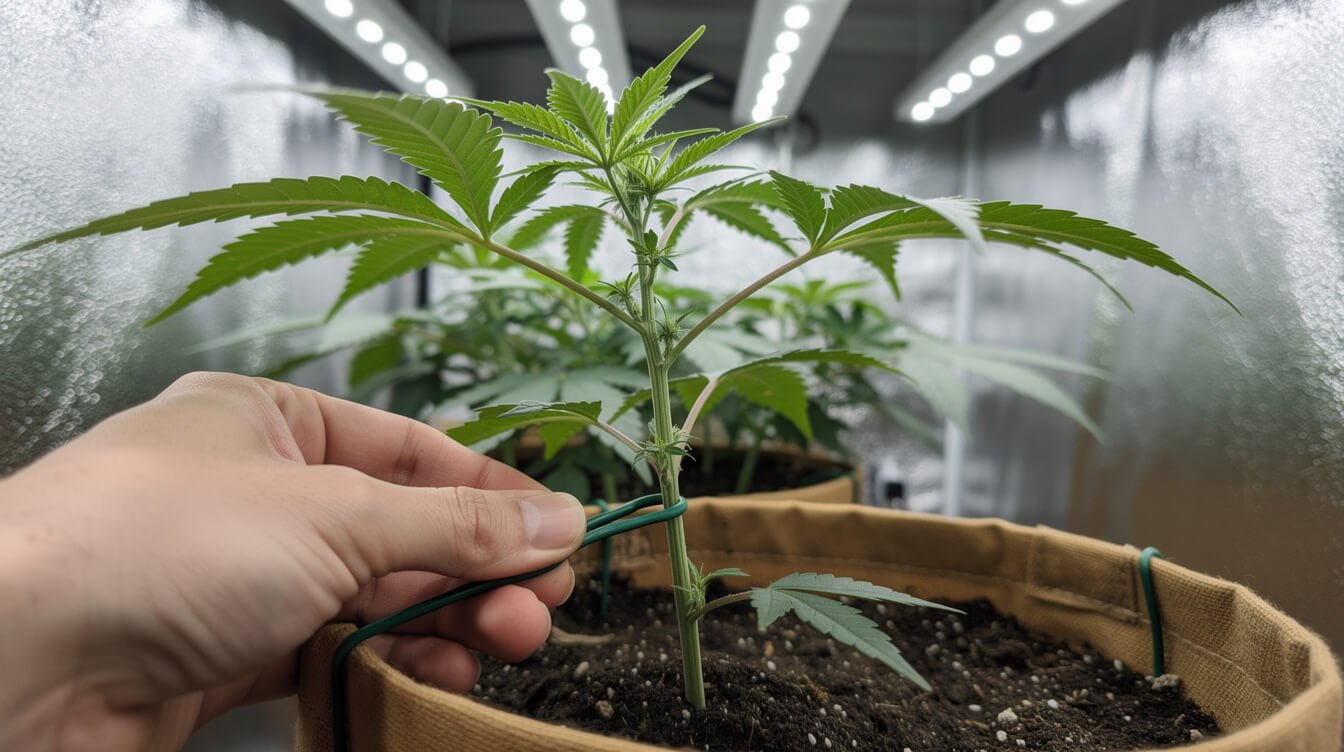
Take the top of the plant and ease it over toward one side of the pot, aiming for horizontal. Do it slowly, with your whole hand supporting the stem rather than pinching one spot — a few seconds of steady pressure, not a snap. You’ll feel the stem give and relax. Secure it with a wire loop around the stem (loose, a finger’s width of slack) tied to the pot rim on the opposite side. Pull it down and away from center — down alone just folds the plant over itself.
3. Let the side branches rise
Over the next three to five days the branches that were in the main stem’s shadow straighten up and reach for the light. It feels like nothing is happening, and then suddenly the plant has four tops instead of one. Don’t touch anything while it does.
4. Tie down the new leaders too
Once those side branches get taller than the rest of the canopy, bend them outward and secure them the same way. Each one you tie down promotes the branches below it. You’re running the same move at smaller and smaller scale, fanning growth out in every direction.
5. Check every three days and level the canopy
Your only ongoing rule: nothing gets to be taller than everything else. Walk up to the plant, look across the canopy at eye level, and tie down whatever is sticking up. Five minutes. A trained canopy should look almost boringly flat.
6. Loosen and re-tie as stems thicken
Stems get fatter every week. A tie that was comfortable ten days ago can be cutting in now. Every time you’re in there, run a finger under each loop — if it isn’t loose, redo it. Re-tying is not a chore you can skip; it’s the maintenance that keeps LST low-stress.
7. Stop training, start supporting
Around week three of flower, switch modes as described above. Hold weight up, stop pulling anything down.
If you’re setting up a first grow and want the surrounding context — pot size, light height, feeding, the whole arc — our honest first-grow walkthrough for growing cannabis indoors covers the rest of the system this technique plugs into.
GanjaTech, weekly
Cannabis, explained. In your inbox.
One email a week: the clearest explainers, honest gear picks, and what the science actually says. 21+ only. No spam, unsubscribe anytime.
LST on autoflowers: the one real difference
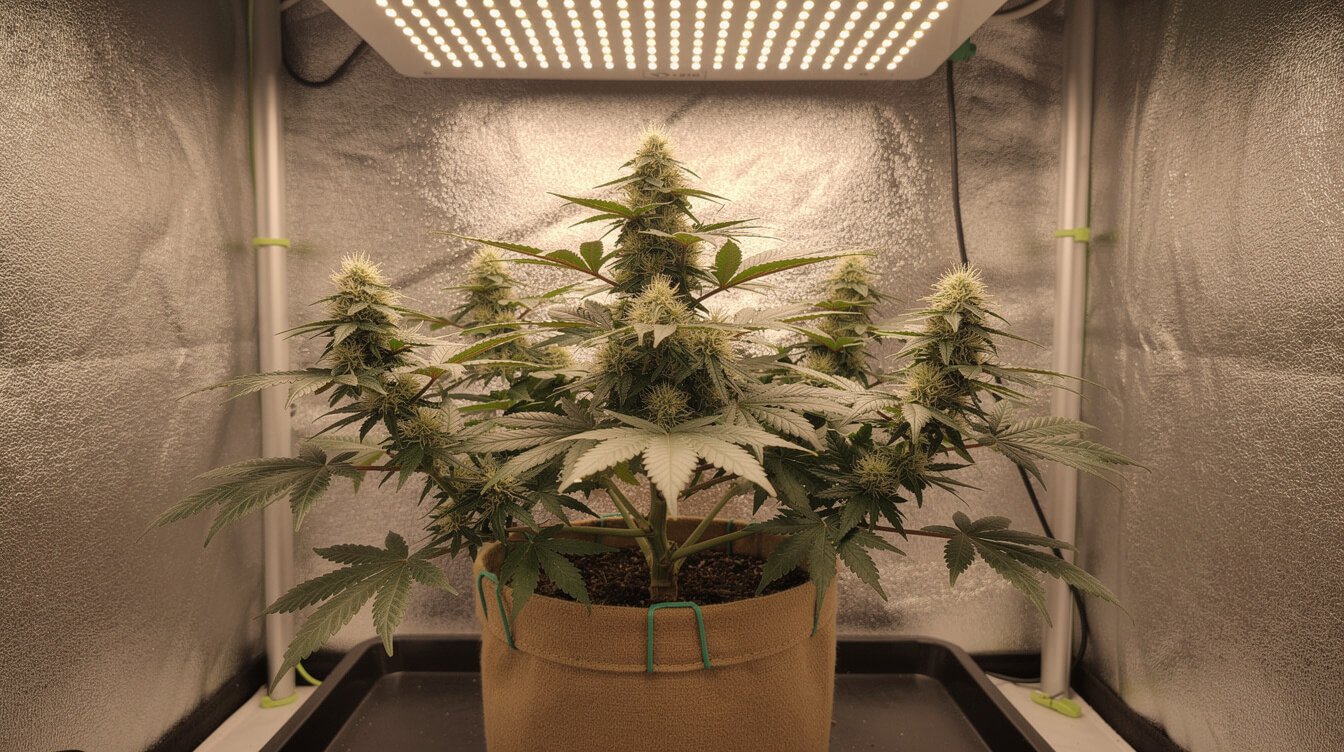
Autoflowers can absolutely be trained — the internet’s “never touch an auto” advice is an overcorrection. But the difference from photoperiod plants is real, and it comes down to one thing: an autoflower has no recovery budget.
A photoperiod plant stays in veg until you decide otherwise. Stress it, lose a week, flip it later — fine. An autoflower starts flowering on its own internal clock at three to five weeks regardless of what happened to it. Any week it spends recovering is a week of flowering time it simply doesn’t get back, and the plant stays permanently smaller.
So the rules tighten:
- Start earlier — three to four nodes. You have a two-week window, not a six-week one.
- Bend gentler, and expect to do it more often. Smaller adjustments, every two or three days, rather than one aggressive bend.
- Don’t top an autoflower. Topping removes tissue, and removing tissue costs recovery days the plant can’t spare. Pure bending costs essentially nothing, which is exactly why LST is the training technique that suits autos.
- Finish by the time flowering starts — typically week four or five from sprout. Once you see the first pistils and the plant starts stretching, you’re in support-only mode. That’s earlier than with photoperiods.
Autos are also where most people start, which is why they show up so often in our rundown of the best beginner strains to grow indoors. Done right, LST is the single highest-value thing you can do to one. Autos are naturally short, and short plants waste a lot of light out at the edges of the footprint. Spreading one flat across the space is often the difference between a disappointing auto grow and a genuinely good one — particularly if you’re running a modest fixture. Our guide to picking the best LED grow light for one plant gets into how footprint and canopy shape interact.
LST vs topping vs high-stress training: do you need both?
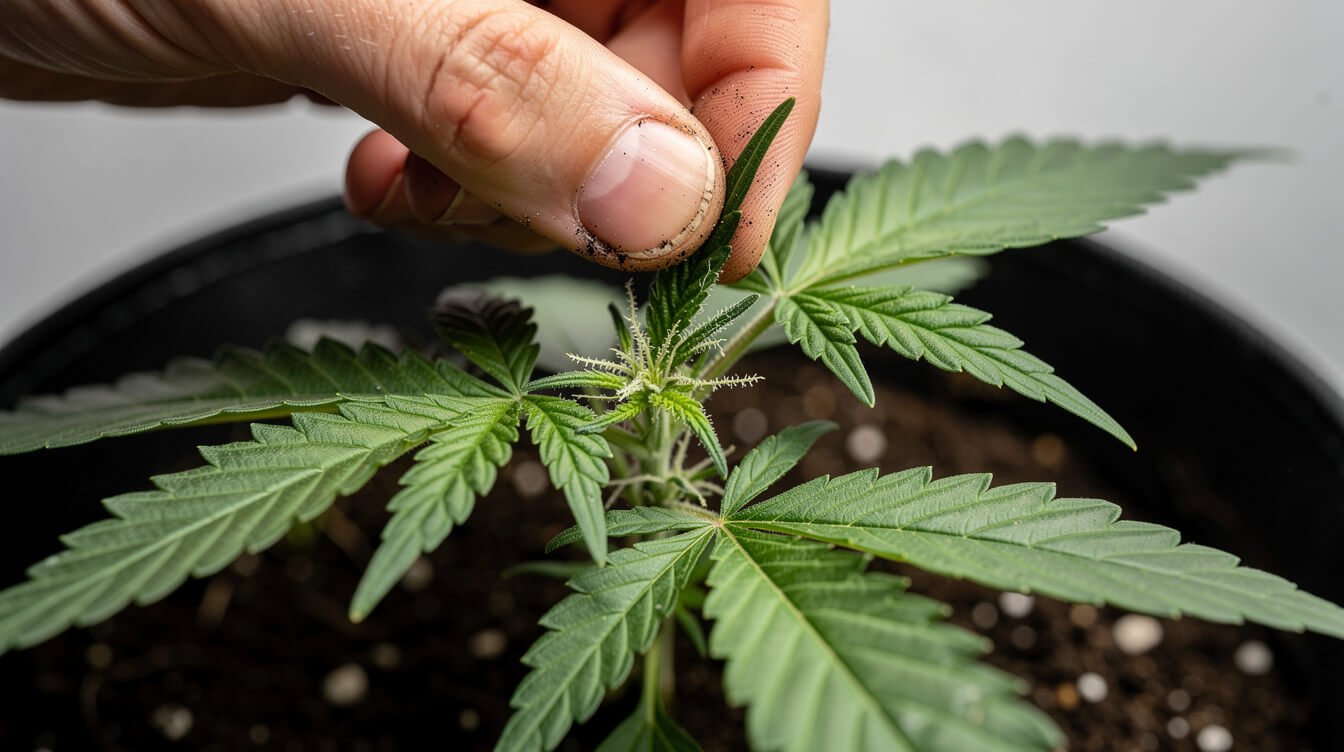
Short answer: no. Low stress training cannabis works fine on its own, and everything else is optional refinement — some of it a bad idea for a first grow. The clean distinction is whether you remove tissue. LST removes nothing: you reposition what’s already there and the plant barely registers it. High-stress training cuts, crushes, or strips, so the plant has to heal, which costs time and carries risk.
- Topping — snipping the growth tip above a node, so one cola becomes two. Mild, popular, well-understood, and it genuinely sets up a more symmetrical plant for LST. It costs a photoperiod plant a few days. Worth doing on your second grow; skip it on your first and skip it on autos.
- FIMming — a deliberately sloppy partial top aiming for three or four new tops instead of two. Results are less predictable. Fun to experiment with, not a foundation.
- Supercropping — pinching and crushing the inside of a stem so it folds over and heals into a thick knuckle. This is what you use when a branch is already too woody to bend. Effective and a bit nerve-racking; the stem will look ruined for two days.
- Defoliation — removing fan leaves to expose bud sites. The one most likely to cost a beginner real yield, because the leaves you’re pulling are the solar panels. A handful of leaves directly shading a bud site is reasonable; stripping a plant is not.
- Mainlining / manifolding — a heavily structured topping scheme that builds a symmetrical hub of eight or more even colas. Impressive, slow, and absolutely not a first-grow project.
The practical stack for most home growers: LST only on grow one. Add topping on grow two. Consider anything else on grow three, once you can read your plant well enough to know whether it’s recovering or sulking. Being able to tell the difference matters — if you’re not yet confident reading plant stress signals, our guide to fixing nutrient burn on cannabis is a decent primer on what a plant looks like when it’s unhappy versus merely busy.
When LST goes wrong, and how to fix it
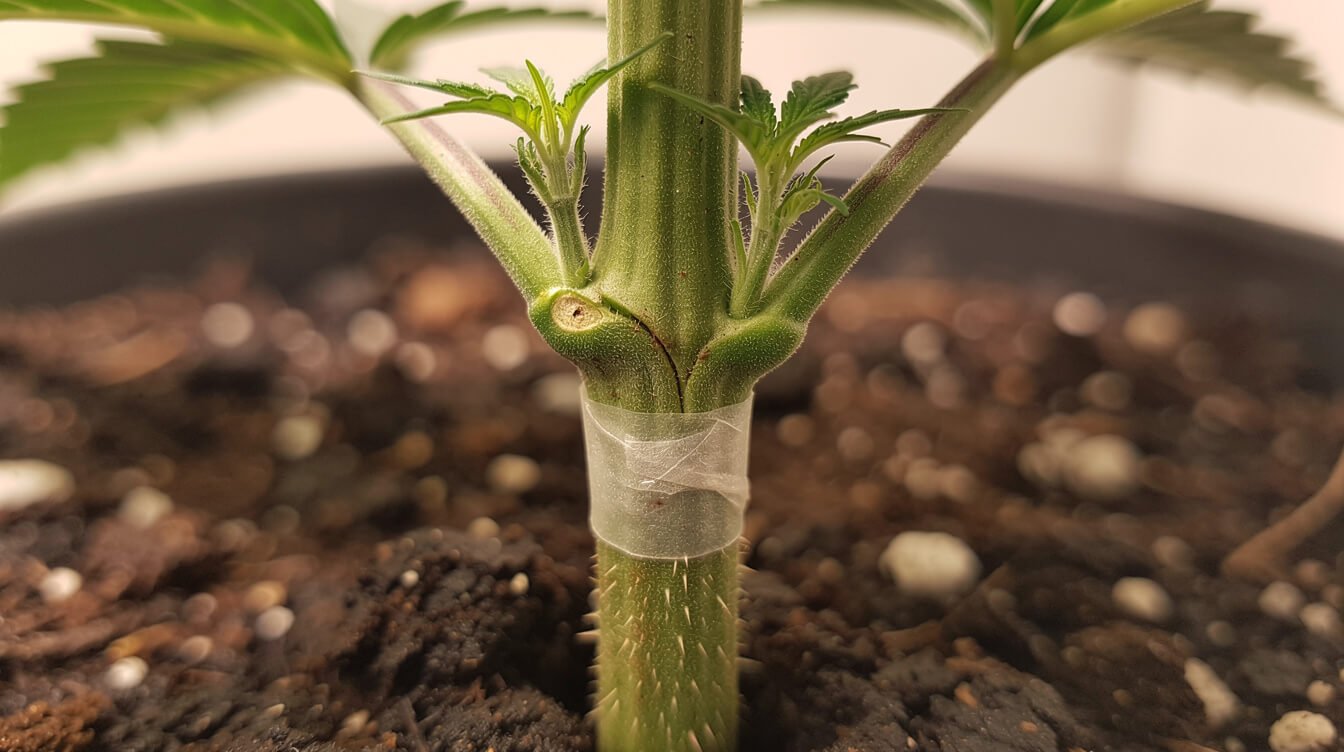
Somewhere in your first run of low stress training cannabis you will hear a crack. It is almost never the disaster it sounds like — cannabis is a weed, and it heals well. Here’s the triage.
You snapped a branch clean through
If there’s still any connected tissue, splint it: bring the two halves back into alignment and wrap the joint snugly with plant tape or a strip of duct tape. Support it so there’s no tension on the joint. Most breaks like this knit back together in about a week, often forming a thickened knuckle that’s stronger than the original stem. If it came off completely and the plant is still in veg, don’t throw it out — that’s a cutting, and our step-by-step guide to cloning a cannabis plant covers what to do with it.
The stem is pinched or crushed where you bent it
Tape it and leave it. A crushed bend heals into exactly the kind of knuckle supercroppers create on purpose. The branch above it may droop for a day or two. If the growth above stays firm, you’re fine.
A tie is cutting into the stem
This is the one that actually causes lasting damage, and it’s always from thin, hard material or a loop left on too long. Cut it off immediately, switch to coated wire, and tape over the wound if it’s broken the skin. Check for this every single time you’re in the tent — a stem can go from snug to strangled in a week of fast veg growth.
Branches are lifting the rootball or tipping the pot
You’ve anchored to something that can’t hold the tension. Move your anchor point: use holes in the fabric pot itself rather than tying across the soil surface, or push bamboo stakes deep into the medium near the pot wall. Never anchor to the stem of the same plant you’re pulling.
The canopy is lopsided
One side got all your attention. Tie the tall side down harder and leave the short side completely alone for a week. This self-corrects faster than you’d expect — whatever is highest grows fastest, so the short side catches up on its own once you stop favoring the tall one.
Your tied-down branches keep curling back up
That’s not failure, that’s the plant working. Branch tips reorient upward toward light within a couple of days — that’s the whole mechanism. Let them rise, then tie the new tall ones down. You’re not holding the plant in a shape; you’re repeatedly resetting what counts as “the top.”
Low stress training cannabis: frequently asked questions
Does low stress training actually increase yield?
Yes, meaningfully, when your light footprint is bigger than your untrained plant’s canopy — which is the usual situation for a single plant under a modern LED. The mechanism is better light distribution, not extra plant energy. Expect a real improvement in the proportion of dense bud to larf, not a doubled harvest.
How long does it take to see results from LST?
Three to five days to see side branches stand up after a bend. Two to three weeks to see a genuinely even multi-cola canopy. The payoff shows up at harvest as more dense bud sites rather than one top and a pile of popcorn.
Can I LST a plant that’s already in flower?
In the first couple of weeks of flower, light adjustments are fine — the plant is still stretching. After about week three, stop. Stems are brittle, buds are gaining weight, and there’s no veg time left to recover. Switch to supporting colas instead of bending them.
Do I need to top my plant before LST?
No. Topping makes the result a bit more symmetrical, but LST works perfectly well on an untopped plant and costs the plant nothing. Skip topping on your first grow, and skip it entirely on autoflowers.
What if my stem is too woody to bend?
Don’t force it — it’ll snap at the base, which is the one break that’s genuinely bad news. Woody lower stems are what supercropping is for: pinch and roll the stem between your fingers until you feel it soften, then fold it. Alternatively leave the main stem alone and train the younger, greener branches above it.
How often should I check a trained plant?
Every two to three days during veg and the flowering stretch. The job each time is thirty seconds of looking across the canopy, plus a finger-check under every tie to make sure nothing is tightening up.
Is LST worth it for outdoor plants?
Yes, for different reasons. Outdoors the sun moves, so light distribution is less of a problem — but height control is often a bigger one. Training plants flat and wide keeps them below a fence line and makes them far less conspicuous, which matters where plant-count and visibility rules apply.
Will training change the potency or effect of my harvest?
No. Cannabinoid and terpene content is driven by genetics, environment, and when you harvest — not by the plant’s shape. Training changes how much bud you get and how dense it is. For the harvest-timing half of that equation, read what trichomes are and how to read them.
The honest takeaway
Low stress training cannabis is the rare growing technique with a genuinely great ratio: five dollars of wire, ten minutes a week, no risk worth worrying about, and a better harvest from the light you already own. It’s also the technique most likely to get oversold to you, because the people writing about it mostly have clips or seeds to move.
So: start around the fourth node, bend down and away, keep the canopy flat, loosen your ties as stems thicken, stop at week three of flower, and switch to holding your colas up. Start earlier and gentler on autos, and don’t top them. If something cracks, tape it and move on — the plant has handled worse.
And when those flat, even colas do come down, the work isn’t over — the last of the quality is decided in the jars, which is what curing cannabis properly is for.
Grow one plant well, train it, and compare it to your last untrained one. That’s the only proof that’ll convince you anyway. Know your local laws, keep it 21+, and enjoy the slow part — watching a flat green canopy fill in is one of the better things about doing this yourself.
Before you go
Get the next explainer first
We publish a new one every day. The best of the week, plus what's new in the shop, lands in one short email.