VPD Chart for Cannabis: The Real Table, the Math Behind It, and the Leaf-Temperature Myth
Here is the honest answer first. A VPD chart turns two numbers you already measure, air temperature and relative humidity, into one number that tells you how hard the air is pulling water out of your plants. That number is vapor pressure deficit (VPD), measured in kilopascals (kPa). Growers aim low for clones (roughly 0.4 to 0.8 kPa), in the middle for veg (0.8 to 1.2), and higher for flower (1.2 to 1.6).
Now the nuance most VPD chart pages skip. Those stage bands are grower convention, passed from one vendor chart to the next, not the result of a cannabis trial. The chart itself rests on an assumption about leaf temperature that can move the reading more than the width of a whole stage band. And the research on leaf temperature says the “LED leaves run cooler” preset baked into many charts is shakier than it looks.
Below you get two computed VPD charts (every cell calculated, not copied from a vendor image), the formula with a worked example, what a cannabis humidity study actually found, and how to fix VPD in a dry winter grow room. Quick housekeeping before the science: home growing is legal in some places and not others, so check the laws where you live first. This guide is for adults 21 and up.
What a VPD chart actually tells you

Plants drink through their roots and “breathe out” water through tiny pores on their leaves called stomata. That outflow is transpiration, and it does real work. It pulls water and dissolved nutrients up the stem, and it cools the leaf. What drives it is the gap between the very wet air inside the leaf and the drier air outside it. VPD is the size of that gap.
Relative humidity can’t tell you this on its own, because warm air holds far more water than cool air. Michigan State University Extension puts it simply: the water-holding capacity of air roughly doubles with every 20°F rise. So 60% humidity at 68°F and 60% humidity at 84°F are very different rooms. The first is gentle, and the second pulls water out of leaves much faster.
VPD folds temperature and humidity into one number that tracks what the plant feels:
- Low VPD (humid air): transpiration slows. Water lingers on and in the leaf, and mold-friendly conditions build in dense canopies.
- High VPD (dry air): water leaves fast. Plants respond by partly closing their stomata to save water, which also cuts their CO2 intake and slows growth.
- In between: steady transpiration, open stomata, and the comfortable zone a VPD chart is trying to point you to.
The UN Food and Agriculture Organization’s crop-water handbook calls the vapor pressure deficit “an accurate indicator of the actual evaporative capacity of the air.” In plain words, it’s the drying power of your room. That is the whole idea, and everything else on a VPD chart is detail.
The VPD chart for cannabis (computed, two versions)

Find your air temperature on the left and your relative humidity across the top. The cell where they meet is your VPD in kPa. Every value below was calculated with the saturation vapor pressure equation from FAO Irrigation and Drainage Paper 56 (the formula is in the math section if you want to check us). The colors mark the conventional stage bands.
We give you two versions because the only real difference between VPD charts is the leaf temperature they assume. The first assumes the leaf is the same temperature as the air, so it’s what a basic hygrometer reading gives you. The second assumes the leaf runs 2°F (about 1°C) cooler, which is closer to what many vendor charts bake in.
| Air temp | 40% RH | 45% RH | 50% RH | 55% RH | 60% RH | 65% RH | 70% RH | 75% RH | 80% RH |
|---|---|---|---|---|---|---|---|---|---|
| 65°F (18°C) | 1.26 | 1.16 | 1.05 | 0.95 | 0.84 | 0.74 | 0.63 | 0.53 | 0.42 |
| 68°F (20°C) | 1.40 | 1.29 | 1.17 | 1.05 | 0.94 | 0.82 | 0.70 | 0.58 | 0.47 |
| 70°F (21°C) | 1.50 | 1.38 | 1.25 | 1.13 | 1.00 | 0.88 | 0.75 | 0.63 | 0.50 |
| 72°F (22°C) | 1.61 | 1.47 | 1.34 | 1.21 | 1.07 | 0.94 | 0.80 | 0.67 | 0.54 |
| 75°F (24°C) | 1.78 | 1.63 | 1.48 | 1.33 | 1.19 | 1.04 | 0.89 | 0.74 | 0.59 |
| 77°F (25°C) | 1.90 | 1.74 | 1.58 | 1.43 | 1.27 | 1.11 | 0.95 | 0.79 | 0.63 |
| 80°F (27°C) | 2.10 | 1.92 | 1.75 | 1.57 | 1.40 | 1.22 | 1.05 | 0.87 | 0.70 |
| 82°F (28°C) | 2.24 | 2.05 | 1.87 | 1.68 | 1.49 | 1.31 | 1.12 | 0.93 | 0.75 |
| 85°F (29°C) | 2.47 | 2.26 | 2.05 | 1.85 | 1.64 | 1.44 | 1.23 | 1.03 | 0.82 |
Very humid (under 0.4 kPa) Clones and seedlings (0.4–0.8 kPa) Veg (0.8–1.2 kPa) Flower (1.2–1.6 kPa) Very dry (1.6 kPa and up)
| Air temp | 40% RH | 45% RH | 50% RH | 55% RH | 60% RH | 65% RH | 70% RH | 75% RH | 80% RH |
|---|---|---|---|---|---|---|---|---|---|
| 65°F (18°C) | 1.12 | 1.02 | 0.91 | 0.81 | 0.70 | 0.60 | 0.49 | 0.38 | 0.28 |
| 68°F (20°C) | 1.25 | 1.13 | 1.01 | 0.90 | 0.78 | 0.66 | 0.55 | 0.43 | 0.31 |
| 70°F (21°C) | 1.34 | 1.21 | 1.09 | 0.96 | 0.84 | 0.71 | 0.59 | 0.46 | 0.34 |
| 72°F (22°C) | 1.43 | 1.30 | 1.16 | 1.03 | 0.90 | 0.76 | 0.63 | 0.49 | 0.36 |
| 75°F (24°C) | 1.59 | 1.44 | 1.29 | 1.14 | 0.99 | 0.85 | 0.70 | 0.55 | 0.40 |
| 77°F (25°C) | 1.70 | 1.54 | 1.38 | 1.22 | 1.06 | 0.91 | 0.75 | 0.59 | 0.43 |
| 80°F (27°C) | 1.88 | 1.70 | 1.53 | 1.35 | 1.18 | 1.00 | 0.83 | 0.65 | 0.48 |
| 82°F (28°C) | 2.00 | 1.82 | 1.63 | 1.44 | 1.26 | 1.07 | 0.88 | 0.70 | 0.51 |
| 85°F (29°C) | 2.21 | 2.00 | 1.80 | 1.59 | 1.39 | 1.18 | 0.98 | 0.77 | 0.57 |
Put the two VPD charts side by side and the takeaway jumps out. At 77°F and 60% humidity, the first chart reads 1.27 kPa, which lands in the flower band. The second reads 1.06 kPa, which is veg. Same room, same hygrometer, and a different stage depending on one assumption about the leaf. In the 70 to 80°F range, every 1°F the leaf runs cooler than the air takes roughly 0.1 kPa off the reading. Keep that rule of thumb handy. It lets you correct any VPD chart once you know your real leaf temperature (more on measuring it below).
A few honest notes on reading these tables:
- Round numbers are fine. Your hygrometer is probably accurate to about ±2 to 3% RH, which moves VPD by roughly 0.05 to 0.1 kPa. Chasing the second decimal is chasing noise.
- Measure at the canopy. A sensor by the tent door or down near the floor reads a different room from the one your leaves sit in.
- Read it lights-on and lights-off. The night reading is where most trouble hides. See the winter section.
How to read a VPD chart by growth stage

Here’s how each band is usually explained, and why it makes physical sense even though nobody has run the trial that would pin the exact numbers down. If you’re not sure which stage your plant is in, our guide to weed plant growth stages walks through how to tell.
Clones and seedlings: about 0.4 to 0.8 kPa
A fresh cutting has no roots, and a seedling has very few, so neither can replace water quickly. Humid air (low VPD) slows the water loss while roots form. That’s the whole job of a humidity dome, and it’s why our cannabis cloning guide keeps the dome at 70 to 80% humidity at 72 to 77°F. On the first VPD chart, that’s roughly 0.55 to 0.95 kPa, a little lower once leaves cool below air temperature. Greenhouse propagators of other crops go even lower: MSU Extension suggests around 0.3 kPa for rooting ornamental cuttings. Once roots show, open the dome gradually over a few days rather than all at once.
Vegetative growth: about 0.8 to 1.2 kPa
Rooted plants can move water, so you let the air get drier. A moderate deficit keeps transpiration, and with it nutrient flow, moving. In real rooms that usually means the low-to-mid 70s °F at 60 to 70% humidity, which reads about 0.8 to 1.2 kPa on the first chart.
Flowering: about 1.2 to 1.6 kPa
Buds get dense, and dense buds trap moisture. Drier air in flower is mostly about mold insurance. Growers commonly run the low-to-mid 70s °F at 45 to 55% humidity, which reads about 1.2 to 1.6 kPa on the first chart and a notch lower on the second. Sources disagree on the top of the band: some say 1.5 kPa, others 1.6. That disagreement is a clue that these numbers are rules of thumb, not measurements.
Late flower: hold the low humidity, watch the nights
The last two or three weeks are when bud rot strikes, so many growers drop humidity to around 40 to 45% and keep air moving through the canopy. At about 70°F that reads roughly 1.4 to 1.5 kPa, still inside the flower band. The daytime VPD matters less here than avoiding long, humid nights.
The honest caveat: these stage bands repeat from one vendor chart to the next with small changes, but we couldn’t find a cannabis trial that tested, say, 1.0 against 1.4 kPa in flower. Treat them as a sensible starting point, not a law, and be skeptical of any VPD page that promises a specific percent yield increase. We found no published cannabis study behind those numbers.
The math: how to calculate VPD yourself

You don’t need an app. You need one formula and a calculator with an ex key. The formula below is the one FAO-56 uses (Equation 11 in its chapter on meteorological data), and it’s the same Tetens-style form most VPD calculators use under the hood.
Step 1: saturation vapor pressure (how much water the air could hold)
SVP (kPa) = 0.6108 × e(17.27 × T) / (T + 237.3), with T in °C.
Step 2: actual vapor pressure (how much water it does hold)
AVP = SVP(air) × RH ÷ 100
Step 3: the deficit
Air VPD = SVP(air) − AVP. For leaf VPD, swap in the leaf temperature for the first term: Leaf VPD = SVP(leaf) − AVP(air).
Worked example: 77°F at 60% humidity
- Convert to Celsius: 77°F = 25°C.
- Exponent: 17.27 × 25 = 431.75, and 25 + 237.3 = 262.3. 431.75 ÷ 262.3 = 1.646.
- e1.646 = 5.186, and 0.6108 × 5.186 = 3.168 kPa (the SVP at 25°C).
- AVP = 3.168 × 0.60 = 1.901 kPa.
- Air VPD = 3.168 − 1.901 = 1.27 kPa.
- Now say your IR thermometer reads the leaves at 23°C (73.4°F). SVP at 23°C = 2.809 kPa, so leaf VPD = 2.809 − 1.901 = 0.91 kPa.
That last step is the one that matters. A 2°C (3.6°F) cooler leaf took a “flower” reading down to a “veg” reading. To sanity-check the method, we ran FAO-56’s own worked example (24.5°C gives 3.075 kPa) and three values from MSU Extension’s published table (60°F, 75°F, and 90°F at 70% RH: 0.53, 0.89, and 1.44 kPa against their 0.55, 0.90, and 1.45). All of them match within rounding. One row of that same MSU table doesn’t compute, though. It lists 75°F at 41% RH as 1.38 kPa, but the formula gives about 1.75 kPa (1.38 at 75°F works out to about 53% RH). Even good tables have typos, which is another reason to know the math.
GanjaTech, weekly
Cannabis, explained. In your inbox.
One email a week: the clearest explainers, honest gear picks, and what the science actually says. 21+ only. No spam, unsubscribe anytime.
Leaf temperature: why the 2-degree preset can be wrong
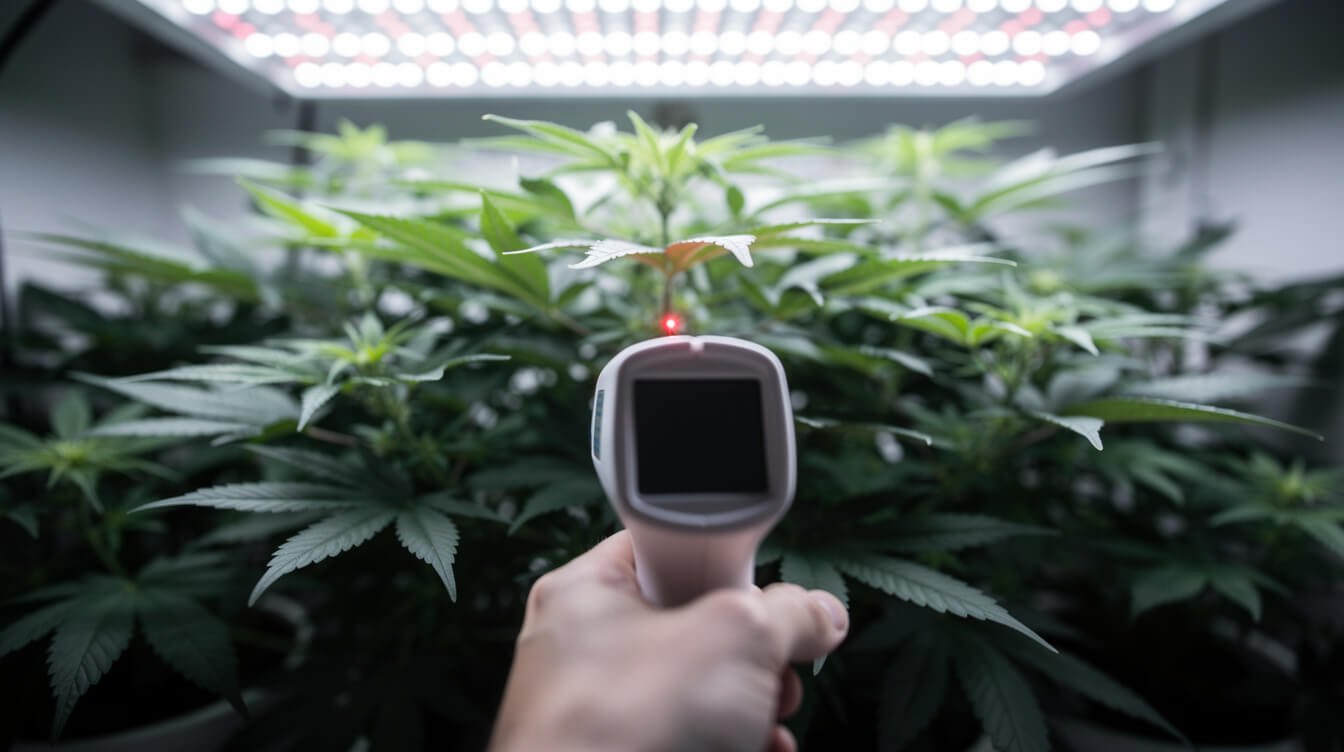
Look at the VPD charts that rank for this search and you’ll see them disagree on the leaf offset. One uses 1°C cooler than the air, another defaults to 2°C cooler, and a third says 2 to 5°F cooler “under most lights.” Many add that LED lights mean cooler leaves, so you should use a bigger offset. Here’s what the research says.
Two crop physiologists at Utah State University, Jacob Nelson and Bruce Bugbee, modeled leaf temperature under four light sources: open-field sun, a glass greenhouse, high-pressure sodium (HPS), and LED (Nelson & Bugbee 2015, PLoS One). Their findings, at equal light intensity:
- Water status beats lamp type. “The effect of plant water status and leaf evaporative cooling is much larger than the effect of radiation source.”
- Unstressed leaves stay close to the air. If plants are not water stressed, leaves under all four sources “were typically within 2°C of air temperature.”
- LEDs help a little, not a lot. LED fixtures shed more of their heat by convection, so leaves run “slightly cooler,” but the effect “is smaller than is often assumed.”
- Stressed leaves can run much hotter than the air. In their near-worst case (water stress, little air movement), the model put leaves about 8°C above air under LED and 12°C above under HPS.
Two caveats keep this honest. It’s an energy-balance model checked against measured radiation, not a cannabis grow trial. And “within 2°C” means within 2°C either way, not “always 2°C cooler.” The takeaway for your tent: a preset offset is a guess, and the guess can point in the wrong direction. A thirsty plant, a crowded canopy with no airflow, or a light hung too close can push leaves above air temperature. A VPD chart that assumes cooler leaves will then tell you the air is gentler than it really is.
How to get your real leaf offset
- Use a basic infrared (IR) thermometer. Leaves emit close to the 0.95 emissivity most IR guns default to.
- Measure the tops of a few upper-canopy leaves in full light, held close so the spot covers leaf only, not the pot or the tent wall.
- Read the air temperature at the same height, then average a few readings.
- Subtract. If the leaves read about the same as the air, use the first VPD chart. If they read about 2°F cooler, use the second. Anything else, apply the ~0.1 kPa-per-°F rule or run the formula.
If your leaves read warmer than the air, don’t just fix the VPD number. Check the plant first. Look at watering, airflow, and light distance.
What happens when VPD is off

A VPD chart is only useful if being outside the colors actually costs you something. Here’s what the evidence shows, from strongest to weakest.
Too low (too humid): the one cannabis study
The clearest cannabis data comes from Colorado State University-Pueblo (Corredor-Perilla et al. 2025, Frontiers in Plant Science). Researchers grew one CBD-dominant cultivar, Cherry Berry, at either low humidity (37 to 58%) or high humidity (78 to 98%), with 10 plants per group. In flower, the high-humidity room ran a VPD of just 0.25 to 0.62 kPa. Compared with the low-humidity plants, the high-humidity plants had:
- 71% less flower biomass and 75% less total biomass
- flowering delayed by about three weeks
- CBDA (the acid form of CBD) about 4.9 times lower
Those are big numbers, so read them carefully. This was one cultivar, a small sample, and a very wide gap: 78 to 98% humidity is a swamp, not a slightly-too-humid tent. It shows that badly low VPD hurts cannabis. It doesn’t show that 0.9 kPa beats 1.1 kPa.
Too low: the mold angle
The mold link is better established. A three-year study of more than 2,000 greenhouse cannabis samples at Simon Fraser University found that higher temperature and relative humidity in the bud microclimate raised yeast and mold counts. Air circulation from fans during flowering lowered them (Punja et al. 2023, Frontiers in Microbiology). That’s why low VPD in late flower is the classic setup for bud rot. If you’ve already found something fuzzy, our guide to what moldy weed looks like shows how to tell mold from trichomes.
There’s a nutrient angle too. Calcium travels mostly in the transpiration stream, so very humid air can short fast-growing tissue on calcium even when the root zone has plenty. Greenhouse lettuce growers know this as tipburn. It’s one reason a “calcium deficiency” in a humid tent sometimes turns out to be a VPD problem.
Too high (too dry)
When the air gets very dry, plants partly close their stomata to save water. That also limits the CO2 they take in, so growth slows even under strong light. You’ll see it as leaf edges curling up (“tacoing”), plants drooping in moist soil during the light period, and pots drying out unusually fast. Very high VPD also stresses fresh clones and seedlings far more than established plants, which is why the bands start low.
Fixing VPD in winter
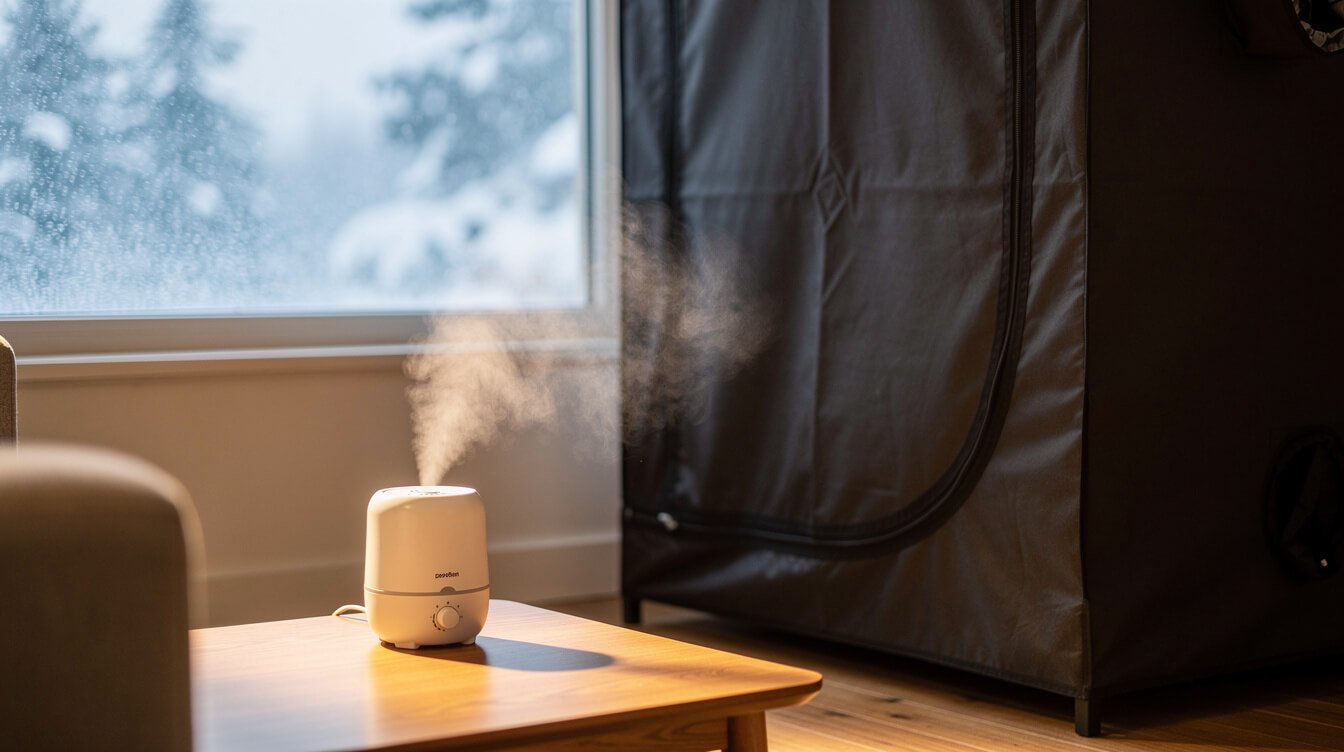
Winter flips the usual problem. Cold outdoor air holds very little water, and when your furnace warms it up, the relative humidity collapses. Run the numbers: 30°F outdoor air at 70% humidity, heated to 77°F with no added moisture, drops to about 12% RH. That’s a VPD near 2.8 kPa, off the top of every VPD chart. Real homes add moisture from cooking, showers, and people, so you’ll usually read higher than that. But it’s why winter grow rooms often run drier than the hygrometer you trusted in summer suggests.
Lights on: add water to the air, or lower the heat
- A humidifier on a humidistat. Ultrasonic units are cheap and effective. Use distilled or low-mineral water, because tap water can leave a fine white mineral dust on leaves and gear.
- Drop the temperature a little. Cooler air holds less water, so the same moisture reads as higher RH and a lower VPD. On the first chart, going from 80°F to 75°F at 45% humidity takes you from 1.92 to 1.63 kPa.
- Slow the exhaust if your fan controller allows it, while keeping enough air exchange for heat and odor. Pulling in bone-dry room air faster pushes VPD up.
- More leaf area raises humidity. A full canopy transpires a lot, so small plants in a big tent are the hardest to keep humid.
Lights off: the dew point trap
Night is where winter grows get into trouble, and it’s the opposite problem. Say your tent sits at 78°F and 45% with the lights on. Turn the lights off, let it fall to 68°F, and that same air now reads about 63% RH before the plants add anything. Plants keep transpiring for a while in the dark, so it climbs from there. If any surface cools to the dew point (about 55°F for that air), water condenses on it. UMass Extension’s greenhouse guidance notes that condensation forms on the coldest surfaces first, and that moisture “promotes the germination of fungal pathogen spores such as Botrytis.”
- Keep the lights-off drop modest. A drop of about 10°F or less is a common target. A small space heater on a thermostat can hold the floor.
- Run the dehumidifier and exhaust through the dark period. Turning the humidifier off at lights-off is often half the fix.
- Keep air moving through the canopy, not just over it, so leaf surfaces don’t sit colder than the air around them.
- Keep tents off cold exterior walls and bare concrete floors in the coldest months.
The same humidity discipline carries into harvest. Our guide on how to dry cannabis covers the 50 to 55% drying-room target and why the first 48 hours matter most.
VPD chart FAQ
What is a good VPD for flowering?
The common target is about 1.2 to 1.6 kPa, with many growers drifting toward the drier end in late flower to protect dense buds from mold. In practice that’s the low-to-mid 70s °F at roughly 45 to 55% humidity, then about 40 to 45% late. The exact numbers are convention, so the bigger win is avoiding long, humid nights.
What does a VPD chart for veg look like?
Use the same VPD chart and target the green 0.8 to 1.2 kPa cells. On the first chart, that’s roughly 60 to 70% humidity in the low-to-mid 70s °F, or about 55 to 60% if your room runs closer to 68 to 70°F.
Does VPD matter in soil?
Yes. VPD describes the air around the leaves, so it applies whether your roots are in soil, coco, or water. What the root medium changes is how fast a pot dries out once transpiration gets going. Fast-draining mixes in a high-VPD room may need water more often. Our breakdown of the best soil for weed covers how mixes differ in water holding.
Should I use air VPD or leaf VPD?
Leaf VPD is what the plant actually feels, but only if you measure leaf temperature. A guessed offset can be worse than none. If you don’t own an IR thermometer, the air chart plus a healthy plant is a fine way to grow.
Do autoflowers need a different VPD chart?
Not that anyone has shown. Autoflowers move through the same stages faster, so the same bands apply. You just move through them on a shorter calendar.
Final thoughts
A VPD chart is a good tool with a misleading amount of precision. The physics is solid. The drying power of the air really does drive how fast your plants move water, and temperature and humidity really do need to be read together. The stage bands are reasonable conventions, and the cannabis humidity data shows that truly swampy air costs you a lot.
The weak link is leaf temperature. Measure it once, pick the chart that matches, and you’ll be ahead of most growers squinting at a vendor image. Watch the nights, hold steady bands instead of chasing decimals, and let the plant have the last word: perky, evenly green leaves beat a perfect number every time.
New to all of this? Our guide on how to grow cannabis indoors sets up the tent, light, and airflow basics that make every VPD chart easier to hit. And as always: know your local laws, keep it 21+, and grow responsibly.
Before you go
Get the next explainer first
We publish a new one every day. The best of the week, plus what's new in the shop, lands in one short email.