How Long Does a Weed High Last? Smoking vs Vaping vs Edibles, Plus the Clock That Matters for Driving
How long does a weed high last? Smoked or vaped, the main high usually runs 1 to 3 hours, with lighter effects that can trail on for a few more. Eaten, it’s a different animal: edibles take 30 to 60 minutes to start, peak around 1.5 to 3 hours, and run 6 to 8 hours or longer. That’s the honest short answer. The nuance most sites skip is that “how long the high lasts” and “how long you’re impaired” are two different clocks, and the second one runs longer.
Look around online and you’ll find the same question answered with 1–3 hours, 1–4 hours, 1–6 hours, and 2–10 hours, sometimes all on the same page. None of those numbers are exactly wrong. They’re just measuring different things, for different people, after different doses. So this guide goes to the source: the controlled studies where researchers dosed adults with a known amount of THC and watched the clock. Here’s what they found, method by method, plus what changes the timeline, when it’s actually safe to drive, and what really helps you come down.
How long does a weed high last? The short answer by method
The single biggest factor is how the THC gets into you. When you inhale it, THC crosses from your lungs into your blood in minutes. When you eat it, it has to go through your gut and liver first, which slows everything down and stretches everything out. Here’s the measured picture:
| Method | Kicks in | Peaks | Main high | Can linger |
|---|---|---|---|---|
| Smoking (joint, pipe, bong) | Within minutes | Around 10–30 minutes | 1–3 hours | Some effects up to ~6 hours |
| Vaping flower or carts | Within minutes | Around 10–30 minutes | 1–3 hours, often stronger than smoking the same dose | Some effects up to ~6 hours |
| Dabs and concentrates | Seconds to minutes | Fast, like smoking | 1–3 hours, longer at big doses | Longer for low-tolerance users |
| Edibles and drinks | 30–60 minutes (up to 2 hours) | 1.5–3 hours | 6–8 hours | Up to 12 hours; residual effects up to 24 |
| Tinctures (swallowed) | Behaves like an edible | Like an edible | Like an edible | Like an edible |
Two things to keep in mind when you read that table. First, these are typical ranges for adults at moderate doses, not promises. A big dose, a low tolerance, or an empty stomach can push you to the long end of every column. Second, the “can linger” column matters more than it looks. The fun part of the high fades before your reaction time and coordination fully come back. We’ll get into that in the driving section, because it’s the part people get wrong most often.
If you’re brand new, the practical takeaway is simple: block off a few hours for inhaled cannabis and most of a day for an edible, and don’t make plans that need a clear head until well after you feel normal.
Smoking and vaping: the inhaled timeline
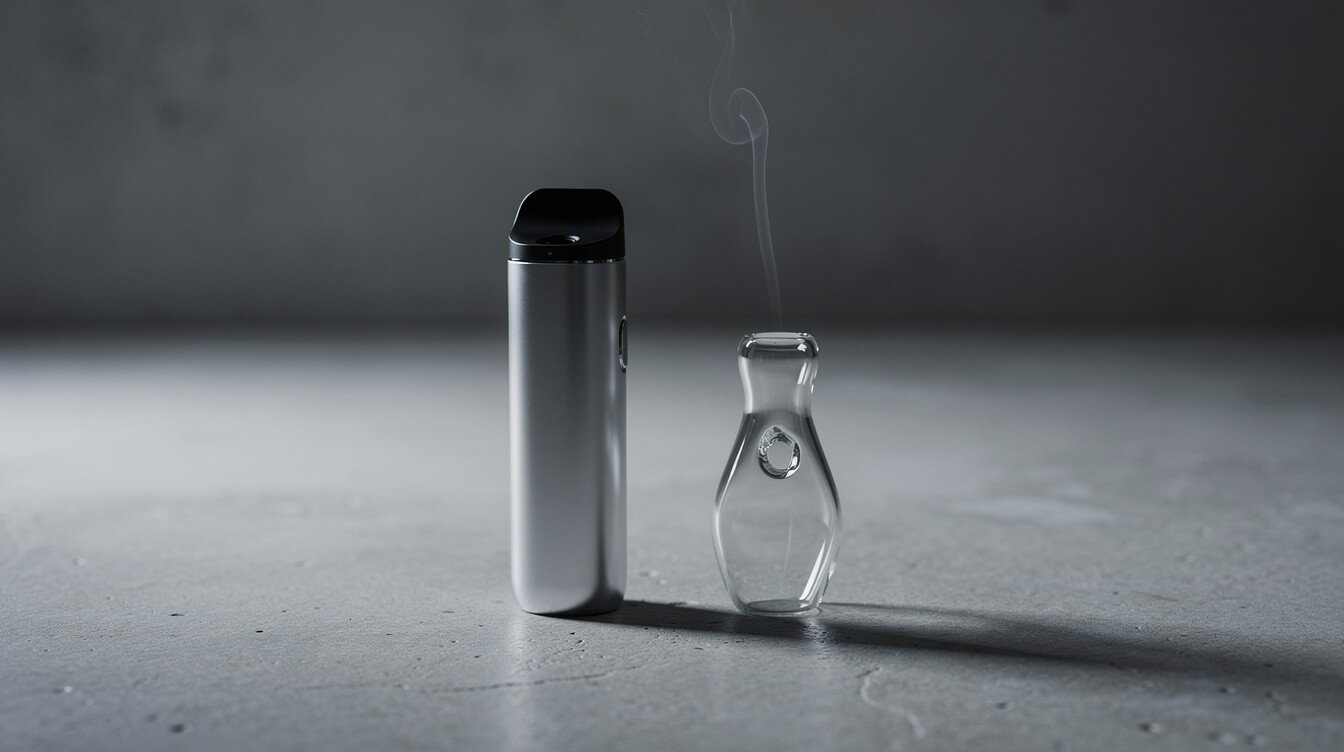
The best measured data on inhaled cannabis comes from a 2018 Johns Hopkins crossover trial published in JAMA Network Open. Seventeen healthy adults who hadn’t used cannabis in over a month smoked and vaped cannabis containing 0, 10, or 25 mg of THC across separate sessions, and researchers tracked them for hours afterward (Spindle et al., 2018).
Here’s what the clock looked like:
- Blood THC and heart rate peaked within 30 minutes of inhaling, then returned to baseline within 3 to 4 hours.
- Several subjective effects and measurable impairments lasted up to 6 hours on average. In other words, the effects outlasted the blood levels.
- 10 mg was noticeable but modest. People could tell they’d had cannabis, with mild cognitive effects.
- 25 mg was a lot for these occasional users, with strong effects, more side effects, and pronounced impairment of cognitive and psychomotor skills.
For a sense of scale, 25 mg of THC is roughly what’s in an eighth of a gram of 20% flower. That’s a modest bowl, not a monster session. Most people lose some THC to sidestream smoke and exhaled breath, so the dose you actually absorb is lower than what’s in the flower, but the point stands: a “normal” amount for a regular smoker can be a big amount for someone who rarely uses.
Why vaping can hit harder than smoking
The same Hopkins study found something that surprises a lot of people. At equal doses, vaping produced stronger effects than smoking, and higher peak blood THC (at 25 mg: 14.4 ng/mL vaped versus 10.2 ng/mL smoked). A vaporizer wastes less THC to combustion and sidestream smoke, so more of the dose actually reaches you. If you’re switching from joints to a vape, start with fewer puffs than you think you need.
Carts work the same way, just with oil instead of flower. A cart high isn’t magically shorter or longer than a flower high. What changes is how much THC you get per puff, which is usually more, and how easy it is to keep hitting it without noticing. That’s how people end up in blinker territory before they’ve realized how high they already are.
The inhaled timeline, minute by minute
For a moderate inhaled dose, the arc usually goes like this. You feel it within a few minutes. It builds for 10 to 30 minutes. You’re at your highest for roughly the first hour. Then it slowly tapers through hours two and three, often ending in a heavier, sleepier stretch. By hour three or four, most people feel close to normal, even though some measurable effects can hang around past that.
Edibles, drinks, and tinctures: the slow, long timeline
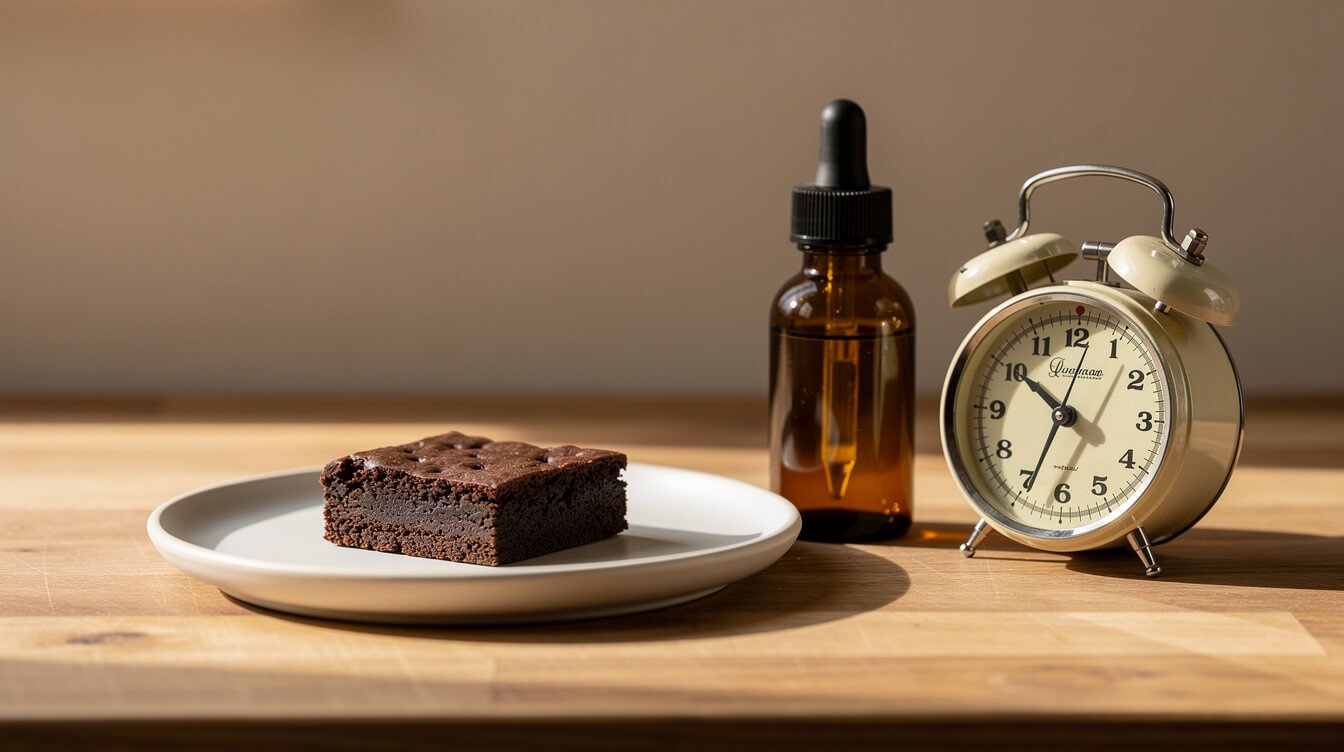
Eating cannabis changes the whole shape of the high. The best numbers again come from Johns Hopkins, where healthy adults ate brownies containing 10, 25, or 50 mg of THC:
- Effects didn’t show up until 30 to 60 minutes after eating, at every dose (Schlienz et al., 2020).
- Effects peaked 1.5 to 3 hours after eating.
- Subjective and performance effects lasted 6 to 8 hours (Vandrey et al., 2017).
One detail matters. Those studies stopped measuring at hour 8. So “6 to 8 hours” is what fit inside the observation window, not proof that everything is gone at hour eight. At bigger doses, it often isn’t.
Why so long? When you swallow THC, your liver converts a good chunk of it into 11-hydroxy-THC, an active metabolite. Meanwhile, absorption from your gut is slow and drawn out, so there’s no sharp spike and fast drop like there is with inhaling. The result is a slower start, a later peak, and a long tail. We’ve covered the full hour-by-hour edible arc, including why the 60-minute redose is such a common mistake, in how long edibles last, so we won’t repeat all of it here.
Drinks and tinctures
Cannabis drinks are still edibles. Some brands use emulsions designed to kick in faster, and many people do report a quicker start, but you’re still swallowing THC, so plan for an edible-length day rather than a joint-length afternoon.
Tinctures are the same story. Most of a tincture dose ends up swallowed, even if you hold it under your tongue, and a controlled study comparing a sublingual spray with oral THC didn’t find the sublingual route kicking in faster. We go deep on that in our cannabis tincture guide. The planning rule is the same: treat a tincture like an edible, and wait at least 2 hours before you even think about more.
Dabs and concentrates: faster, stronger, not always longer
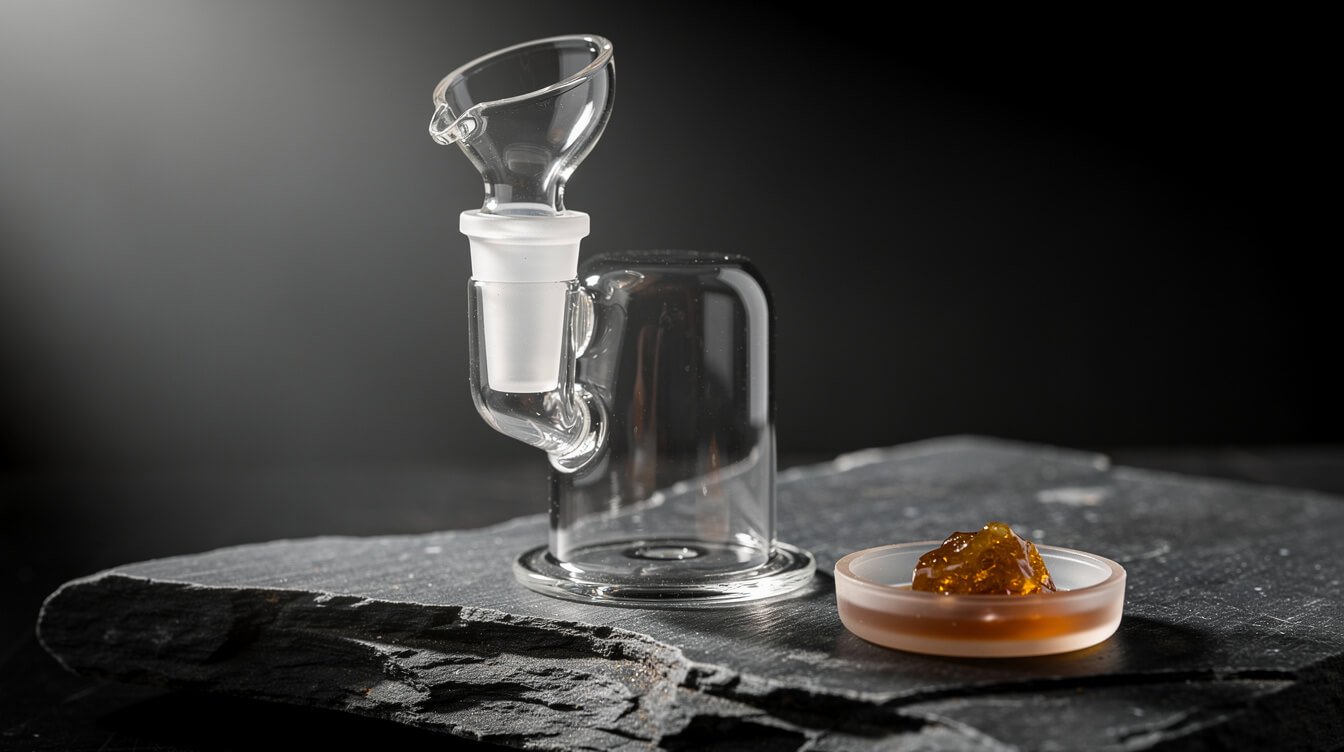
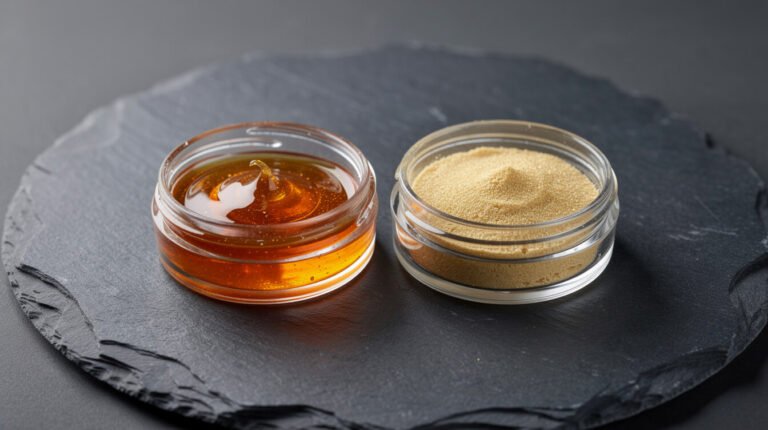
Dabs are inhaled, so the timing follows the inhaled curve. You feel it within seconds to minutes, and it peaks fast. What changes is the dose. A single dab of a 70–90% THC concentrate can carry far more THC than a few hits of flower, so for many people the high feels bigger and stretches toward the long end of the range. If you’re curious what a dab actually is and how it’s taken, our dabbing explainer covers the basics.
Here’s the interesting part. A 2020 University of Colorado study in JAMA Psychiatry followed 121 regular users who used their own legal-market products: flower users on 16% or 24% THC flower, and concentrate users on 70% or 90% concentrates (Bidwell et al., 2020). The concentrate users ended up with much higher blood THC. Yet the measured impairment, mostly in delayed verbal memory and balance, didn’t differ by product type or potency.
That doesn’t mean dabs are “the same as flower.” It means experienced users tend to self-titrate. They take what they’re used to and stop. The risk with concentrates sits with people who aren’t used to them: a newcomer who takes a full dab is taking a dose that would knock out a lot of seasoned flower smokers. If that’s you, start with a tiny amount and wait 15 minutes before deciding you need more.
One caution worth repeating: the Colorado study only measured people up to an hour after use. It tells you how intoxicated people were, not how long that lasted. Don’t read it as “dabs wear off as fast as a joint.”
GanjaTech, weekly
Cannabis, explained. In your inbox.
One email a week: the clearest explainers, honest gear picks, and what the science actually says. 21+ only. No spam, unsubscribe anytime.
What makes a weed high last longer or shorter
Route sets the basic shape. After that, five things move the needle.
1. Dose
This is the big one. In every controlled study above, higher doses produced stronger and longer effects. Twice the THC doesn’t just feel twice as strong. It also stretches the tail. If you want a shorter high, the most reliable lever is simply taking less.
2. Tolerance
Regular use blunts both the high and the impairment. A study that gave frequent smokers (4+ times a week) and occasional smokers (under twice a week) the same 6.8% THC joint found that the occasional smokers struggled noticeably more on tracking and divided-attention tasks, suggesting partial tolerance in the frequent group (Desrosiers et al., 2015). A 2021 meta-analysis landed in the same place: regular users showed less impairment than occasional users overall.
That’s why a daily user and a first-timer can smoke the same joint and walk away with completely different afternoons. So how long does a weed high last for a heavy user? Often shorter and flatter, which is exactly what drives people to use more. If your high has gotten noticeably shorter over the months, that’s tolerance, and the honest fix is a tolerance break, not a bigger dose.
3. Food
For inhaled cannabis, a full stomach doesn’t change much. For edibles, it matters more: what’s in your stomach can change how quickly and how completely THC gets absorbed, which shifts both the start time and how intense the peak feels. The practical rule is consistency. If you’ve learned how a particular dose hits you after dinner, an empty-stomach version of the same dose may land differently.
4. Alcohol
Mixing makes the high stronger and longer. In one controlled study, drinking a low dose of alcohol 10 minutes before vaping significantly raised peak blood THC compared with vaping alone (Hartman et al., 2015). Even when the order is reversed and blood THC doesn’t change, combined impairment is worse and lasts longer. We break down the research in weed and alcohol. Short version: crossfading doesn’t just add up, and it’s a common route to greening out.
5. CBD (not the off-switch it’s sold as)
You’ll often read that CBD “balances out” THC and makes the high gentler or shorter. The controlled evidence doesn’t back that up. In a trial with 46 infrequent users, adding CBD to vaped THC at 1:1, 2:1, and 3:1 ratios didn’t significantly change THC’s effects on memory, mood, or anything else measured (Englund et al., 2023). And in an oral study, a brownie with 20 mg THC plus a large 640 mg dose of CBD actually raised blood THC levels and produced more anxiety, sedation, and impairment than the same THC alone (Zamarripa et al., 2023).
Body and metabolism
Body size, liver enzymes, sleep, and genetics all play a role too. They’re real but hard to predict, which is why two people at the same table can have very different nights. If a dose surprised you once, believe it next time.
Feeling sober isn’t the same as being unimpaired
This is the section we’d most want a friend to read. The moment you stop feeling high is not the moment your reaction time, tracking, and attention are back to normal. Those skills recover on a slower clock.
The clearest data comes from a 2021 systematic review and meta-analysis out of the University of Sydney’s Lambert Initiative, which pooled 80 studies and 1,534 performance outcomes (McCartney et al., 2021). The key findings:
- After inhaling 20 mg of THC, most driving-related skills recovered within about 5 hours, and almost all within about 7 hours.
- Oral THC impairment may take longer to clear.
- The authors’ bottom line: wait at least 5 hours after inhaled cannabis before safety-sensitive tasks like driving.
In the university’s own summary of the study, the researchers put the overall “window of impairment” at 3 to 10 hours for moderate to high doses. A more typical duration was around 4 hours after lower inhaled doses on simpler tasks, stretching to 6 or 7 hours after higher inhaled doses on complex tasks like driving. High oral doses could stretch to 10 hours. They also noted that a “moderate” dose for a regular user can be a high dose for an occasional one.
Line that up with the earlier numbers and the gap is obvious. The main inhaled high is 1 to 3 hours. The safe-to-drive window starts at 5. With an edible, you’re looking at the whole day, and a late-evening edible can still be in play the next morning.
The rule we’d actually live by: if you smoked or vaped, don’t drive for at least 5 hours, and longer after a big session. If you ate it, don’t drive that day. Feeling fine isn’t the test.
A note on the law: rules on cannabis and driving vary a lot by state and country, and some places use blood-THC limits that don’t line up neatly with how impaired you feel. Don’t try to calculate your way around a legal limit. Plan your ride before you start. And if you’re wondering about drug tests rather than impairment, that’s a third clock entirely, covered in how long weed stays in your system.
Coming down: what actually helps (and what’s folklore)
There’s no button that switches a high off. Your body clears THC on its own schedule. What you can do is make the ride smoother while you wait.
What helps
- Time, honestly. If you smoked, the worst of it is usually behind you within an hour or two. If you ate it, settle in. Knowing it will pass is half the battle.
- A calm setting. Lower the lights, put on something familiar, and step away from anything stressful. Uncomfortable highs feed on overstimulation.
- Water and a snack. Dry mouth is real, and eating something light can help you feel more grounded. Plan the snack ahead, because the munchies are well documented.
- Slow breathing. If your heart is racing, a few minutes of slow breaths can take the edge off the anxious feeling.
- Sleep. If it’s late, lying down is a perfectly good plan. Most people wake up feeling clearer.
- Stop using. More cannabis won’t “level you out,” and alcohol will make it worse.
What’s folklore
You’ve probably seen the tip to sniff or chew black peppercorns, eat pine nuts, or sip lemon peel to come down. Those tips trace back to a 2011 review in the British Journal of Pharmacology that discussed terpenes like caryophyllene, pinene, and limonene as possible “antidotes” to THC, partly based on folk remedies and lab pharmacology (Russo, 2011). It’s an interesting hypothesis paper, not a human trial. We couldn’t find a controlled study showing that sniffing pepper shortens a high. Smelling pepper won’t hurt you. Just don’t count on it.
The CBD trick falls in the same bucket, as covered above. At the ratios people actually use, controlled trials haven’t shown CBD reliably taking the edge off THC, and at large oral doses it can make things more intense.
When to get help
Most bad highs are miserable but not dangerous. Get medical help if someone has chest pain, trouble breathing, a seizure, can’t stay awake or be woken, or might have taken something other than cannabis. If a child or pet got into an edible, call Poison Control at 1-800-222-1222 in the US right away. For the full rundown on getting too high, see our guide to what greening out is and what helps. And if a high feels nothing like weed usually feels, our laced weed explainer covers what labs have actually found.
How long does a weed high last? Quick answers to common questions
How long does a weed high last from one hit?
For one modest hit of flower, most people feel it for roughly 30 minutes to an hour and a half, with a gentle taper after that. One hit from a strong cart or a dab can carry a lot more THC, so it can last longer and hit harder. If you rarely use, even “one hit” can feel like plenty.
How long does a cart high last compared with flower?
About the same shape: minutes to kick in, a 1-to-3-hour main high. The difference is dose per puff. Cart oil is usually far more concentrated than flower, so it’s easier to take more than you meant to, and that’s what makes a cart high feel longer.
Is a “weed hangover” real?
Sort of, and the research is mixed. A 1985 study found small changes in mood ratings and time estimation the morning after (about 9 hours after smoking) in 13 men who’d smoked low-potency cannabis the night before (Chait et al., 1985). A 1990 follow-up with regular smokers found no residual high and nothing like an alcohol-style hangover (Chait, 1990). Both used much weaker cannabis than today’s. So feeling foggy the next day after a big night, or a late edible, is plausible. Sleep, water, and a real breakfast are the sensible play.
What happens if you go to sleep high?
For most adults, nothing dramatic. You’ll likely fall asleep easily and wake up when you normally would. Sleeping is a fine way to ride out a high. Just stay off the road the next morning if you took a large edible late at night, since oral THC can still be working when your alarm goes off.
How do I make a high last longer?
The honest answer is a bigger dose or an edible, and neither is something we’d push. Chasing a longer high usually ends in an uncomfortable one. If your high feels shorter than it used to, that’s tolerance talking. A break will do more than another hit. If you do want a longer experience, a small, measured edible is the predictable route. Start low, and don’t redose for at least 2 hours.
Why does a weed high feel shorter than it used to?
Tolerance. Frequent use blunts both the effect and the impairment, as the studies above show. The fix is time off, not more THC. Our T break guide covers how long a reset really needs to be.
Is weed relaxing or energizing while you’re high?
It depends heavily on dose. Lower doses tend to feel lighter and more social, and higher doses tend to feel heavy and sedating. We unpack that dose flip in is weed a stimulant or depressant.
Final thoughts
So, how long does a weed high last? Plan on 1 to 3 hours for smoking or vaping, with effects that can trail toward 6. Plan on 6 to 8 hours or more for edibles, drinks, and swallowed tinctures. Dabs follow the fast curve but bring a much bigger dose. Dose and tolerance stretch or shrink all of it, and alcohol stretches it further.
The number that matters most isn’t how long you feel high. It’s how long you’re impaired. Give inhaled cannabis at least 5 hours before driving, and give an edible the rest of the day. Start low, wait longer than feels necessary, and know the rules where you live, because they vary. This guide is for adults 21 and over, and it’s education, not medical advice. If you have health questions about cannabis, a doctor is the right call.
Respect the plant, respect the clock, and you’ll have a much better time with both.
Before you go
Get the next explainer first
We publish a new one every day. The best of the week, plus what's new in the shop, lands in one short email.