What Is CBN? Cannabinol, the Aged-THC Cannabinoid, and What the Sleep Trials Actually Found
What is CBN? It’s cannabinol, the compound THC turns into as it ages. Leave cannabis exposed to air, light, and warmth long enough and some of its THC slowly converts to CBN, which is why old flower tends to have more of it. CBN is far milder than THC, and almost everything you’ve heard about it as “the sleepy cannabinoid” comes from marketing that got well ahead of the research.
That’s the short version. The longer one is more interesting, because 2026 brought something the CBN conversation never had before: a proper sleep-lab trial. Below we cover what CBN is chemically, how it forms, whether it gets you high, what the two modern human trials actually measured (including the parts the product pages leave out), and where the “5 mg of CBN equals 10 mg of Valium” line came from. Same deal as always here: reported results, not medical claims, written for adults 21+.
What is CBN? The short answer

CBN (cannabinol) is a minor cannabinoid that forms when THC breaks down. The plant doesn’t really make it on purpose. Fresh cannabis builds THCA, CBDA, CBGA, and friends in its trichomes, but CBN shows up mostly as a degradation product, which is why it’s sometimes called an “aged-THC” cannabinoid. A 2021 review in Cannabis and Cannabinoid Research puts it plainly: unlike other phytocannabinoids, CBN “is not biosynthesized in an acid form by the plant,” and its levels rise over time as THC is exposed to light, oxygen, and heat (Corroon, 2021).
A few quick facts to anchor the rest of this guide:
- It’s old news to chemists. CBN was the first cannabinoid isolated from cannabis. Cambridge chemists Wood, Spivey, and Easterfield pulled it from charas, a hand-rubbed cannabis resin, in the 1890s and published “Cannabinol. Part I” in 1899. Its structure was worked out in the 1930s, decades before THC’s.
- It’s closely related to THC. The two molecules share a carbon skeleton. CBN is basically THC with one ring fully aromatized, meaning it’s lost four hydrogen atoms (THC is C21H30O2, CBN is C21H26O2). That’s also why THC’s formal name contains “tetrahydro” in it, which we break down in what THC actually stands for.
- It’s much weaker at the main receptor. CBN is a partial agonist at the CB1 receptor, the one behind THC’s high, but its binding affinity is roughly a tenth of THC’s in the values Corroon cites (Ki of 211.2 nM vs 21 nM, where lower means tighter binding).
- It’s usually a trace compound. In reasonably fresh flower, CBN typically sits well under 1%. It climbs with age and poor storage, but slowly.
So if someone asks you what is CBN in one line: it’s the mild breakdown product of THC, famous mainly for a sleep reputation that the evidence has only partly caught up with.
How THC turns into CBN: heat, light, oxygen, and time
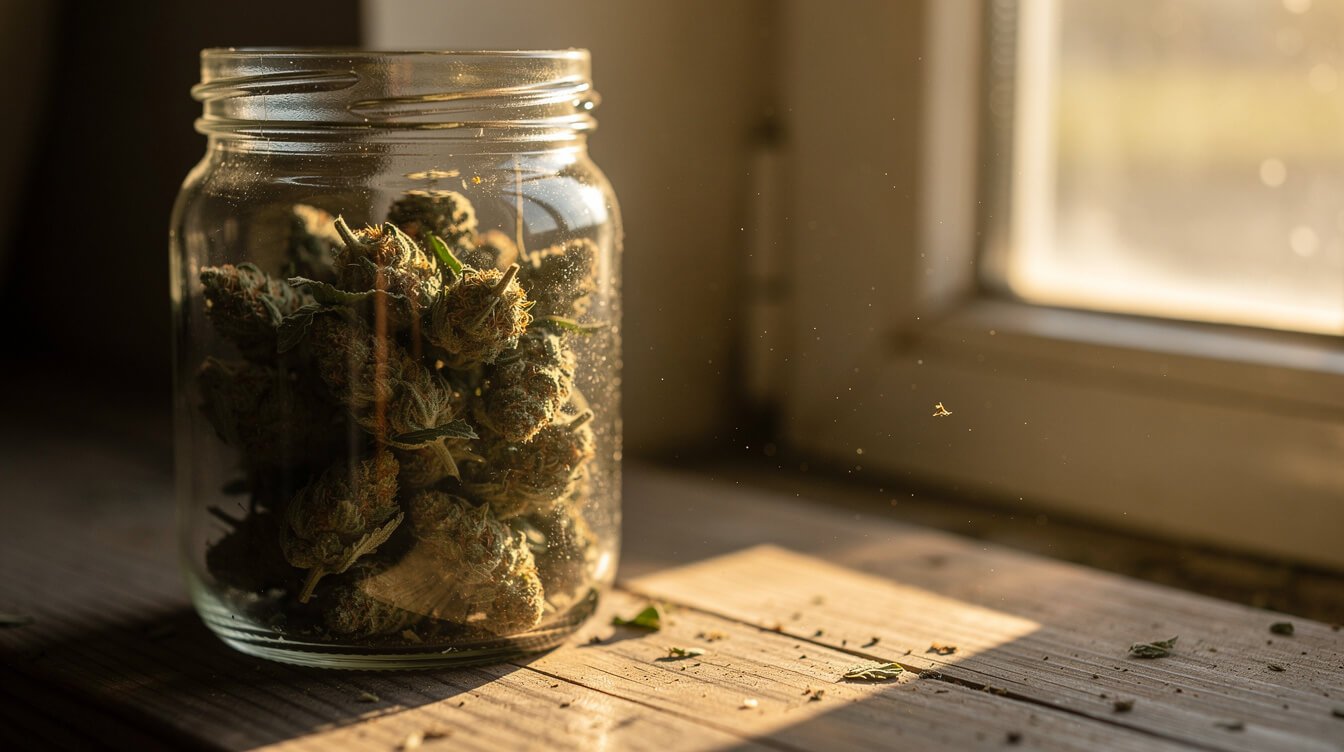
CBN formation is chemistry you can watch happen in slow motion. The THC molecule oxidizes, its ring flattens into a more stable aromatic form, and you end up with CBN. Four factors matter:
Oxygen
Oxygen is the reactant. Less air around your flower means slower conversion, which is the main reason a properly sized, well-sealed jar beats a big half-empty one. We get into the practical side in does weed go bad.
Light, which is more complicated
Light is the biggest single destroyer of cannabinoids, but it doesn’t simply make CBN. A 1976 two-year storage study found light was “the greatest single factor” in cannabinoid loss, yet THC lost to light did not show up as extra CBN, while air oxidation in the dark did (Fairbairn et al., 1976). Other researchers, summarized in a 1997 UN review we cite below, found cannabinolic acid (CBNA), the acid form of CBN, in stored hemp but not fresh hemp, and linked it to UV, storage, and heat. Either way, the advice is the same: keep flower in the dark.
Heat
Temperature changes the rate dramatically. A 2022 kinetics study heated cannabis resin at 50, 60, 70, and 80 °C and found CBN formation sped up as the temperature rose, with the fastest changes at 70 °C under acidic conditions (Jaidee et al., 2022). Older work summarized in that UN review reported THC disappearing at about 3.8%, 5.4%, and 6.9% per year when stored at −18, 4, and 22 °C, respectively.
Time
The best real-world numbers come from a University of Mississippi team that tracked flower stored at room temperature (20–22 °C) for four years. On average, THC fell by 16.6% of its starting value after one year, 26.8% after two, 34.5% after three, and 41.4% after four (Ross & ElSohly, UNODC Bulletin on Narcotics, 1997). The CBN-to-THC ratio climbed steadily enough that the authors proposed it as a clock for estimating a sample’s age.
Two takeaways. First, CBN builds slowly. A few weeks in a decent jar won’t turn your flower into a “sleep strain.” Second, by the time a meaningful share of THC has become CBN, the terpenes are long gone, which becomes important later. If you grow, this is also part of why harvest timing matters: amber trichome heads are partly a sign of THC starting to degrade, something we cover in what trichomes tell you about harvest.
Does CBN get you high?

After “what is CBN,” this is the next thing most people ask. The answer is no, not in any way most people would recognize, at the amounts found in flower or typical products. At very large doses, there’s some evidence of a mild effect. The older studies and the newest one don’t fully agree, so here’s what each found.
The 1970s evidence: mostly nothing on its own
In a small Brazilian study, five men took 50 mg of oral CBN, 25 mg of THC, combinations of the two, and placebo, a week apart (Karniol et al., 1975). THC raised heart rate and made people feel drugged, drunk, dizzy, and drowsy. CBN alone did none of that. When CBN was added to THC, people reported feeling a bit more of those THC effects, but the authors called the changes small. Corroon’s 2021 review looked across the old human studies and summarized the evidence that CBN produces cannabis-like effects as “mixed, with the majority of available evidence demonstrating a lack of such an effect.”
The 2026 evidence: something, at 300 mg
The new Sydney sleep trial (more on it below) found “some modest subjective drug effects” at a 300 mg dose, which the authors estimated as about ten times milder than THC’s. That’s a huge dose, far above anything in a typical product, and still nowhere near a THC-style high.
So the honest answer: CBN is very weakly psychoactive at most. It won’t get you high the way THC does. That said, many CBN products also contain some THC, so the product in your hand may not be “non-intoxicating” even if the CBN is. Don’t drive after using any cannabis product, and start low.
CBN and sleep: what the studies actually measured

Ask a product page what is CBN for and you’ll hear one word: sleep. This is where most CBN pages get vague. They either repeat “the sleep cannabinoid” as fact or say “more research is needed” and move on. There are now two modern human trials. Neither one cleanly confirms the marketing, and neither one rules it out. Here’s each one, in order.
Before 2023: no real sleep trials at all
Corroon’s 2021 review screened 99 human studies and found eight relevant ones, mostly small and from the 1970s and ’80s. It found no published trial linking CBN to validated sleep questionnaires or polysomnography (the overnight brain-wave recording used in sleep labs), and concluded there was “insufficient published evidence to support sleep-related claims.” It also noted that products marketed for sleep typically contained 5 mg of CBN or less, which is very low compared with doses studied in humans.
The 2023 online trial: the main outcome missed
The first sizable randomized trial put 20 mg of CBN, with or without added CBD, against placebo for seven nights in adults who rated their own sleep as poor (Bonn-Miller et al., 2024, published online in 2023, 293 people analyzed). Results by outcome:
- Primary outcome, overall sleep quality: not statistically significant (p = .082). The authors called it “potentially meaningful,” but it missed.
- Secondary outcomes: 20 mg CBN reduced the number of nighttime awakenings and overall sleep disturbance compared with placebo.
- No difference for time to fall asleep, time awake after falling asleep, or daytime fatigue.
- Adding CBD didn’t help.
Two caveats worth knowing. Everything was self-reported at home, not measured in a lab. And most of the authors listed Canopy Growth, a cannabis company, as their affiliation, with another from Wana Brands. That doesn’t make the results wrong, but you should know who ran the study. Some product pages cite this study as proof that CBN “enhanced sleep quality.” Its primary outcome says otherwise.
The 2026 sleep-lab trial: the first objective test
In February 2026, researchers at the Woolcock Institute and the University of Sydney’s Lambert Initiative published the first trial to test CBN on its own with full polysomnography (Lavender et al., 2026, Journal of Sleep Research). Twenty adults aged 25 to 65 with physician-diagnosed insomnia each spent three single nights in the lab, getting 30 mg CBN, 300 mg CBN, or placebo in random order, two weeks apart.
- Primary outcome, wake time after falling asleep: no significant change at either dose (−6.3 minutes at 300 mg, with a confidence interval running from −18.2 to +5.5).
- At 300 mg only: people fell asleep faster (sleep-onset latency roughly halved, about 7 minutes shorter), rated their sleep better, and showed fewer brain-wave arousals and more stage-2 sleep.
- At 30 mg, which the authors describe as roughly typical community use of over-the-counter CBN, nothing significant moved.
- Next day: the team found “no compelling evidence of a next-day ‘hangover’ effect,” while noting longer studies are needed.
The authors’ own conclusion is the right one to repeat: the trial “does not provide direct evidence that CBN is effective for insomnia in routine clinical care.” It was small, ran one night per dose, measured many outcomes, and the positive signals came from a dose about ten times what people typically take. The modest drug effects at 300 mg also mean some participants may have been able to tell they got something, which can feed placebo effects.
Bottom line on the research: two trials, two missed primary outcomes, and some positive secondary signals, mostly at doses higher than typical products contain. That’s worth knowing, but it’s not proof that CBN works for sleep. If sleep is a real problem for you, talk to a doctor. Persistent insomnia has many causes, and treating it is not a job for a gummy.
GanjaTech, weekly
Cannabis, explained. In your inbox.
One email a week: the clearest explainers, honest gear picks, and what the science actually says. 21+ only. No spam, unsubscribe anytime.
Where the “sleepy cannabinoid” reputation came from

Search “what is CBN” and nearly every result leads with sleep. If the evidence is this thin, why is CBN sold everywhere as a sleep aid? Two stories got combined.
Story one: old weed feels heavier
People have long noticed that old, badly stored flower feels flatter and more couch-heavy. Since old flower also has more CBN, the leap to “CBN is sedating” was easy. The more likely explanation is what aging removes. Light monoterpenes like limonene and pinene evaporate first, while heavier sesquiterpenes hang around longer. Researcher Ethan Russo put it this way to Leafly in 2020: leaving cannabis in the sun is “a good way to waste the monoterpenoid fraction and leave sedating sesquiterpenoids and CBN behind.” Old flower has also simply lost THC, which changes the experience in its own right. We made the same argument in our guide to aging flower: terpene loss, not CBN gain, is the likelier reason old weed feels different. For more on how individual terpenes are thought to shape effects, see our list of terpenes and effects.
Story two: the diazepam line
The most copied CBN claim online is some version of “2.5–5 mg of CBN equals 5–10 mg of diazepam (Valium).” It traces back to a blog post by the cannabis testing lab Steep Hill, not to any published trial. When Leafly asked about it in 2020, Steep Hill didn’t comment, but it did rewrite its page to say that “with the advent of a few small trials, sedative qualities have not been observed.” The original line is still all over seller pages years later, and at least one page ranking for CBN today still repeats it.
Corroon’s review quotes a similar marketing claim that CBN’s “sedative properties are up to 10 times stronger” than prescription and over-the-counter sleep drugs. No human study has ever shown anything like that.
What about the “research suggests” lists on product pages, covering pain, inflammation, appetite, neuroprotection, and more? When you click through, those citations are almost all rodent or cell studies. One 2024 rat study did find increased sleep after CBN and its metabolite 11-hydroxy-CBN, which is part of why the Sydney team ran its trial. Animal results like that are reasons to run human trials. They aren’t results in people.
CBN vs THC vs CBD at a glance

People mix these three up constantly, especially CBN and CBD. Here’s how they actually compare:
| THC | CBD | CBN | |
|---|---|---|---|
| Where it comes from | Made by the plant as THCA, activated by heat | Made by the plant as CBDA, activated by heat | Mostly a breakdown product of THC/THCA |
| Gets you high? | Yes | No | Very weakly at most, only at large doses |
| CB1 receptor | Partial agonist, relatively strong binding | Very weak binding, works mostly through other targets | Partial agonist, roughly a tenth of THC’s affinity |
| Typical amount in flower | Often 15–25%+ (as THCA) | Varies widely by cultivar | Usually a trace, higher in old flower |
| Human evidence base | Large | Large, including an FDA-approved drug for specific seizure disorders | Small: a few old studies plus two modern trials |
One note on receptors, since seller pages often call CBN “a CB2 compound” as if that settled anything: a 2025 meta-analysis of binding data actually grouped CBN with THC as a relatively strong binder at both CB1 and CB2, compared with CBD, CBG, and CBC, which bind 10 to 100 times more weakly (Queiroz et al., 2025). Binding numbers in a dish don’t predict how something feels in a person, which is why the human studies matter more.
For the full THC-and-CBD comparison, see CBD vs THC effects, side by side. If you’re collecting minor cannabinoids, CBN’s opposite in a sense is CBG: CBG comes at the very start of the plant’s cannabinoid chemistry, and CBN comes at the end. We cover it in what is CBG in weed.
What to know before you see CBN on a label

Read enough CBN packaging and you’d think the answer to what is CBN is simply “a sleep aid.” We don’t recommend products or brands here, and we won’t point you to sellers. But if CBN products show up where you live, here’s what the research says to keep in mind. Laws on cannabis and hemp-derived products vary a lot by state and country, and federal hemp rules in the US are changing in 2026, so check what applies to you. (For a sense of how differently places treat it: CBN is so tightly controlled in Australia that the Sydney trial needed government approval just to give it to volunteers.)
The dose on most labels is far below what was studied
Corroon’s 2021 review put typical sleep-product doses at 5 mg or less. The Sydney team described 30 mg as typical community use. Either way, the only objective positive signals came at 300 mg, and the online trial’s secondary signals came at 20 mg. A low-dose CBN product is a long way from anything that’s been tested.
The CBN may not be the active ingredient
Plenty of “CBN” products also contain THC, CBD, melatonin, or other ingredients. If a product has THC in it, that THC can do more than the CBN. Harm-reduction site Plug Reports specifically warns about CBN products combined with melatonin in “mystery doses.” That warning has data behind it. When researchers tested 25 melatonin gummy products sold in the US, 22 were mislabeled, with actual melatonin ranging from 74% to 347% of the labeled amount, and one product contained no melatonin at all, just CBD (Cohen et al., JAMA, 2023).
Check the lab report, not the marketing
Where products are legal and regulated, look for a certificate of analysis from an independent lab that lists CBN, THC, and anything else in the product, matched to your batch. “The sleep cannabinoid” on the front of a package isn’t evidence of anything.
Mixing and driving
Anything sedating can stack with alcohol, sleep medications, and other depressants. If you take prescription medications, ask a doctor or pharmacist before adding any cannabinoid. And because CBN products can contain THC, the usual rule applies: don’t drive after using them.
What is CBN? Quick answers to common questions

What is CBN in weed, exactly?
In flower, CBN is mostly a sign of age. It forms as THC and THCA oxidize, so fresh, well-cured flower has very little and old or badly stored flower has more. It’s one of over a hundred cannabinoids, and usually a minor one.
Is CBN the same as CBD?
No. The names differ by one letter, but they’re different molecules with different origins. The plant makes CBD directly (as CBDA). CBN mostly forms when THC breaks down. They act on the body differently too, as the table above shows.
Does old weed have more CBN?
Yes, and the amount rises with time, warmth, light, and air. In the four-year Mississippi study, THC at room temperature dropped by about a sixth in the first year, and CBN rose steadily enough to work as a clock. Old weed is still mostly lower in THC and terpenes, not loaded with CBN.
So what is CBN good for, according to the research?
Honestly, it’s still unclear. In people, two modern trials missed their primary sleep outcomes, with some positive secondary results mostly at high doses. Most other “benefits” listed online come from animal or cell studies. If you’re dealing with a health problem, talk to a doctor rather than relying on a cannabinoid.
Can CBN show up on a drug test?
Possibly on the first screen. A 2020 lab study found CBN cross-reacted with two common urine immunoassays designed to detect THC’s metabolite. One needed about 5 times more CBN than THC metabolite to trigger a positive and the other about 20 times more, and in one assay CBN added to a weak THC signal (Kroner et al., 2020). Confirmatory lab testing can tell the compounds apart, but many CBN products also contain THC. For how THC testing works in general, see how long weed stays in your system.
What is CBN vs THC, in one sentence?
THC is the main intoxicating compound the plant produces, and CBN is what THC slowly turns into, with roughly a tenth of THC’s affinity for the receptor behind the high.
The bottom line on CBN
CBN is a real and interesting compound with an inflated reputation. It’s THC’s aging product: the first cannabinoid chemists ever isolated, a useful clock for forensic labs, and a weak partial agonist at the receptor behind THC’s high. The “sleepy cannabinoid” label came from old-weed lore plus a lab’s marketing line that the lab itself later walked back.
The research has finally started catching up, and it’s more mixed than either side of the debate suggests. Two modern trials, two missed primary outcomes, and some positive signals at doses well above what most products contain. That’s a reason for more research, not a reason to treat any product as a sleep aid. If sleep is a real problem, a doctor is the right call.
If you came here wondering what is CBN and whether old flower is secretly a sedative, the practical answer is simpler. Store your flower well so it doesn’t turn into CBN in the first place, and if it already has, expect less THC and fewer terpenes rather than a better night’s sleep. Know your local laws, start low, and enjoy responsibly.
Before you go
Get the next explainer first
We publish a new one every day. The best of the week, plus what's new in the shop, lands in one short email.