What Does a Weed Plant Look Like? A Leaf-to-Bud ID Guide (and the Look-Alikes That Fool People)
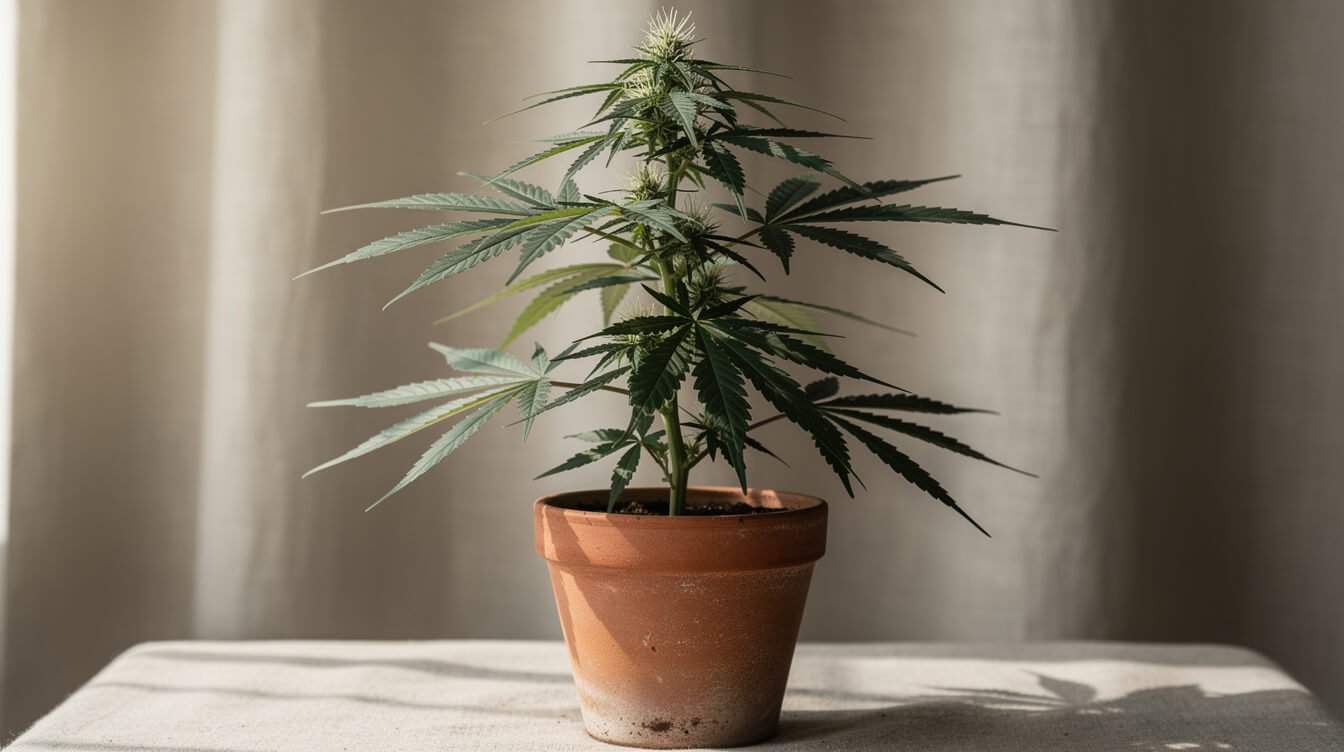
What does a weed plant look like? Picture an upright, bushy herb with leaves that look like an open hand: five to nine long, narrow, saw-toothed leaflets fanning out from a single point. Leaves and branches come off the main stalk in pairs, and as the plant matures, sticky, frosted flower clusters pile up at the branch tips. Get close and you’ll smell it before you can name it. That’s the short version. The longer version is more useful, because a few common garden plants copy that leaf surprisingly well, and the “skinny leaves vs fat leaves” rule most people learn is mostly folklore.
This guide walks the plant from the ground up: the leaf, the stalk and nodes, the flowers, male vs female, how the look changes from seedling to harvest, and the look-alikes that fool people. It’s written for adults (21+), for curious readers and home growers in places where growing is legal. Home-grow laws vary a lot by state and country, so check yours before you plant anything.
What does a weed plant look like? The short answer
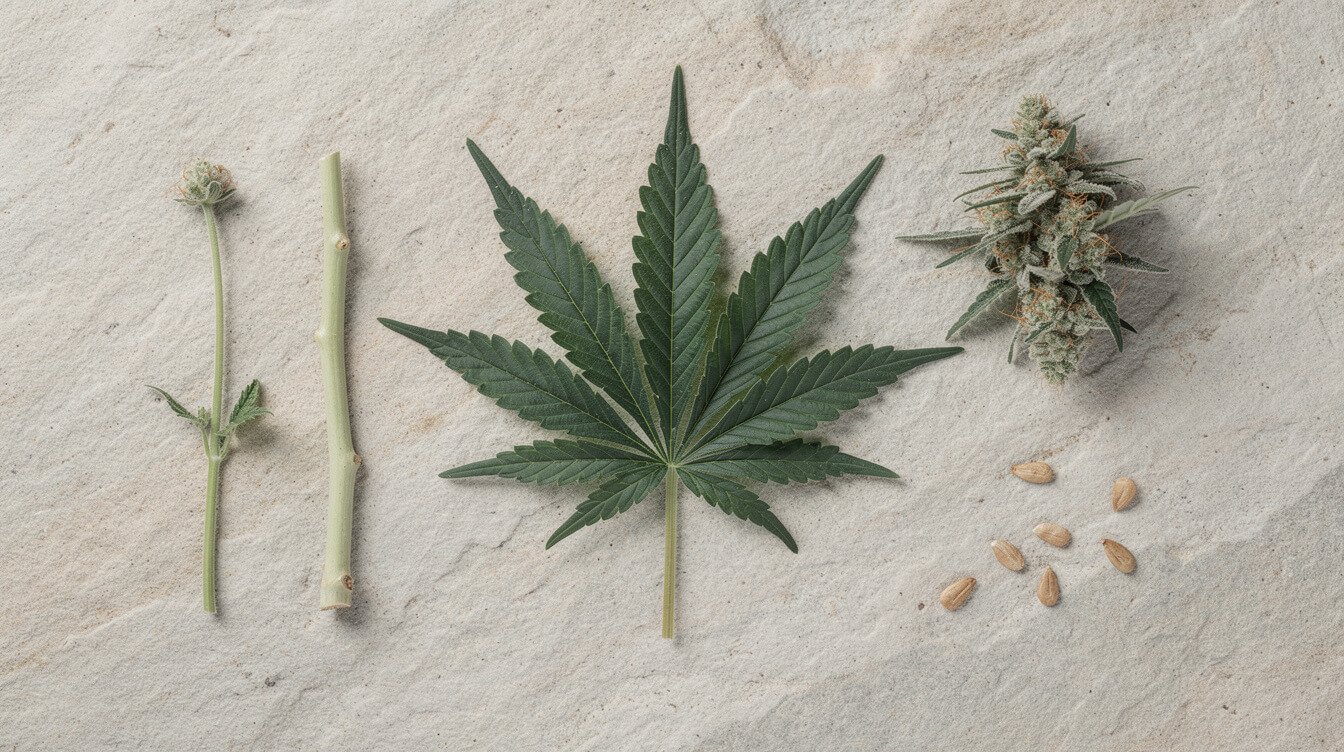
Botanists at the University of Florida put together one of the clearest ID guides out there, Cannabis sativa Plant Identification and Its Look-Alikes (AG476), and their description lines up with what growers see every day. Strip it down and you get five tells:
- The leaf is compound, not lobed. Each big leaf is split all the way down into separate leaflets that meet at one point on the end of the leaf stem. Usually 3 to 7, sometimes up to 11.
- The leaflets are long, narrow, and coarsely toothed. Think saw blade, not scallop. Each one has a strong center vein and tapers to a long point.
- It grows upright, not as a vine. A main stalk, side branches, and a rough Christmas-tree shape if nobody has trained it. UF/IFAS gives a mature height of about 0.3 to 3 meters (1 to 10 feet), with fiber hemp at the tall end.
- The flowers are small and clustered. No petals, no showy blooms. Females make dense, hairy, resin-coated clusters. Males make loose sprays of tiny pollen sacs.
- It smells. Rub a leaf and your fingers pick up a herbal, skunky, or piney note from the resin glands. In flower, the smell gets loud.
If a plant hits all five, you’re almost certainly looking at cannabis. If it misses even one, especially the compound leaf or the small flowers, it’s probably something else. We’ll get to the usual suspects later.
One species, many looks
Hemp, “weed,” marijuana, and the plant on the dispensary jar are all Cannabis sativa. A 2018 review of cannabis systematics by John McPartland lays out the botany: one species, with subspecies and a long history of people sorting plants by whatever they happened to be growing them for. That’s why a tall, gangly fiber crop and a short, dense flower plant can look like cousins rather than twins. They’re the same plant, bred in different directions.
The leaf: how to recognize a cannabis leaf
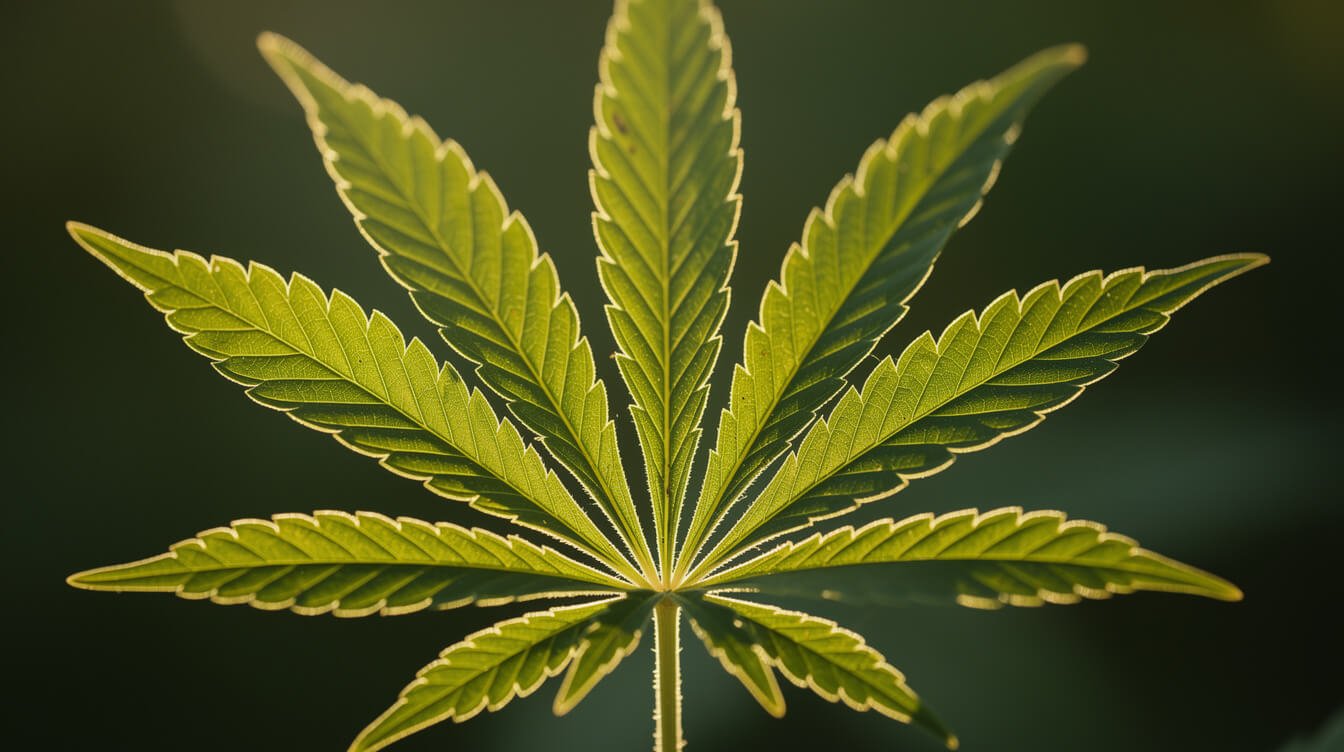
The leaf is the plant’s logo for a reason. It’s distinctive, and once you know what to look for, it’s hard to unsee.
Count the leaflets, but don’t count on a number
Mature fan leaves usually carry 5, 7, or 9 leaflets, and almost always an odd number, with the longest one in the middle and shorter ones stepping down toward each side. The count isn’t fixed, though. It depends on how old the plant is and where the leaf sits. A seedling’s first true leaves have one leaflet each. Leaves near the top of a flowering plant drop back down to three, then one. So “seven fingers” is the classic look, not a rule.
Check the edges and the base
Run a fingernail along a leaflet’s edge and you’ll feel the teeth. They’re coarse, fairly regular, and angle toward the tip. Now look where the leaflets meet. On cannabis, every leaflet attaches directly at the same point on the end of a long leaf stem (the petiole), like spokes from a hub. There’s no webbing of leaf tissue joining them at the base. That detail, compound vs merely lobed, is the single best tell, and it’s the one most look-alikes fail.
Feel the surface
The top of a leaf is a slightly rough, matte green. The underside is paler, with veins standing out. Young leaves and stems carry fine hairs, which UF/IFAS describes as pubescent. Healthy color runs from lime to deep forest green. Some cultivars push purple into leaves and stems, especially when nights turn cold late in the season.
What leaves can’t tell you
Leaf shape varies with genetics, light, age, and stress. Some cultivars are bred for oddities, like webbed “duckfoot” leaves or deeply split ones. Yellowing, burnt tips, or spotting are care problems, not identity features. Our nutrient burn guide covers the most common one.
Stalk, branches, and nodes
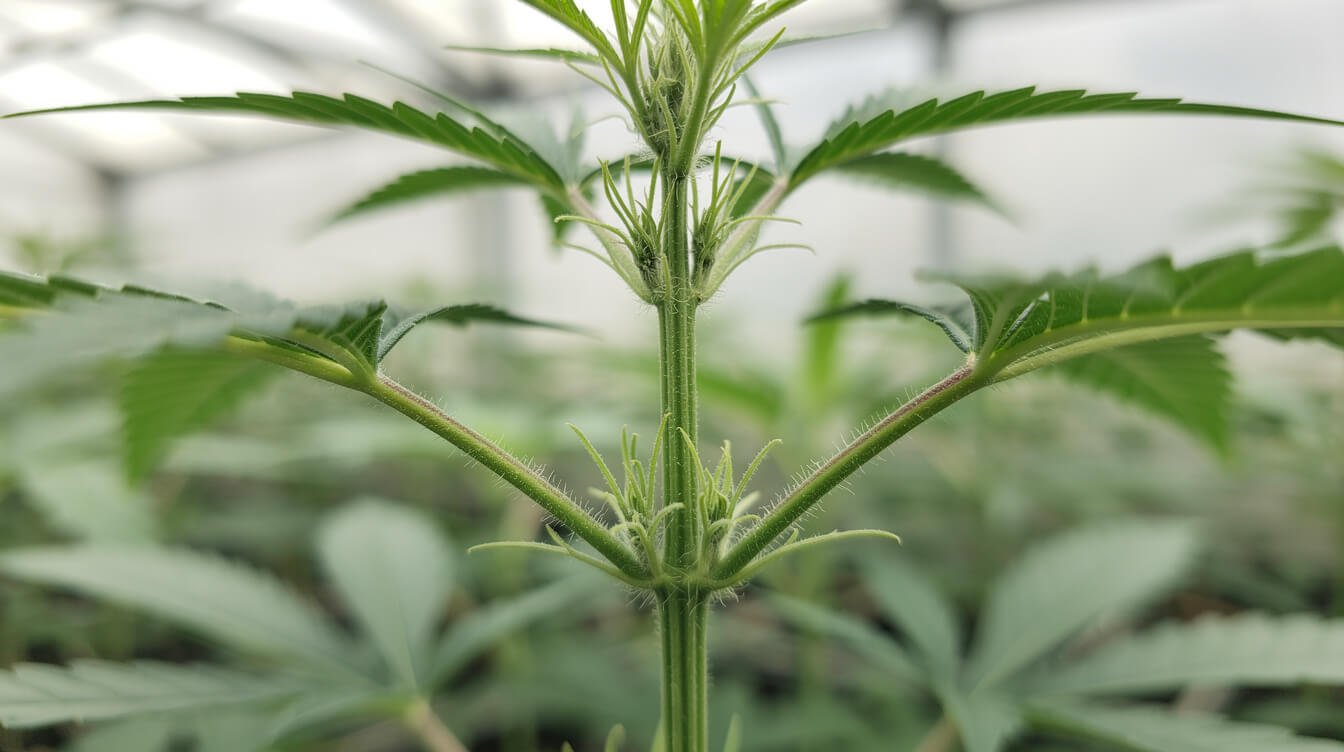
Step back from the leaf and look at the frame. A cannabis plant is built from repeating units: a section of bare stalk (the internode), then a node where a leaf and a side shoot come off, then another internode, and so on up the plant.
Opposite pairs low, often alternating higher up
On a young plant, leaves and branches usually come off the stalk in matched pairs, one on each side at the same height. Higher up, and as the plant matures, that tidy pattern often loosens into a staggered, alternating arrangement. Botanists list cannabis leaves as “alternate or opposite” for exactly this reason. McPartland’s review notes that cannabis and its closest relative, hops, both have both arrangements. Growers often read the shift toward alternating as one of several signs that a plant is maturing. It’s a hint, not a clock.
Stipules and pre-flowers live at the nodes
Look closely where a leaf stem meets the stalk and you’ll see two thin, pointed slivers called stipules. Right in that junction is also where the plant’s first sex organs, its pre-flowers, show up. That makes nodes the most important place on the plant for a grower to look. We’ll come back to them in the male vs female section.
The stalk itself
Young stems are green, slightly fuzzy, and often faintly ridged or squared rather than perfectly round. With age, the main stalk thickens and gets woody near the base. The outer layer of that stalk is where hemp’s long bast fibers come from, which is why fiber hemp has been grown for rope and cloth for thousands of years. Spacing between nodes says a lot about the plant’s life. Short gaps suggest strong light and a compact habit. Long, stretchy gaps usually mean the plant was reaching for more light, or that it just started flowering, when many plants stretch hard for a couple of weeks.
Shape also depends on how a plant was grown. Indoor plants are often topped or trained flat, so they look more like a low hedge than a tree. Our low stress training guide shows how growers deliberately reshape the frame, so don’t expect every plant to have the textbook cone.
Flowers and buds up close: pistils, calyxes, and trichomes
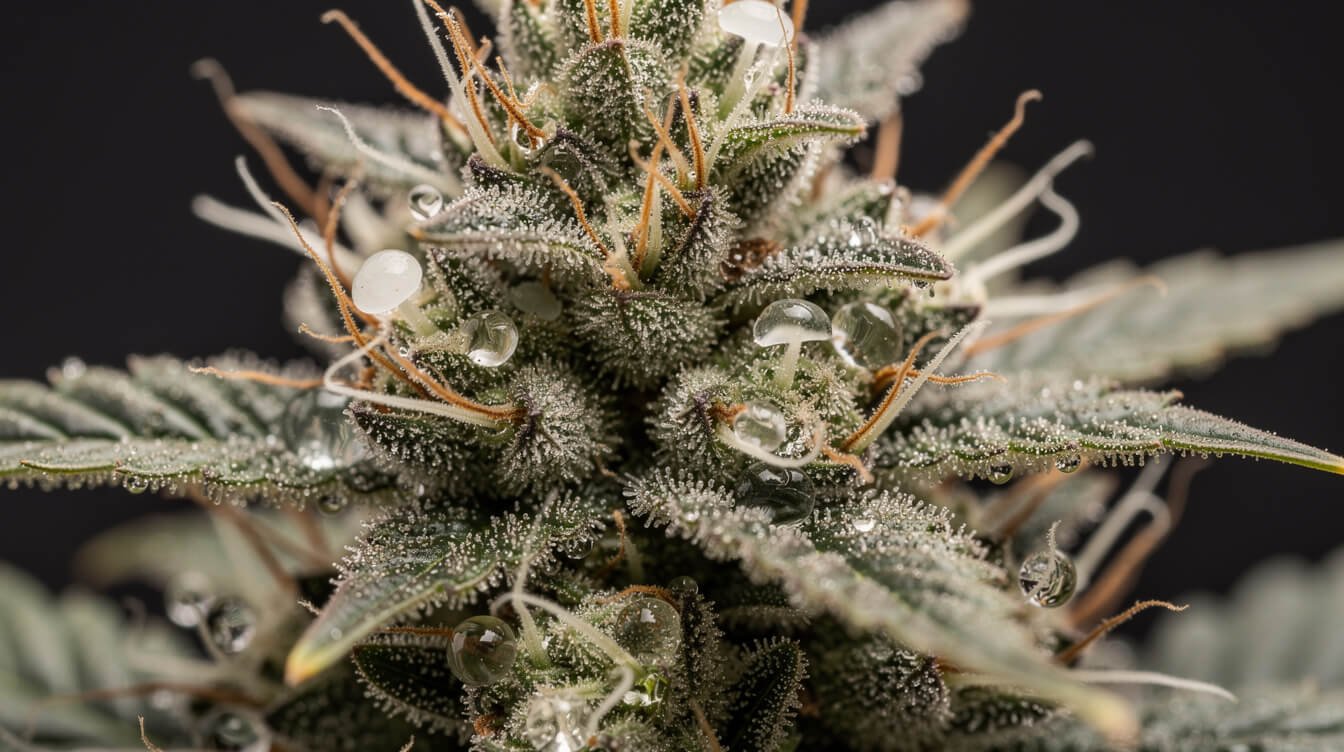
This is the part people picture when they say “bud.” It’s also where the plant looks least like a typical flower, because cannabis flowers have no petals at all.
What you’re actually looking at
- Pistils (the “hairs”): thin, wispy threads sticking out of the flower. They start white and darken to orange, red, or brown as the flower ages. Their job is to catch pollen.
- Calyxes (technically bracts): the small, teardrop-shaped green pods each pistil pair grows out of. Growers call them calyxes. Botanists call the structure a bract, a modified leaf wrapped around the actual flower. A 2019 study of how female cannabis flowers develop maps exactly where these bracts form at each node. Stacks of calyxes are what make up the bulk of a bud.
- Sugar leaves: small, single-bladed leaves poking out of the bud, dusted with resin. They’re the ones that get trimmed off at harvest.
- Trichomes: the frost. Under a magnifier, they look like tiny glass mushrooms with a stalk and a round head. Those heads hold most of the plant’s cannabinoids and aromatic terpenes, and they’re why a flowering plant feels sticky.
- Colas: the long clusters of buds at the top of the main stalk and the major branches.
Why trichomes matter more than color
Trichome heads change from clear to cloudy to amber as the flower matures, and growers watch that shift to time harvest. Pistil color is a rougher signal. We break down how to read both in what trichomes are and how to tell when to harvest, and how that same resin becomes kief when it falls off.
What a flower should not look like
Healthy trichomes sparkle and stand up individually. Gray or white fuzz that looks like cobweb or powder, or a bud that’s browning and mushy from the inside out, is a different story. If you’re not sure, our guides on how to tell mold from trichomes and spotting bud rot early have side-by-side clues. Moldy flower isn’t something to smoke or eat.
GanjaTech, weekly
Cannabis, explained. In your inbox.
One email a week: the clearest explainers, honest gear picks, and what the science actually says. 21+ only. No spam, unsubscribe anytime.
Male vs female vs hermie at a glance
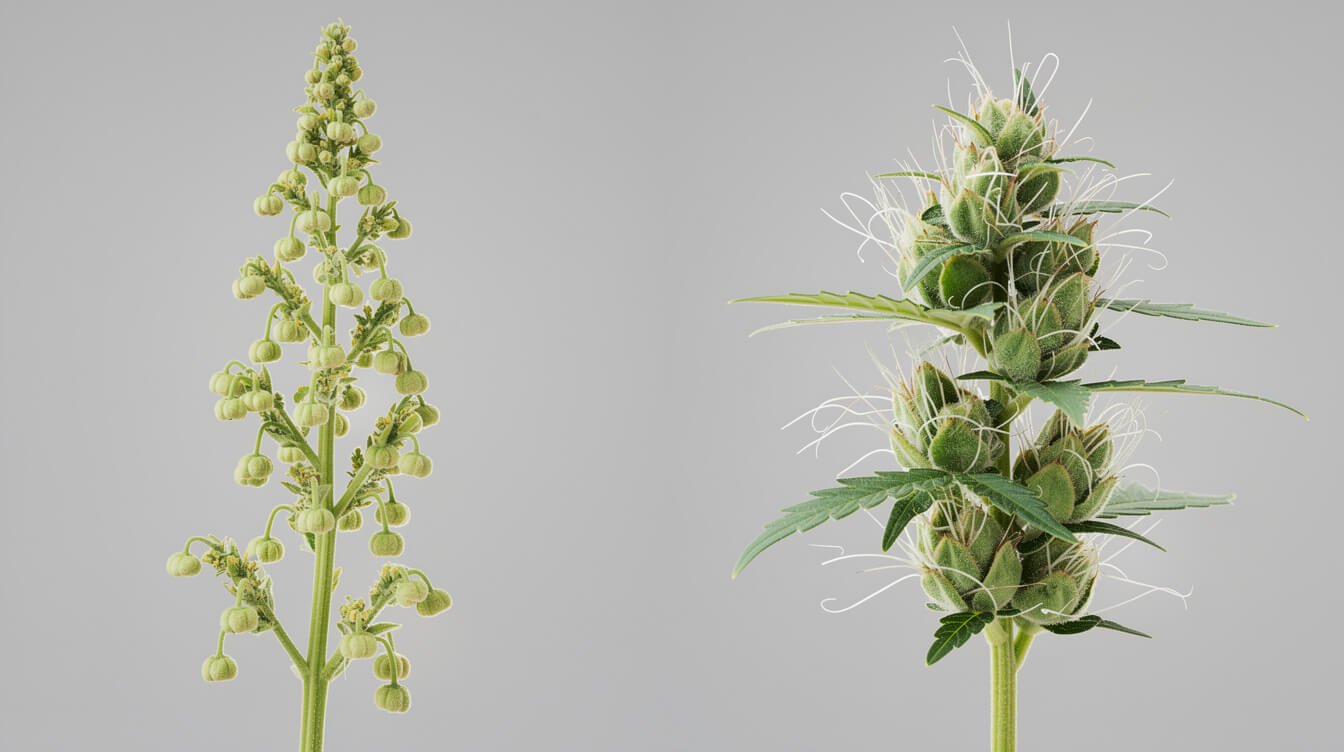
Cannabis plants are usually either male or female. UF/IFAS describes the species as dioecious or monoecious depending on the variety, and the two sexes look noticeably different once they flower.
- Male plants grow loose, drooping clusters of small, round, greenish sacs that hang like tiny bells. UF/IFAS describes them as loose panicles up to about 18 cm long. When the sacs open, they shed pollen. Males tend to be taller and leggier, with fewer leaves near the flowers.
- Female plants grow tighter, more compact clusters. Each flower sits in its own teardrop calyx with a pair of white pistils sticking out. These are the plants that make resinous buds.
- Hermaphrodites (“hermies”) show both. That’s usually a mostly female plant with a few pollen sacs, or banana-shaped “nanners,” tucked in among the buds, often after stress like light leaks or heat.
The early version of all this shows up as pre-flowers at the nodes, usually somewhere between weeks three and eight from germination. That’s the window when growers check. We cover the details, including the “crossed stipules” myth and how to pull a male without dusting your whole grow, in our male vs female cannabis plants guide, so we won’t repeat it here.
How a weed plant changes from seedling to harvest
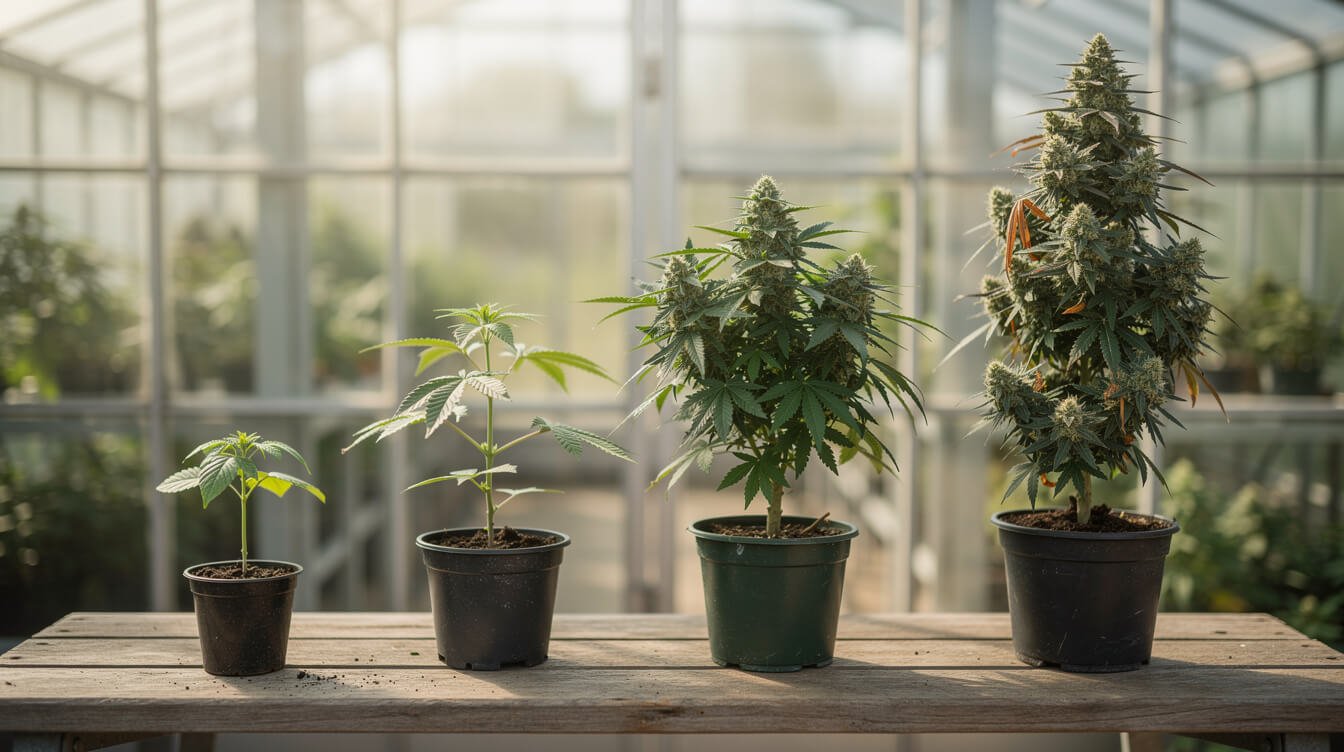
Cannabis changes outfits a few times over its life. If you only know the flowering look, a young plant can be easy to miss.
Seedling: almost nothing like the logo
The first two leaves to open are seed leaves (cotyledons): small, smooth, rounded ovals with no teeth at all. Next come the first true leaves, a pair of single leaflets with serrated edges. Each new node adds leaflets, with three, then five, and so on. For the first couple of weeks, a cannabis seedling looks like a lot of generic sprouts. Our seed germination guide shows this stage in detail.
Vegetative: the classic leafy look
This is when the plant looks most like the leaf on a T-shirt. Big fan leaves, fast vertical growth, new nodes every few days, and no flowers yet except possible pre-flowers at the nodes. Indoors, growers can keep a photoperiod plant here for weeks. Autoflowers move through it on their own schedule.
Flowering: buds take over
Once flowering starts, the plant often stretches hard for a couple of weeks, then puts its energy into flower clusters at every node and the tips. White pistils appear first, then buds fatten, frost over, and smell stronger by the week. Late in flower, fan leaves may yellow and drop as the plant pulls nutrients from them. A bit of that is normal. A lot of it early isn’t.
Ready for harvest: frosted, darker hairs, fading leaves
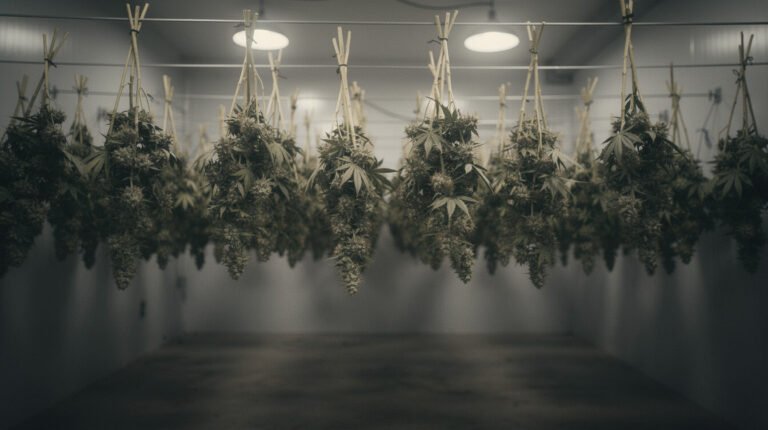
By the end, buds are dense and sticky, many pistils have darkened and curled in, and trichomes have turned mostly cloudy. How long all of this takes depends on genetics, setup, and how long you veg. Our honest grow timeline walks through each stage and how long it takes.
Plants that look like weed but aren’t
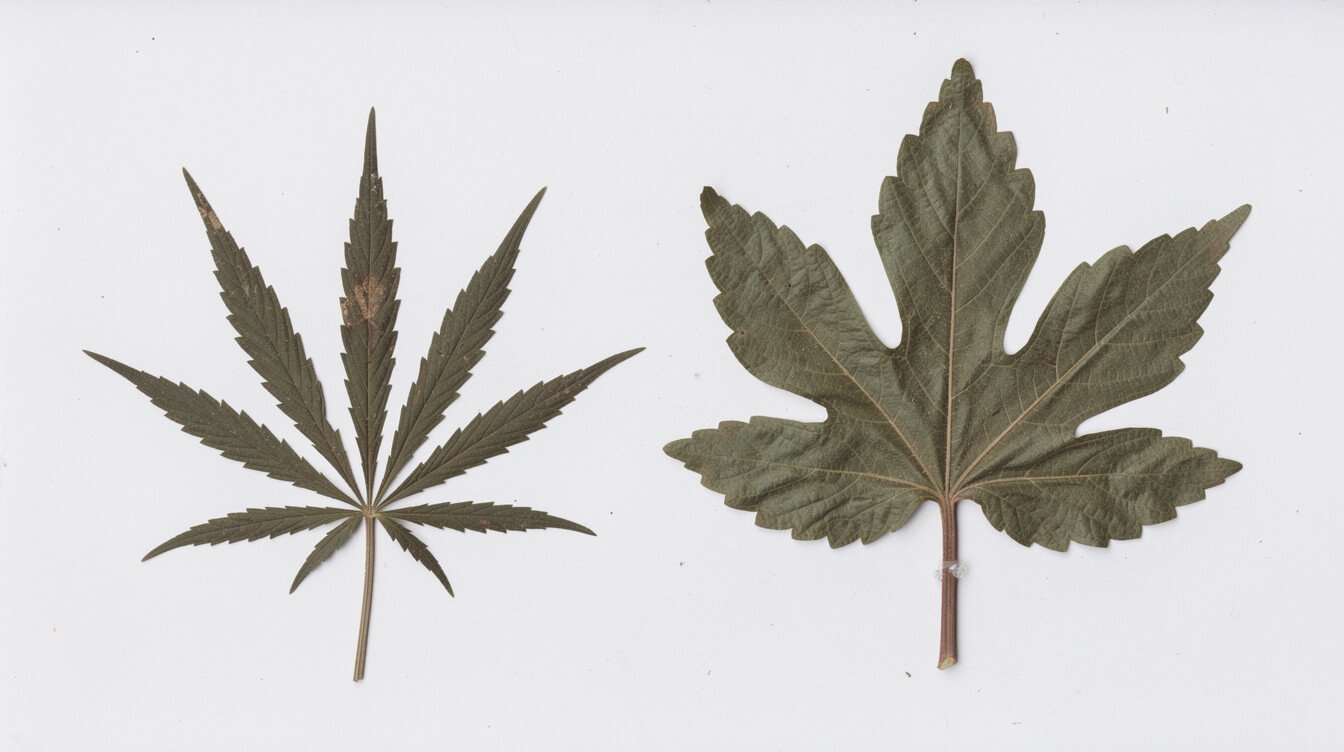
Here’s the gap most “what does weed look like” pages skip. Several common plants share one or two cannabis traits, like narrow pointed segments, toothed edges, or five-part leaves, and get mistaken for it all the time. The UF/IFAS guide lists the main offenders in Florida and the differences that give them away:
| Plant | Why it gets confused | How to tell it’s not cannabis |
|---|---|---|
| Kenaf (Hibiscus cannabinus) | Upright; deeply 5-lobed leaves with narrow, toothed lobes | Irregular serrations; large, single hibiscus-style flowers |
| Roselle (Hibiscus sabdariffa) | Upright; 3 to 7 lobed leaves | Leaves are lobed, not compound; broad lobes; large single flowers |
| Lilac chastetree (Vitex agnus-castus) | Upright; five narrow leaflets; small clustered flowers | Woody shrub or small tree; smooth leaflet edges, paler underneath; blue, tubular flowers |
| Virginia creeper (Parthenocissus quinquefolia) | Five toothed leaflets; small flowers | Woody climbing vine; broad, oval leaflets; fleshy berries |
| Woodrose and morning-glory vines (Distimake, Ipomoea) | 5 to 7 part leaves; some with narrow, toothed leaflets | Twining vines; large, single, showy flowers |
The 30-second look-alike checklist
- Is the leaf split into separate leaflets that all meet at one point? If the segments are joined at the base like a mitten, it’s lobed and not cannabis. That rules out kenaf, roselle, okra, Japanese maple, and most “pot leaf” lookalikes.
- Are the edges evenly saw-toothed? Smooth edges (chastetree, schefflera) or ragged, irregular teeth point elsewhere.
- Does it climb or twine? Cannabis stands up on its own. Vines and creepers aren’t it.
- Are the flowers big and showy? Any petals, any single trumpet or hibiscus bloom, and it’s not cannabis.
- Is it woody all over? A shrub or a tree isn’t cannabis. Only its main stalk gets woody, and only with age.
Cassava, Japanese maple, and okra aren’t in the UF/IFAS tables, but they come up constantly in “looks like weed” threads. All three have a single leaf divided into lobes rather than true separate leaflets, and okra adds big hibiscus-style flowers, so the first checklist question catches them. Hops are worth knowing too. They’re cannabis’s closest living relative, but hop leaves are lobed and the plant is a climbing bine.
When in doubt, ask an expert instead of guessing. Many university extension offices, including the UF/IFAS Plant Identification and Information Service the guide points to, will identify a plant sample for you.
The “wide leaves vs narrow leaves” myth
You’ve probably heard that fat, dark leaves mean indica and skinny, light leaves mean sativa, and that this tells you what kind of high you’ll get. The leaf-shape part has a real history. Botanists once used broad vs narrow leaflets to describe different plant populations, and McPartland’s review traces how those labels drifted into today’s “Sativa” and “Indica” store categories. He concludes that categorizing cannabis that way “has become an exercise in futility,” because decades of crossbreeding have blurred the lines. His example is a hybrid that won “Best Sativa” at a 1999 cannabis competition and “Best Indica” four years later.
Can leaf shape tell you anything? A 2024 study in New Phytologist found that detailed computer measurements of leaflet shape could tell different cannabis lines apart. The same researchers note that attempts to link leaf shape to chemical makeup have been inconclusive. So a leaf can hint at a plant’s family tree. It can’t tell you what’s in the flower. For what the labels do and don’t mean, see our breakdowns of sativa vs indica strength and indica vs hybrid.
What does a weed plant look like? Common questions
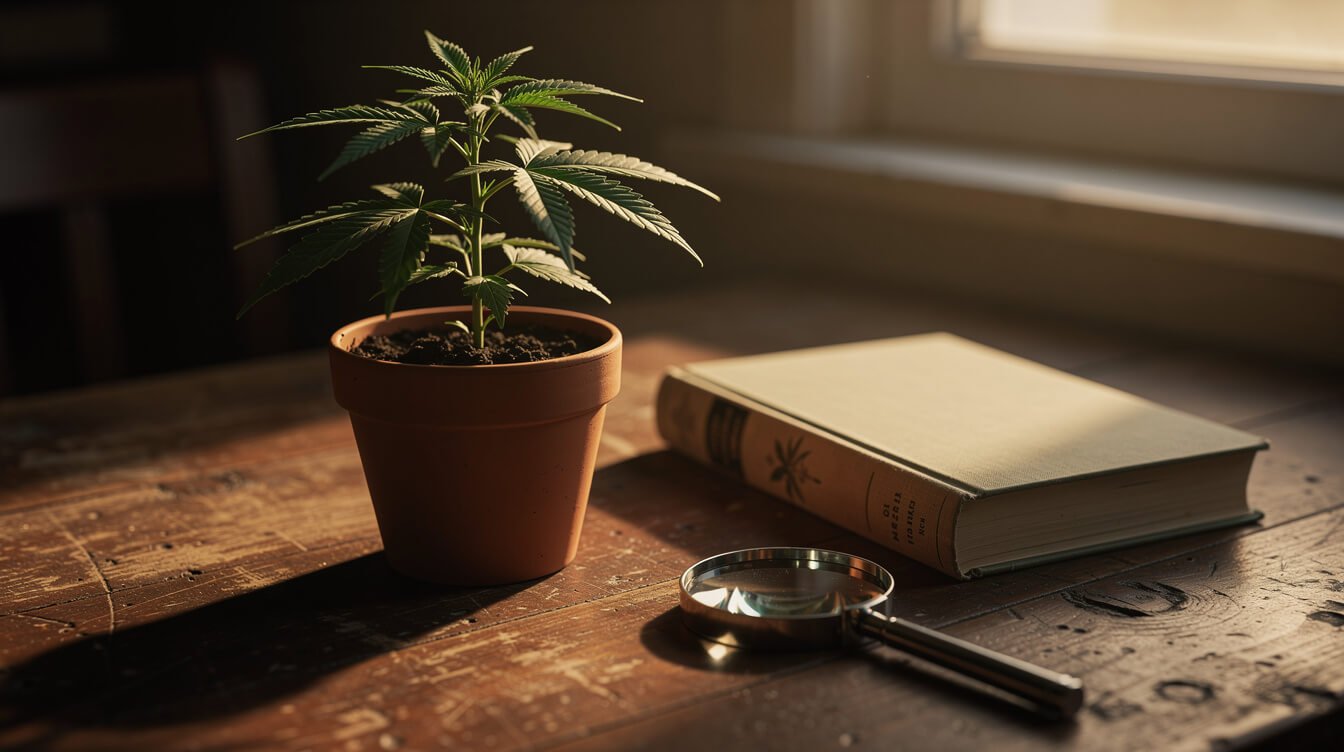
What house plant looks like weed?
The usual suspects are schefflera (umbrella plant), false aralia, and Japanese maple. Schefflera has leaflets radiating from a point, like cannabis, but they’re glossy, thick, and smooth-edged. Japanese maple has toothed edges, but each leaf is one piece with joined lobes, on a woody tree. False aralia is the trickiest, with narrow, toothed leaflets, but it’s a woody shrub with dark, leathery leaves and no cannabis smell.
Do hemp and marijuana plants look different?
Not in any way you can rely on. They’re the same species. Fiber hemp is often bred tall and thin with few branches, while flower-focused plants tend to be bushier and resin-heavy, but there’s huge overlap. In the US, the legal line between hemp and marijuana is a lab test for THC content, not a visual check, and the details of that line have been shifting, so look up current rules where you live. UF/IFAS makes the same point: once a plant is identified as cannabis, only a lab can tell you which side of the line it’s on.
Can you tell how strong a plant is by looking at it?
No. Frosty-looking buds have plenty of trichomes, but trichome coverage and THC percentage don’t line up neatly, and neither leaf shape nor color predicts potency. Testing is the only real answer.
Does a weed plant smell before it flowers?
A little. Vegetative plants carry some resin glands on stems and leaves, so brushing them releases a mild herbal or skunky smell. The strong, room-filling smell arrives in flower, when trichome production ramps up. The aroma comes from terpenes. Our terpene reference breaks down the main ones.
What does a weed plant look like in its first few weeks?
Small and unremarkable. You’ll see two rounded seed leaves, then a pair of single, toothed leaflets, then three-leaflet leaves. The classic multi-finger fan leaf usually doesn’t show up until a few weeks in.
What does a weed plant look like when something’s wrong?
Healthy leaves are evenly green and held out firmly. Droopy, clawed, spotted, or yellowing leaves, burnt tips, or fuzz on the buds all signal a problem. Each has its own cause, and most are fixable if you catch them early. Start with our indoor growing walkthrough for the basics.
How do I know if a plant is a weed?
If you mean a garden weed in the ordinary sense, any plant growing where you don’t want it, that’s a different question with a different answer. Your local extension office is the best resource. Everything on this page is about Cannabis sativa specifically.
Final thoughts
So, what does a weed plant look like once you know where to look? An upright herb with leaves split into separate, saw-toothed leaflets meeting at one point, leaves and branches paired at the nodes, small petal-free flowers that turn into frosted, hairy clusters on females, and a smell that gives the game away. Check those traits together and you’ll rarely mistake it for kenaf, a creeper, or a maple.
Just as useful is knowing what looking can’t tell you. A leaf won’t reveal THC, “indica” or “sativa,” or whether a plant counts as hemp. That takes genetics, a lab, and the label on a tested product. If you’re growing, it’s also worth learning to read the plant’s sex and maturity at the nodes and in the trichomes, because that’s where the plant tells you what it’s doing. Our best beginner strains to grow indoors is a good next read if you’re planning a first grow where it’s legal.
Great plant. Learn to read it, know your local laws, and enjoy it responsibly.
Before you go
Get the next explainer first
We publish a new one every day. The best of the week, plus what's new in the shop, lands in one short email.