Bud Rot: How to Spot Botrytis Early, Stop the Spread, and Know When to Chop
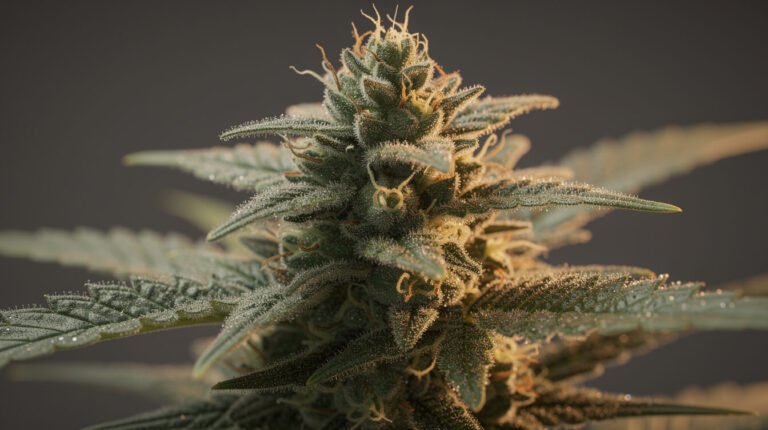
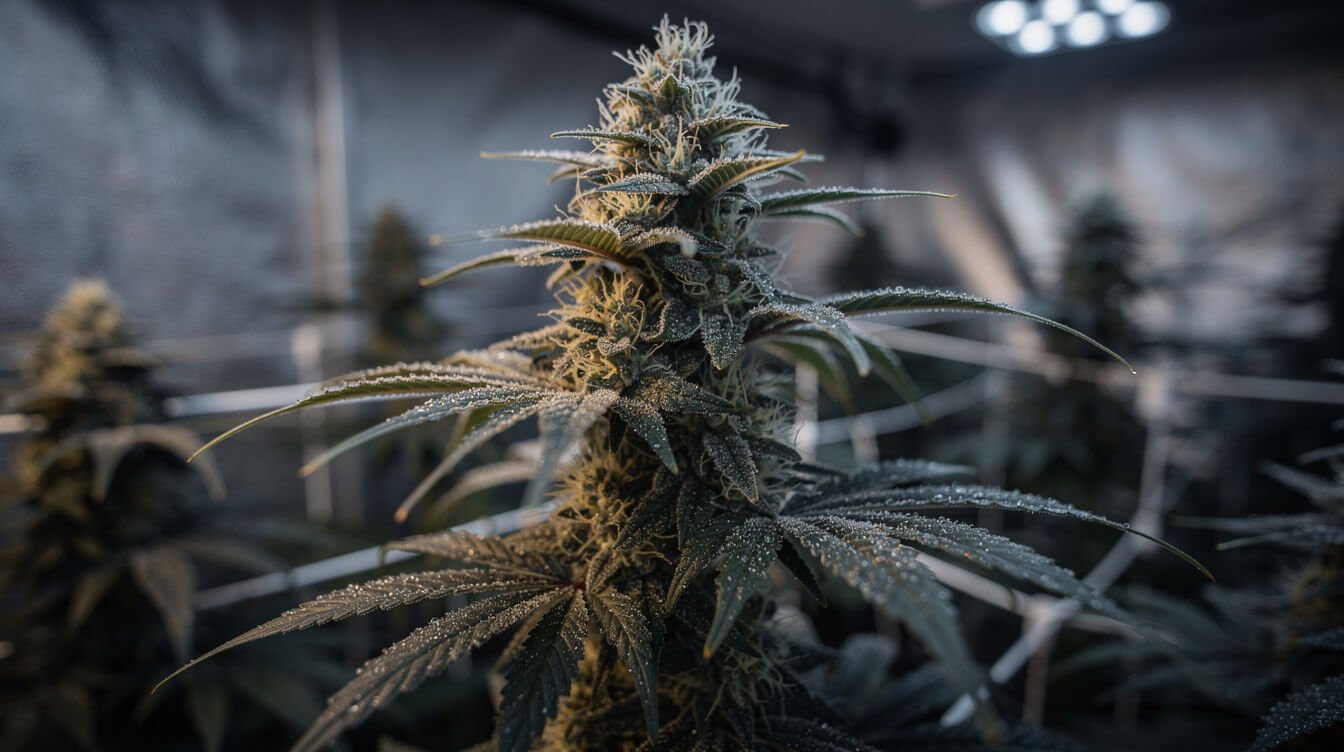
Bud rot is a fungal disease, almost always Botrytis cinerea (gray mold), that rots cannabis flowers from the inside out. It hits the biggest, densest colas late in flowering, usually when nights turn cool and damp. You often catch it first as a single yellow, wilted sugar leaf sticking out of an otherwise perfect bud. Pull that leaf and you find grey-brown mush and fuzz underneath. Infected flower can’t be saved. What you can save is everything around it, and that depends on how fast and how cleanly you act.
That’s the short version. Below is what most guides skip: why the “right temperature” advice online contradicts itself, what actually triggers an outbreak (water condensing on your buds at night), how to cut rot out without spraying spores across the room, and how to decide between chopping early and riding it out. Then the honest answer on smoking, washing, or cooking rotted weed. Don’t, and for better reasons than the scare-copy gives.
Quick housekeeping: this is for adults 21+. Home-grow rules (whether you can grow at all, and how many plants) vary a lot by state and country, so check yours first. And nothing here is medical advice.
What is bud rot?
Bud rot is what growers call the flower-stage infection caused by Botrytis cinerea, a fungus plant pathologists call gray mold. It isn’t a cannabis specialist. Utah State University Extension lists it on over 200 crops. It’s the same gray fuzz you find on forgotten strawberries.
Three facts about Botrytis explain almost everything else here:
- It gets in through damage and dying tissue. Per USU, the fungus “invades only through wounds or dying plant parts.” Late flower is full of both: senescing sugar leaves, dying pistils, caterpillar damage.
- It needs water to get started. Spores need moisture to germinate, so cool temperatures, high humidity, and free water (rain, dew, condensation) are the recipe.
- It starts inside the bud. The center of a big cola dries last, gets the least air, and holds moisture longest. That’s where infections take hold, so by the time you see it on the outside, the inside has usually been going for a while.
A 2019 survey of licensed cannabis facilities by plant pathologist Zamir Punja’s team (Punja et al., Frontiers in Plant Science) found Botrytis alongside two lesser-known rot fungi, Penicillium and Fusarium. In severe outbreaks up to 50% of plants were affected, and the authors note that infections picked up during flowering can cause significant losses later, in storage. The chop date isn’t a finish line.
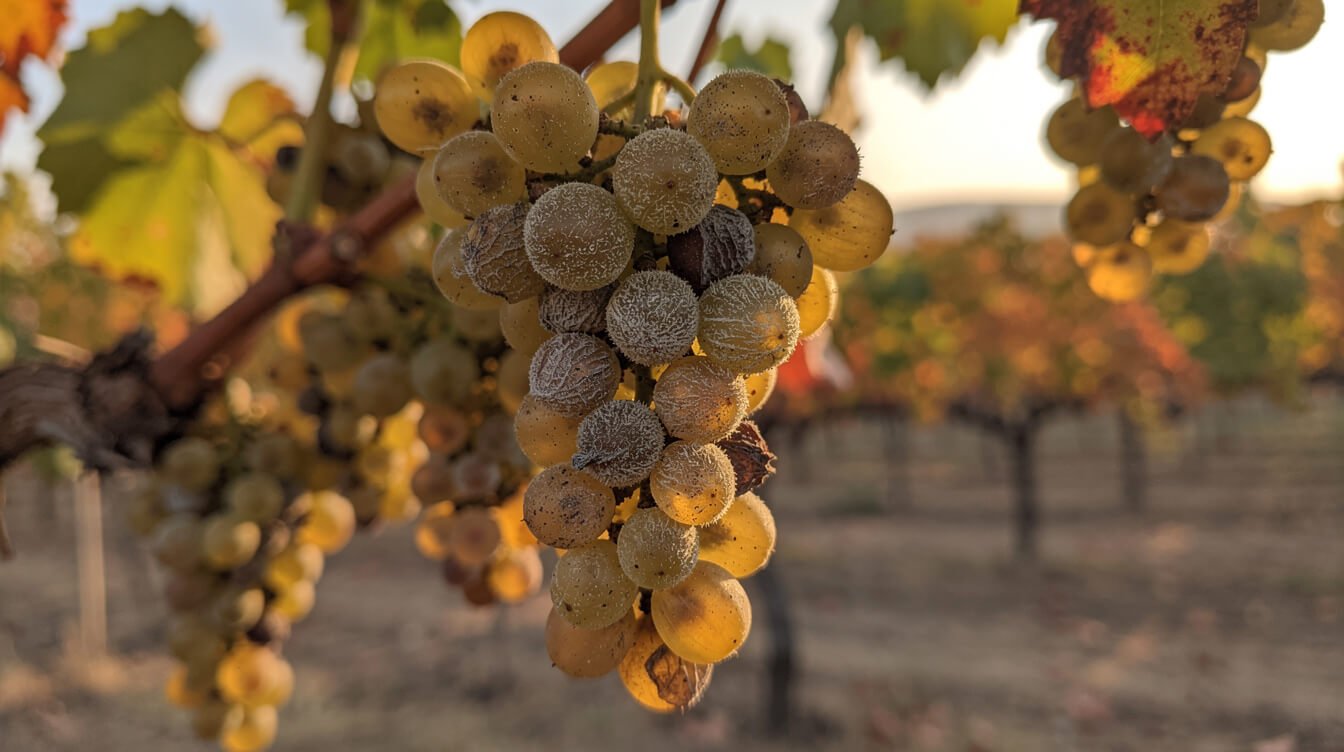
Same fungus, wrong crop. Botrytis cinerea is also the “noble rot” behind some of the world’s most prized dessert wines, including Sauternes and Hungary’s Tokaji. Under misty-morning, dry-afternoon conditions it shrivels ripe grapes and concentrates their sugars (Tokaj researchers still study exactly how). On a grape, the fungus is the point. On a cola, the infection runs hidden through dense flower, and the result goes into your lungs instead of a fermentation tank.
What bud rot looks like, from first sign to too late
It follows a consistent progression. Learn the early stage and you’ll catch most cases while they’re one cola, not one plant.
Early: the yellow sugar leaf that pulls right out
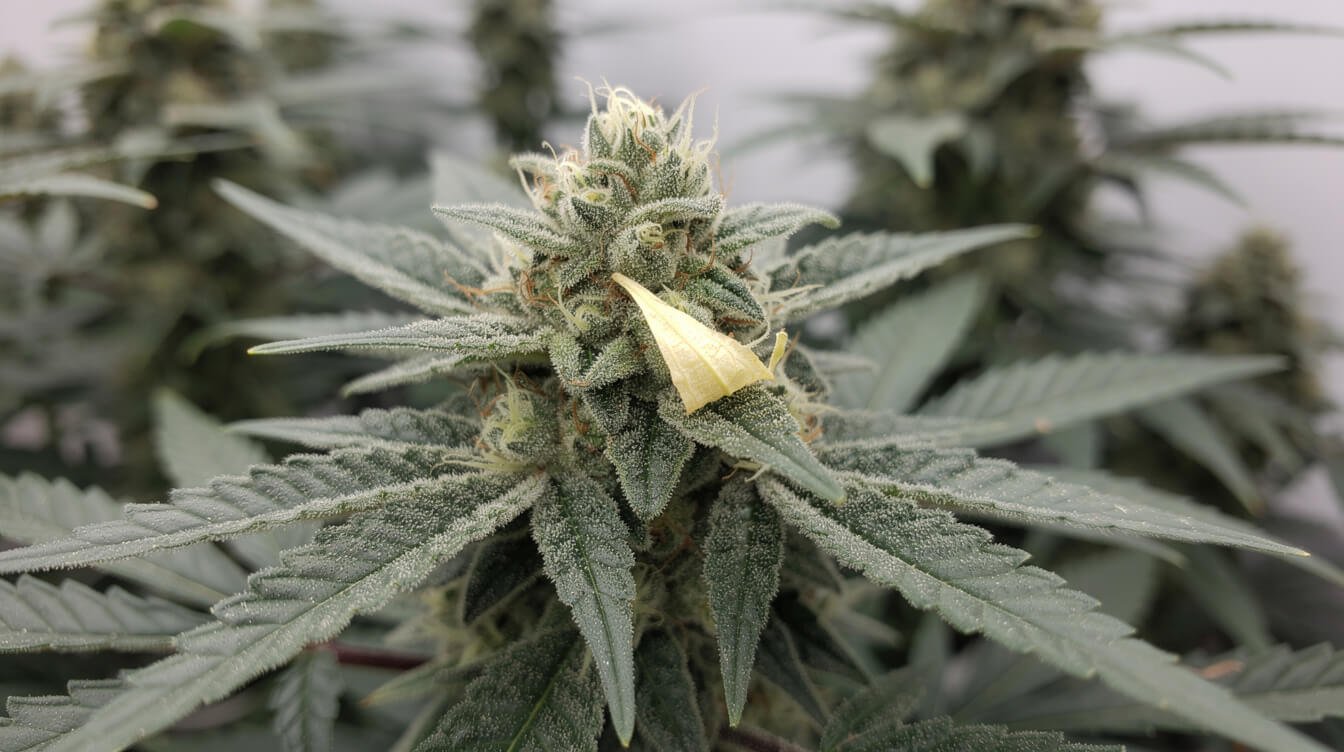
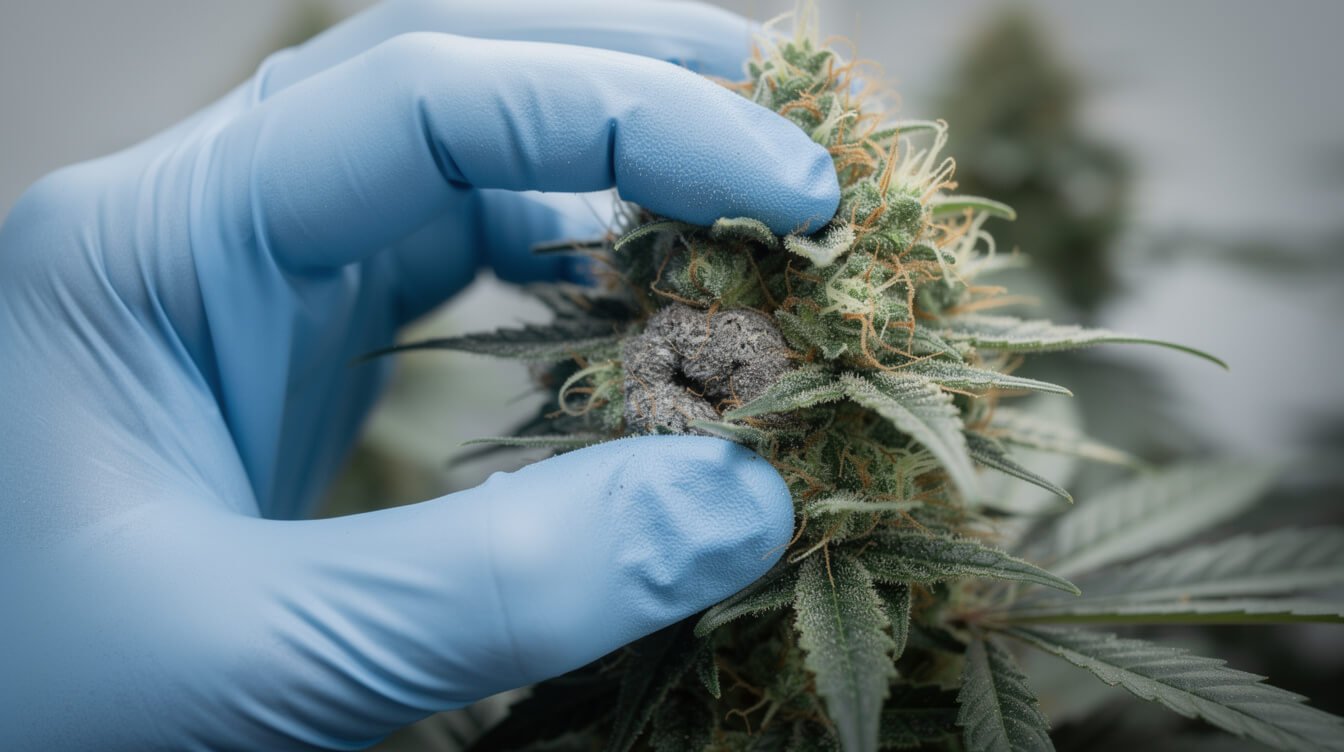
The classic first sign is a single sugar leaf (or a small cluster) on a big, healthy-looking cola that suddenly turns pale yellow or dull and limp. USU’s photos show exactly this: a yellowing leaf bract as the early symptom. Tug it gently. A healthy leaf resists, but one with rot at its base slides right out. Look into the gap it leaves. If you see grey-white fuzz, brown discoloration, or tissue that looks wet and collapsed, that’s bud rot.
Middle: brown, mushy, and fuzzy inside
As the infection spreads, USU describes flower parts developing a “water-soaked lesion that turns necrotic” (dead), followed by a gray mat of mycelium inside and around the flower cluster. Outside, the cola may look dull or shrunken in one section while the rest stays frosty, and that part feels soft or spongy. Break it open (outside the grow space) and the center is brown or grey-black.
Late: spores everywhere
Once the fungus sporulates, the fuzz turns grey and dusty. USU notes these mats form “thousands of spores,” which go airborne and start new infections nearby. The cola is lost, and the job becomes protecting the rest of the room.
What isn’t bud rot
- Nutrient burn shows crispy, brown leaf tips, across many leaves, and the leaves stay firmly attached. (Our nutrient burn guide walks through it.)
- Normal late-flower fade yellows the big fan leaves evenly across the plant. Rot yellows one or two sugar leaves on one cola.
- Purple or dark bracts from genetics or cool nights are even, glossy, and firm. Rot is patchy, dull, and soft.
- Caterpillar damage looks a lot like rot, and USU lists corn earworm feeding as a true look-alike. Look for frass (tiny dark droppings) and chewed tunnels. The two often go together, since chewed tissue is an open door for Botrytis.
If you’re trying to judge dried, jarred weed rather than a living plant, that’s a different question with different tells. Our guide to what moldy weed looks like covers the loupe check for mold versus trichomes.
Why bud rot hits in harvest season: cool, wet, and dense
Search for prevention tips and you’ll find advice that contradicts itself. USU Extension says infection is favored by cool temperatures of 65-75°F plus humidity and moisture. A popular seed-bank guide tells you to keep the room at 70-78°F “to deter fungal growth.” Those ranges overlap, so which is it?
The answer is that temperature by itself isn’t the trigger. Water on the plant is. Temperature matters mostly because of what it does to that water.
The dew point problem
Warm air holds more water vapor than cool air. When air cools, its relative humidity climbs, and if it cools enough it hits the dew point, where vapor condenses into liquid water on the coldest surfaces. UMass Extension’s greenhouse fact sheet spells out what that means for Botrytis: “At night as the air cools to the dew point, condensation occurs and water droplets are formed on cooler surfaces such as the leaves”, and that moisture “promotes the germination of fungal pathogen spores such as Botrytis.”
The margin can be tiny. Per UMass, at 85% relative humidity and 60°F, condensation forms on any leaf colder than about 55°F. At 95% RH, a leaf only one degree cooler than the air gets wet. Their bottom line is the most useful sentence in this guide: keep the plant canopy dry, especially from dusk to dawn.
Why late flower and fall line up so badly
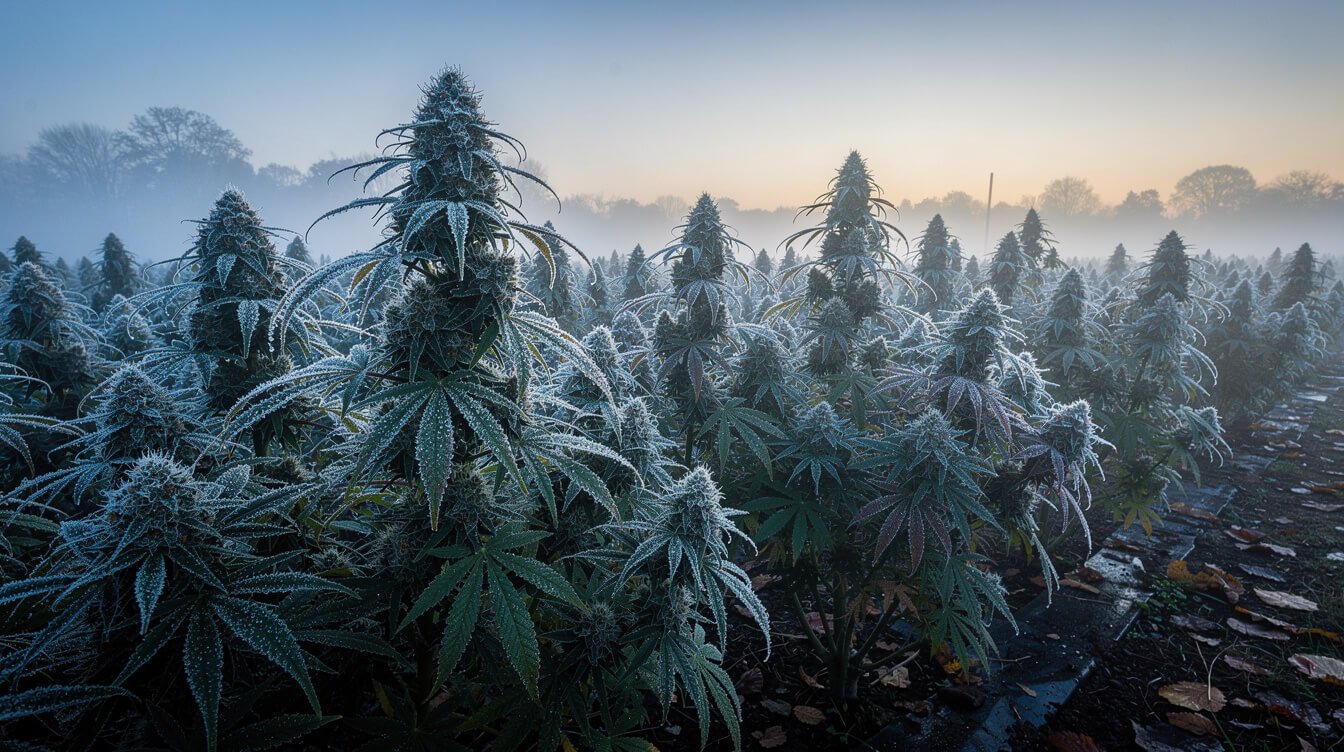
- Outdoors, late flower lands in September and October for most of the Northern Hemisphere. Nights get cold, and dew, fog, and rain arrive right when colas are densest. USU flags “prolonged (one week or longer) greenhouse humidity or cool outdoor rains” as the time for concern.
- Indoors, lights-off is your nightfall. The temperature drops, relative humidity spikes, and a tent that read 50% all day can sit near the dew point for hours, while the hygrometer at head height still says “fine”.
- The buds themselves are at their biggest and tightest, and still transpiring. A fat cola is a sponge that dries slowly after any wetting.
So both sources point at the same thing. A warm, stable room with small day-night swings rarely reaches dew point on the buds, and a cool, damp one does. Manage moisture on the plant, and use temperature swings as the lever.
The day you find bud rot: a calm, clean cut-out
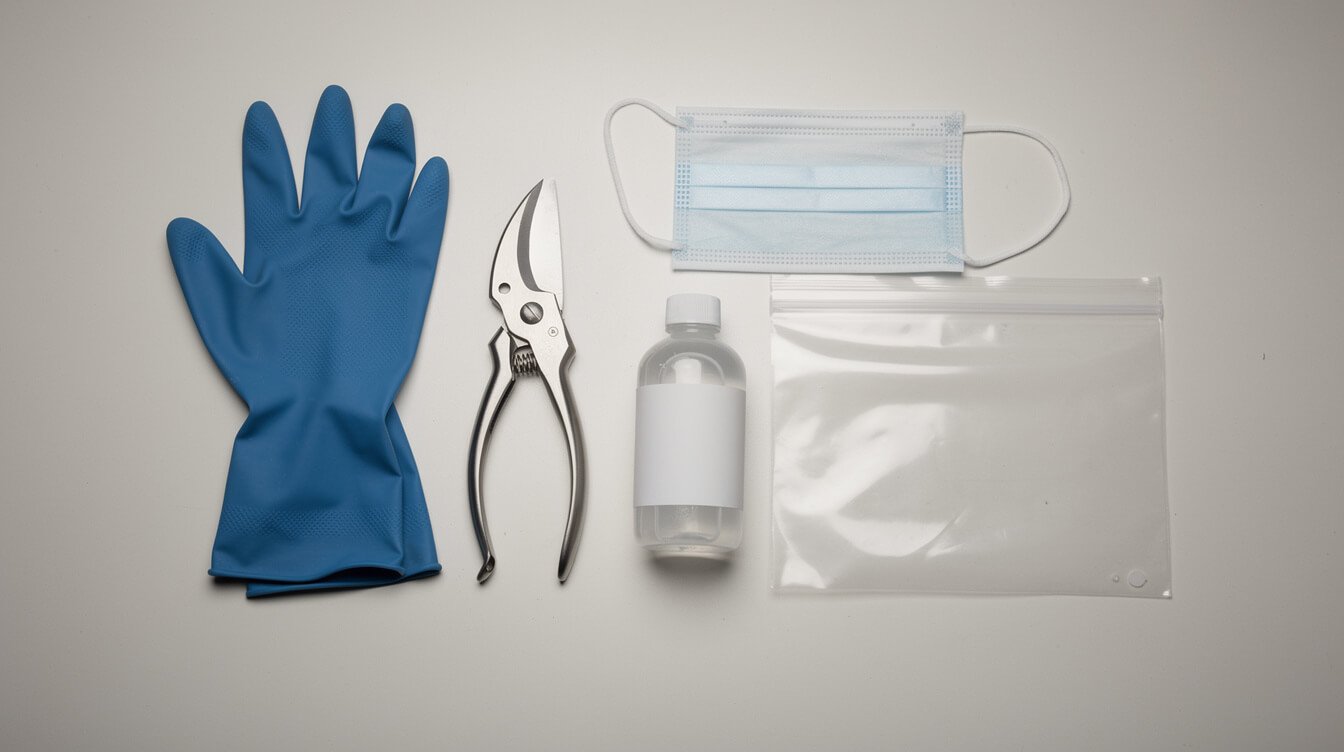
USU is blunt that infections “cannot be cured.” Nothing turns rotted flower back into good flower. Your job now is removing the spore source before it seeds the room, calmly, because shaking plants spreads more spores than it removes.
What you need
- Disposable gloves and a face mask. USU specifically warns to “wear a mask or be careful to not breathe spores as they may cause an allergic reaction.”
- Sharp pruning snips and isopropyl alcohol (or wipes) to clean them between cuts.
- A zip-top or trash bag, so cuttings never travel uncovered.
The cut-out, step by step
- Pause fans aimed at the affected plant while you work, then turn them back on.
- Bag before you cut. Slip the bag over the infected cola, then cut beneath it. Spores fall into the bag instead of onto the canopy.
- Cut well past the visible rot. The infection runs through the inside of the cola, so the visible edge isn’t the real edge. A common grower rule of thumb is to cut at least an inch into clean, green tissue. If the stem center at the cut is brown, cut lower.
- Clean the snips after every cut so you don’t carry the fungus into the next cola.
- Seal the bag and take it out. Don’t compost it near your garden.
- Inspect every neighbor. Check the other colas and the plants touching it, especially the biggest tops.
Then fix the conditions
The cut-out treats the symptom, not the cause. Drop relative humidity into the low 40s if you can, move air through (not just over) the canopy, and shrink the lights-off temperature drop. Then check daily, because unseen spores are already waiting on nearby buds for the next damp night. USU also recommends cleaning tools and grow spaces with a 10-15% household bleach solution between runs. That’s for surfaces and tools only, never for plants.
What not to do
Skip the internet remedy sprays. Hydrogen peroxide, baking soda, and potassium bicarbonate don’t cure infected flowers, and wetting dense buds in late flower is exactly the condition Botrytis wants. USU notes that no fungicides are currently available for use against bud rot on hemp, and licensed growers have been fined over fungicide residues on flower. Pesticide rules for cannabis vary by state, so check before you spray anything. When in doubt, keep sprays off flowers entirely.
GanjaTech, weekly
Cannabis, explained. In your inbox.
One email a week: the clearest explainers, honest gear picks, and what the science actually says. 21+ only. No spam, unsubscribe anytime.
Chop early or keep going? How to make the call
Most guides barely touch this decision. Every day you wait buys a little more ripening and gives the fungus another day. Here’s how to weigh it.
Four questions to ask
- How much is affected, and is it spreading? One cola on one plant, cleanly cut out, with nothing new the next day: keep going and watch closely. New spots appearing daily: the conditions are winning, and you probably should be harvesting soon.
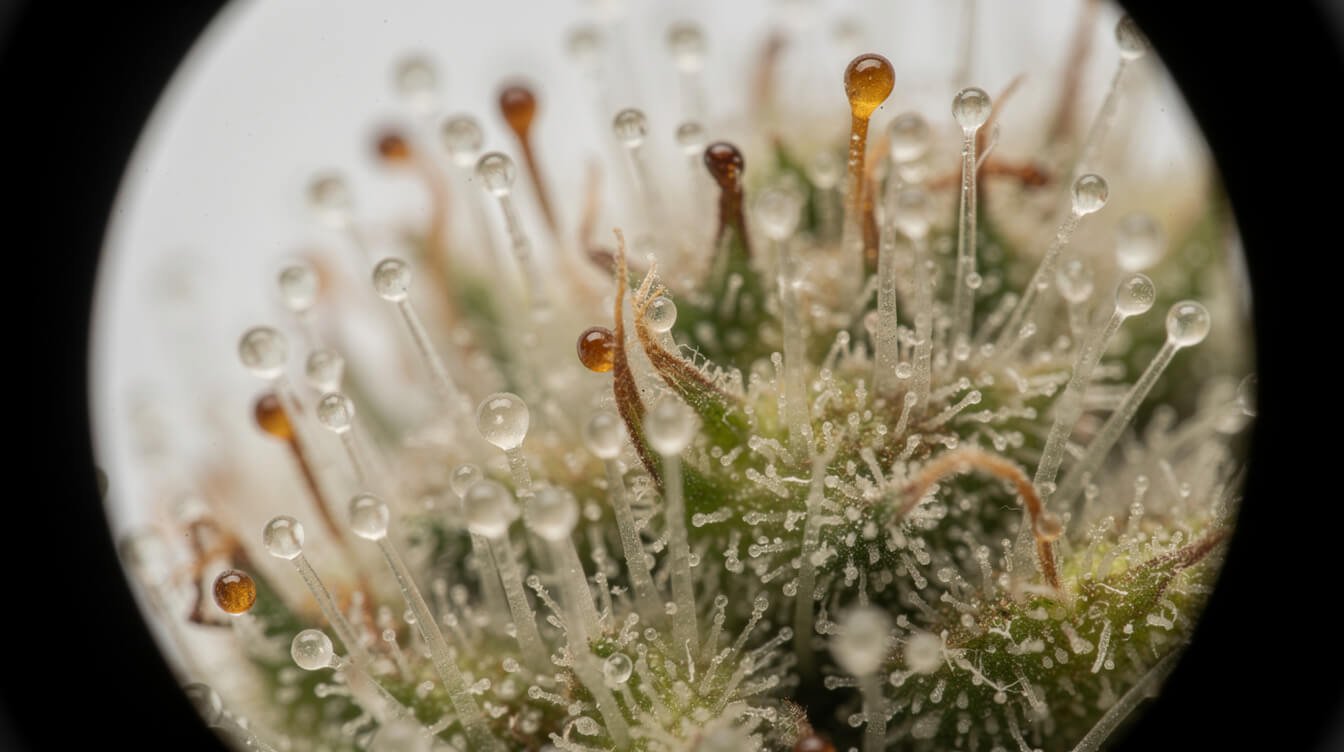
- How close are you to the window? Check the trichomes with a loupe. If most heads are already cloudy, you’re in the window, and chopping now costs little. If they’re mostly clear, early harvest costs more, and fighting on may be worth it. Our trichome harvest guide explains how to read them.
- What’s the weather (or your room) doing next? Outdoors, a forecast of several cold, wet days in a row is a strong case for harvesting before it hits. Indoors, uncontrolled lights-off humidity means the same risk every night.
- Where is it? Rot in a side bud is a cut-out. Rot that’s reached the main stem or the base of the top cola means the plant’s most valuable flower is compromised.
Some growers use a rough rule of thumb, popularized by seed-bank guides: if more than half the plant is affected or the main stem is involved, harvest what’s clean and call it. That’s a heuristic, not science, but it points the right way. Botrytis rarely pauses while cold, damp nights continue.
The partial harvest
You don’t have to choose all or nothing. Many growers harvest the biggest, densest top colas first and let airier side branches ripen a few more days. A plant at mostly cloudy trichomes, harvested a week “early,” still makes a perfectly good stash. A plant left for amber while rot works through it makes compost.
Harvest doesn’t end the risk
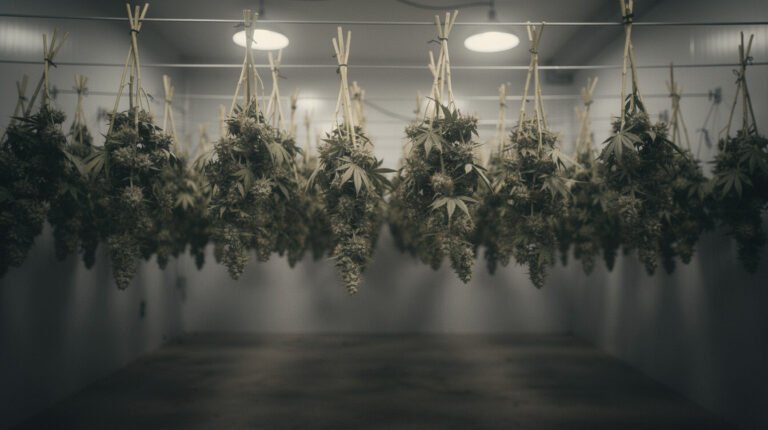
Punja’s team found that when diseased flowers were sealed in a plastic bag for 48 hours, gray-brown mycelium was already growing. Harvested buds are dying tissue, exactly what Botrytis infects, so treat the dry room as part of the fight. Break big colas into smaller branches so they dry evenly, keep air moving gently, inspect daily for the first several days, and pull anything that turns soft or brown. Our guide to drying cannabis covers target conditions, and how to trim cannabis explains why wet trimming helps dense flowers dry evenly.
How to prevent bud rot indoors and outdoors
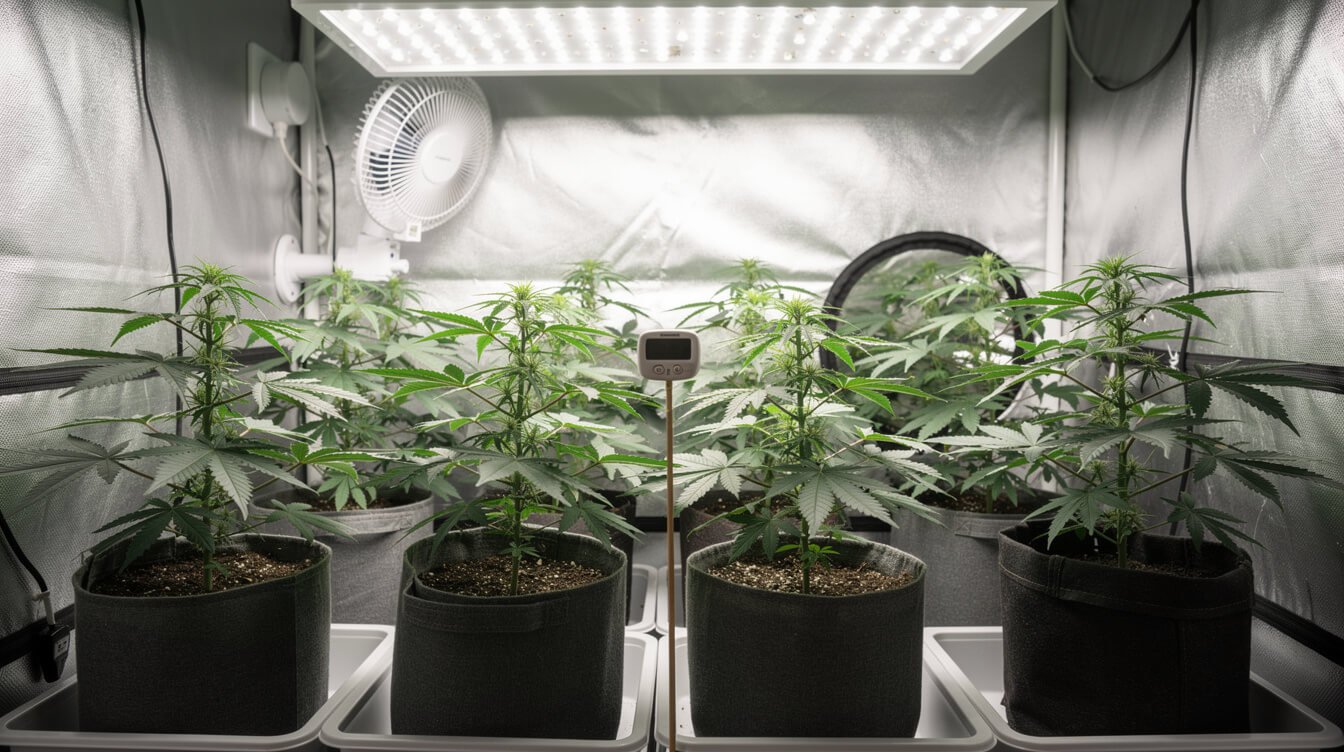
Prevention is the only real cure, and it comes back to one goal: keep water off and out of your colas, especially at night.
Indoors
- Hold relative humidity around 40-50% in late flower. USU says to keep greenhouse RH below 50%, and Grow Weed Easy flags anything above 60% as major risk. Check lights-off readings, not just daytime ones.
- Manage lights-off. Keep the night temperature drop modest, and run dehumidifier and exhaust through the dark period, when RH spikes.
- Move air through the canopy. UMass has a neat test: air movement is adequate “when the leaves move slightly.” Mixed air keeps leaf surfaces from cooling below the dew point. Fans above and below the canopy beat one fan blasting the top.
- Thin and spread the canopy. Strategic defoliation opens airflow into the bud sites, and low stress training spreads colas out so they don’t form one damp wall. Leave space between plants.
- Water at lights-on, not right before dark. Wet media evaporates into the air, and you want that happening while lights and fans can carry it away, not going into the night.
- Clear out dying leaves. Dead foliage inside the canopy is an open door for Botrytis.
If you’re still setting up your first space, our walkthrough on how to grow cannabis indoors covers ventilation and humidity basics from the start.
Outdoors
- Pick genetics for your climate. If your falls are wet, favor airier, earlier-finishing cultivars. Our list of beginner-friendly strains explains what makes a plant forgiving.
- Site for morning sun and wind. Early sun burns off dew fast, and low, sheltered corners hold moisture all morning.
- Cover against rain where you can. A simple overhead cover during wet spells keeps colas from soaking, as long as the sides stay open for airflow.
- Watch for caterpillars. Chewed buds are wounds, and wounds are entry points.
- Scout after every cold, wet stretch. The morning after a rainy or foggy night is when to walk the garden.
After harvest
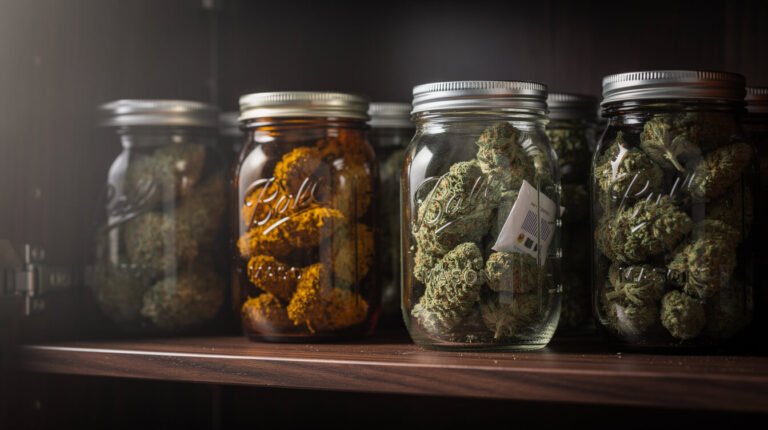
Prevention doesn’t stop at the chop. Dry slowly but with steady airflow, then cure properly. Our guides on how to cure cannabis and curing buds in jars cover burping and moisture checks, and humidity packs can help hold a stable range once flower is properly dry. Never jar buds that are still wet inside. That’s how a hidden infection finishes the job in storage.
Is bud rot weed safe to smoke, wash, or cook?
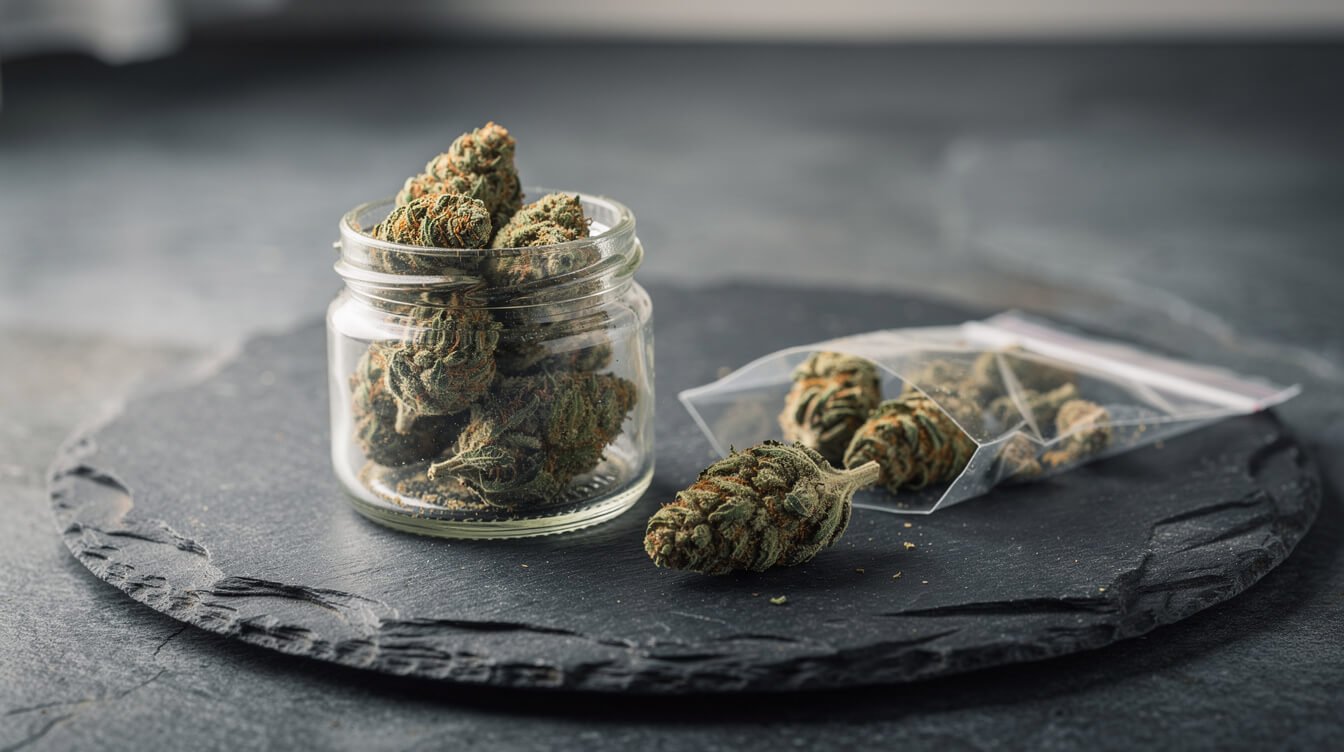
No. Throw out anything with bud rot, plus anything it was touching. The reasons are worth getting right, because a lot of pages overstate them.
What the evidence does and doesn’t say
You’ll often read that Botrytis “produces mycotoxins” that make rotted bud dangerous. That’s shakier than it sounds. Botrytis’s best-known toxins, botrydial and botcinic acid, are phytotoxins: compounds that kill plant cells so the fungus can feed on them. When researchers review the fungi in cannabis that matter for consumer health (Gwinn, Leung, Stephens & Punja, 2023), the mycotoxin concern centers on Aspergillus, Penicillium, and Fusarium, not Botrytis.
That doesn’t make rotted bud fine. It just means the real reasons are different:
- You can’t tell which fungus you’ve got. Punja’s facility survey found Penicillium and Fusarium rots alongside Botrytis, and USU notes that look-alikes can’t be told apart “without a microscope to examine spores.” Rotting flower also feeds whatever other molds are around.
- The spores are allergenic. That’s why USU tells growers to wear a mask just to remove infected plants.
- Smoke doesn’t sterilize. Researchers have isolated live Aspergillus fumigatus spores from cannabis smoke. A lighter flame is not a decontamination step.
Washing, hash, and butter don’t fix it
A common salvage idea is to wash rotted trim into hash, sift it for kief, or cook it into butter. Skip it. The 2023 review notes that fungal spores stick to trichome heads and can be embedded in resin, and every one of those methods works by concentrating the trichome layer. You’d be concentrating the contamination along with the cannabinoids. Our guides to making hash and what kief is assume clean starting material, for exactly this reason.
The careful part, said plainly: if you’re immunocompromised, have asthma or another lung condition, or are otherwise worried about mold exposure, talk to a doctor before handling or cleaning up a moldy crop, and let someone else do the cut-out if you can.
Bud rot FAQ
How long does bud rot take to spread?
There’s no fixed clock, because it depends on moisture and temperature. In damp conditions it moves fast. Punja’s team saw mycelium on diseased flowers within 48 hours in a humid bag, and growers often report a cola going from one yellow leaf to obvious rot in a few days of wet weather. Assume days, not weeks, and inspect daily once you’ve found any.
Can you still harvest a plant with bud rot?
Yes. Cut out every affected cola with a wide margin, bag it, and harvest the clean flower. Then dry it with good airflow and inspect daily, since hidden infections can surface during drying.
Bud rot vs mold: what’s the difference?
Bud rot is a kind of mold. “Bud rot” usually means Botrytis attacking living flowers from the inside, on the plant. “Mold” is the broader term, and it includes the powdery mildew that coats leaves and the Aspergillus or Penicillium that can grow on dried flower in a jar that was sealed too wet. If you’re checking finished weed rather than a growing plant, start with our post on what moldy weed looks like, and see does weed go bad for the non-mold ways old flower degrades.
What does bud rot look like early?
One or two sugar leaves on a big cola turning yellow or limp while everything around them stays green and frosty. The leaf pulls out easily, and there’s brown or grey tissue at its base. Catching it here usually means losing one cola instead of a plant.
Can bud rot happen after harvest?
Yes. The infection often starts on the plant, stays hidden, then takes off once the flower is cut, especially in dense colas, a crowded or humid dry space, or buds jarred before they’re dry inside. Airflow during the dry and patience before the cure are your defense.
Final thoughts: bud rot is a moisture problem
Strip away the panic and bud rot comes down to one thing: water sitting on and inside dense flowers, most often in the cool hours of the night, late in the season. Manage that, especially from dusk to dawn, and you’ve done most of the prevention. Watch your biggest colas for the yellow sugar leaf, cut out what you find cleanly, and make the chop-early call with your trichomes and forecast in front of you, not hope.
When it does get a cola, let it go. The same fungus makes beautiful wine, but on cannabis there’s no noble version. Bin it and protect the rest of the room. Great plant. Respect it, know your local laws, and grow responsibly.
Before you go
Get the next explainer first
We publish a new one every day. The best of the week, plus what's new in the shop, lands in one short email.