What Does Moldy Weed Look Like? How to Tell Mold From Trichomes (and What to Do About It)
What does moldy weed look like? Usually like grey-white fuzz or thin, cobweb-like threads sitting on or between the buds. It’s dull and matte, not sparkly, and it shows up in irregular patches instead of an even frost. Sometimes it’s grey, brown, black, or blue-green spots, and it nearly always comes with a musty, damp-basement smell. If you see fuzz and smell basement, the answer is done: throw it out.
That’s the easy part, and it’s what most guides stop at. The rest of this page covers what they skip. You’ll learn the 10-second loupe check that separates mold from trichomes, the look-alikes that fool people (powdery mildew, bud rot, kief, plain old lint), and why breaking a nug open tells you more than staring at the outside. Then the uncomfortable bit, said plainly and without fear-mongering: some of the fungi that matter most on dried flower are invisible, and smoking doesn’t reliably sterilize them. Finally, the boring storage physics that keeps your jar from growing anything in the first place.
Quick housekeeping: this is for adults 21+, cannabis laws vary by state and country, and nothing here is medical advice. If your health is involved, that’s a conversation for your doctor.
What does moldy weed look like? The short answer, then the details
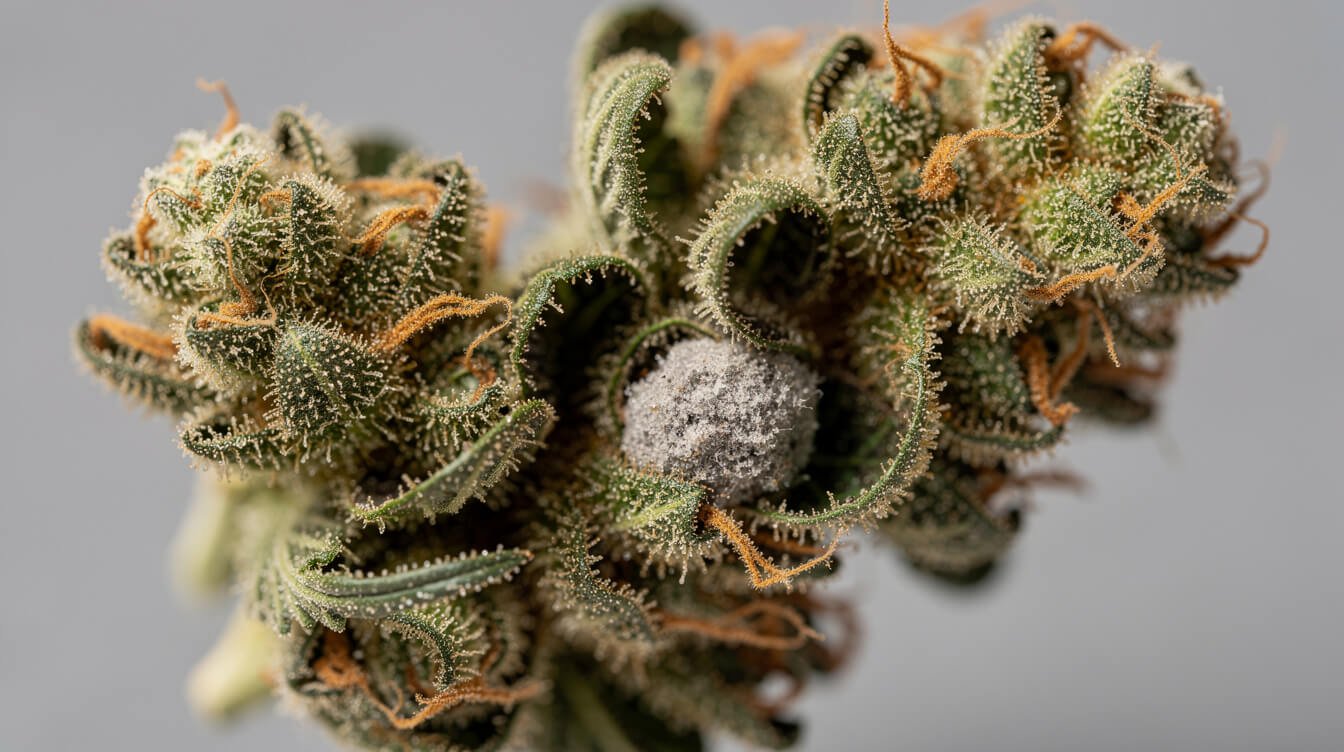
Visible mold on cured flower has a handful of consistent tells. You rarely get all of them at once, but one clear one is enough.
- Fuzz or webbing. Fine white or grey threads, like a wisp of cotton or a tiny spider web, stretched across the surface or tucked into the crevices between calyxes. Those threads are hyphae, the body of the fungus. Trichomes never look like that.
- A dull, flat coating. Healthy frost glitters when you tilt the bud under a light. Mold looks powdery and matte, like someone dusted the nug with flour and the shine went with it.
- Patches, not coverage. Trichomes coat a bud fairly evenly. Mold starts somewhere (a dense pocket, a spot that stayed wet) and spreads outward, so you see a blotch on one side and clean flower on the other.
- Off-color spots. Grey, brown, or black specks, or a blue-green tint. Brown, mushy tissue deep inside a dense bud points to bud rot, which we’ll get to.
- Wrong texture. Properly dried flower is slightly springy and its small stems snap. Moldy or rotting flower often feels damp, spongy, or oddly soft in one spot.
Now the nuance. Color is the least reliable of those signals. Cannabis comes in purples, deep greens, and orange-pistil chaos, and plenty of healthy buds have dark patches from genetics or a cold finish. Texture and pattern carry far more weight than color. A purple bud with an even sparkle is fine. A green bud with one grey, cottony corner is not.
Also, look at the whole jar, not just the nug in your hand. Mold spreads by spores, so if one bud is fuzzy, its neighbors have been sharing air with it. Check every piece, and pay the most attention to the biggest, densest ones, since they dry slowest and trap moisture longest.
If you’re asking what does moldy weed look like because you just saw something odd and want a fast verdict, here’s the honest shortcut. Visible fuzz plus a musty smell means it’s moldy, full stop. Anything less clear-cut deserves the loupe check in the next section before you decide.
Mold vs trichomes: the 10-second loupe check
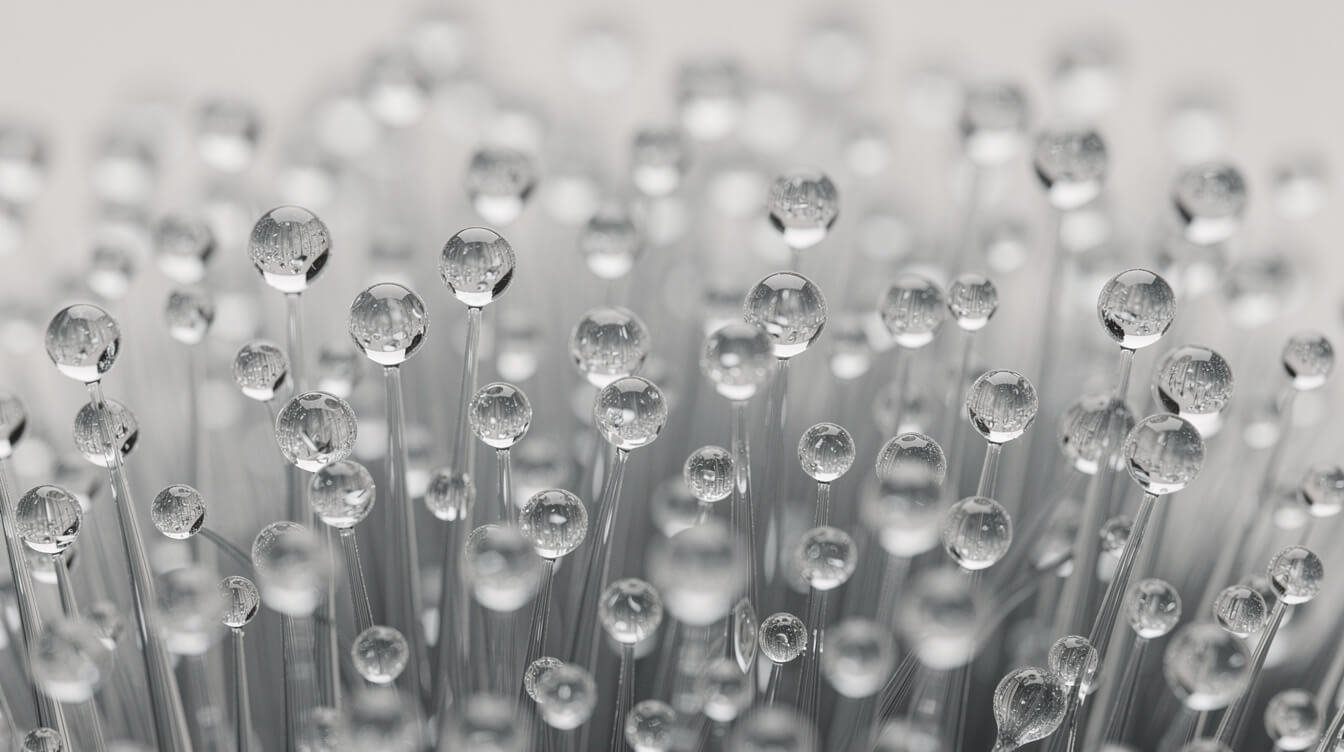
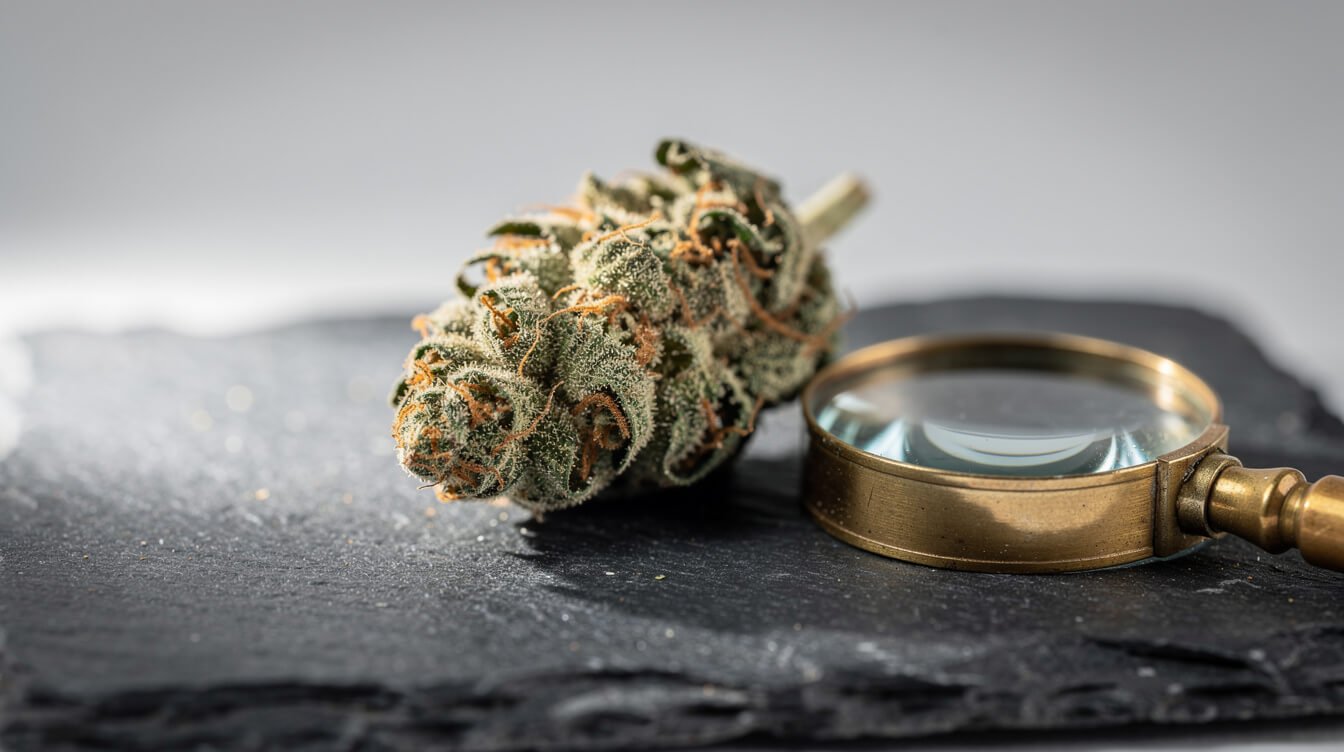
This is the confusion that sends most people searching. Good, frosty flower is literally covered in tiny white structures, so a heavy trichome coat can look “fuzzy” to the naked eye. The fix costs about ten dollars: a 30x to 60x jeweler’s loupe or a cheap pocket microscope. (If you’ve used one to read trichomes at harvest, you already own the right tool.)
Put the bud under good light, get the loupe close, and look for shape.
What trichomes look like up close
The resin glands that matter (capitate-stalked trichomes) look like tiny mushrooms or golf balls on tees: a thin stalk topped by a round, glassy head. They’re clear, cloudy, or amber. They stand up from the surface in a fairly even forest, and they catch the light like glass beads. Everything is organized. Every gland is the same basic shape, repeated thousands of times.
What mold looks like up close
Mold has no heads and no order. Under magnification you see tangled threads running across the surface and between trichomes, not standing up from it. It often looks like cotton candy, felt, or a smear of dull powder. Where it’s thick it hides the trichomes underneath. It doesn’t sparkle, and its threads go wherever they want.
The quick version you can remember:
- Trichomes: stalk plus round head, glassy, uniform, upright, shiny.
- Mold: threads or powder, matte, patchy, lying flat and tangled.
One more tell: trichomes are attached to the plant and break off as golden-tan dust when you grind. That dust is kief, and it’s just trichome heads. Mold threads behave more like lint. They lift away in wisps or smear, and they stay grey-white rather than turning golden. If what you’re seeing under the loupe is a field of little glass mushrooms, relax. That’s the good stuff doing its job.
Mold look-alikes: powdery mildew, bud rot, kief, and lint
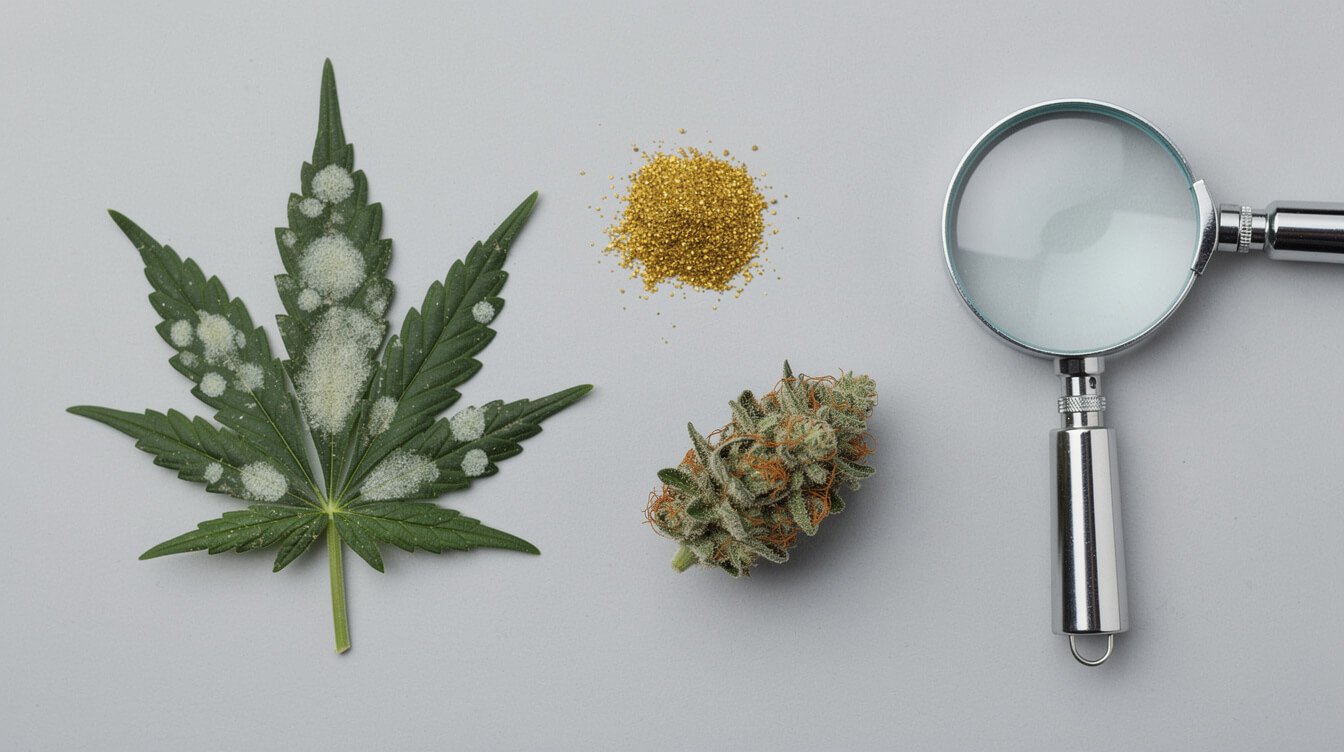
Not every white or brown thing on a bud is mold, and not every kind of fungal damage looks like fuzz. Here’s how the usual suspects compare.
| What you see | What it looks like | Where it shows up | Verdict |
|---|---|---|---|
| Trichomes | Glassy stalks with round heads, even frost, sparkles | All over buds and sugar leaves | Healthy. That’s the point of the plant. |
| Kief clumps | Golden-tan powder, loose and sandy | Grinder chamber, jar bottom, broken nugs | Healthy. Fallen trichome heads. |
| Lint, pet hair, dust | Single fibers, often colored, no spreading pattern | Anywhere, usually on the surface | Pick it off. Not a fungus. |
| Powdery mildew | Flat white, flour-like dusting in spots that merge | Fan and sugar leaves first, then flower | Fungal. Don’t smoke affected flower. |
| Bud rot (botrytis) | Brown, mushy interior, dry brown leaves poking out, grey fuzz later | Inside dense buds, near the stem | Fungal. Discard the whole bud and check the rest. |
| Surface mold | Grey-white cotton or webbing, sometimes dark or blue-green spots | Crevices, dense pockets, spots that stayed wet | Fungal. Discard. |
Powdery mildew is the look-alike growers know best. It’s a fungus that grows as a flat white powder, usually on leaves first. On dried flower it reads as a dusty coating that dulls the frost. A loupe shows a felt-like film instead of upright glands, and that’s the difference that counts.
Bud rot is the sneaky one, because it starts on the inside. The fungus behind it, Botrytis cinerea, likes the humid core of fat, dense colas. It often rots the bud from the stem outward before anything shows on the surface. On a cured nug the clue is a brown, crumbly or slimy center, or a few dead, dry leaves sticking out of an otherwise healthy-looking bud. We cover the grower side (spotting it on the plant, and when to chop) in our bud rot guide. For a consumer, the rule is simple: brown mush inside means the bud goes in the trash.
Kief and lint are the false alarms. Kief is golden and sandy and collects where buds rub together. Lint is individual fibers with no spreading pattern, often a color the plant doesn’t make. Neither one is a reason to toss anything.
Smell, feel, and the break-it-open check
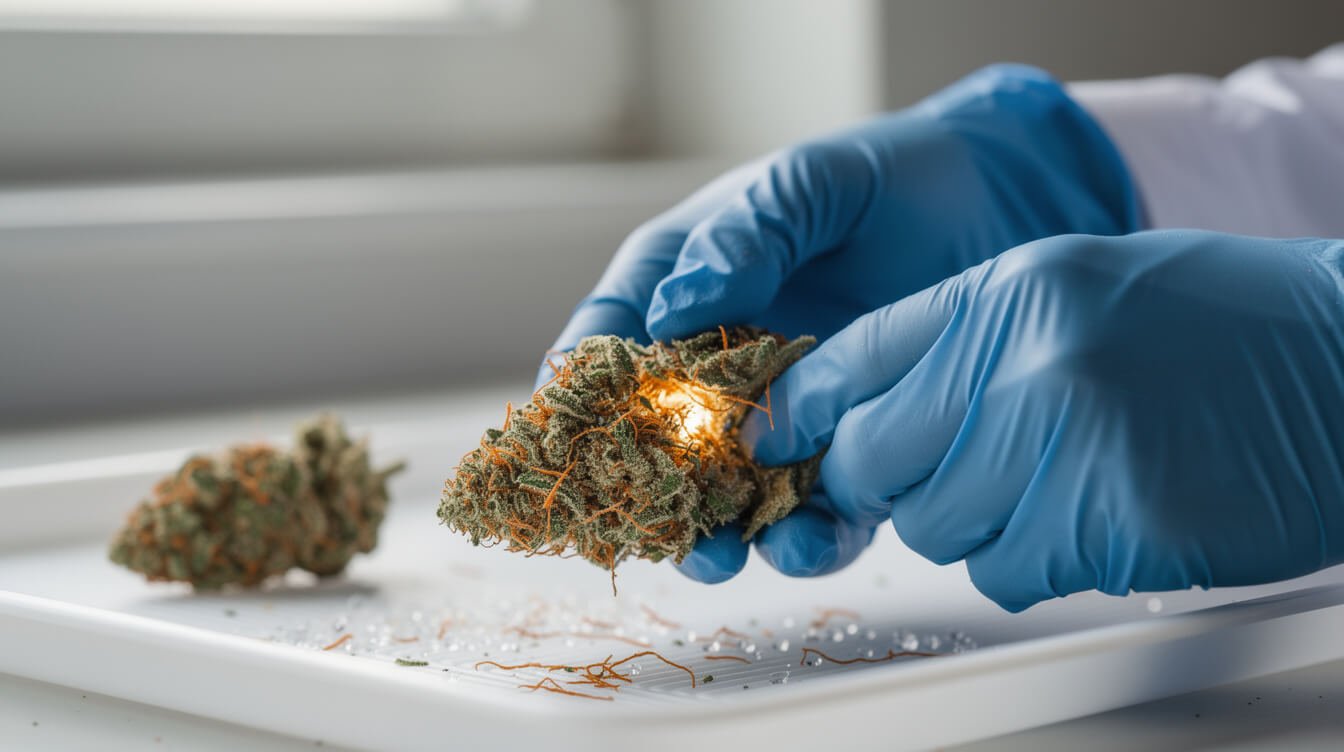
Your eyes catch surface mold. Your nose and fingers catch the rest. Run all three checks on anything you’re unsure about.
The smell test
Good flower smells like its terpenes: citrus, pine, fuel, berry, pepper, skunk. Even old, faded weed still smells like weak plant. Mold smells different. People describe it as musty, damp basement, wet cardboard, a gym bag, or old wet hay. Once you’ve smelled it, you don’t forget it.
Two smells get mistaken for mold, and it helps to tell them apart:
- A fresh-cut grass or hay smell usually means the flower was dried too fast or barely cured, so chlorophyll is still hanging around. It’s unpleasant, but it isn’t mold. A proper cure fades it.
- A sharp ammonia or “pee” smell from a freshly opened jar means it was sealed too wet. It isn’t proof of mold yet, but it’s a loud warning that conditions inside are right for it. Open it up, inspect every bud, and let them air out before resealing.
If the smell is musty in the damp-basement sense rather than grassy, trust it. Your nose often catches mold before your eyes do.
The feel test
Properly dried and cured flower is a little springy. Squeeze it gently and it gives, then holds its shape. Small stems snap instead of bending. Moldy or rotting flower often feels damp, spongy, or soft in one spot compared to the rest of the bud. Flower that’s wet enough to feel clammy is wet enough to grow something, mold or not.
Break the big ones open
This is the step almost nobody does, and it’s the one that catches hidden rot. Dense buds dry from the outside in, so the center is the last part to lose moisture and the first place a fungus gets comfortable. Take your largest, tightest nug and pull it apart by hand over a clean white surface. Healthy flower is the same color all the way through, with trichomes inside as well as out. Rot shows up as brown, grey, or black tissue in the core, sometimes with fine webbing, and often a stronger musty smell once it’s open.
If the biggest bud in the jar is clean in the middle, the smaller ones are very likely fine too. If it isn’t, check everything else in that container before you use any of it.
GanjaTech, weekly
Cannabis, explained. In your inbox.
One email a week: the clearest explainers, honest gear picks, and what the science actually says. 21+ only. No spam, unsubscribe anytime.
The mold you can’t see
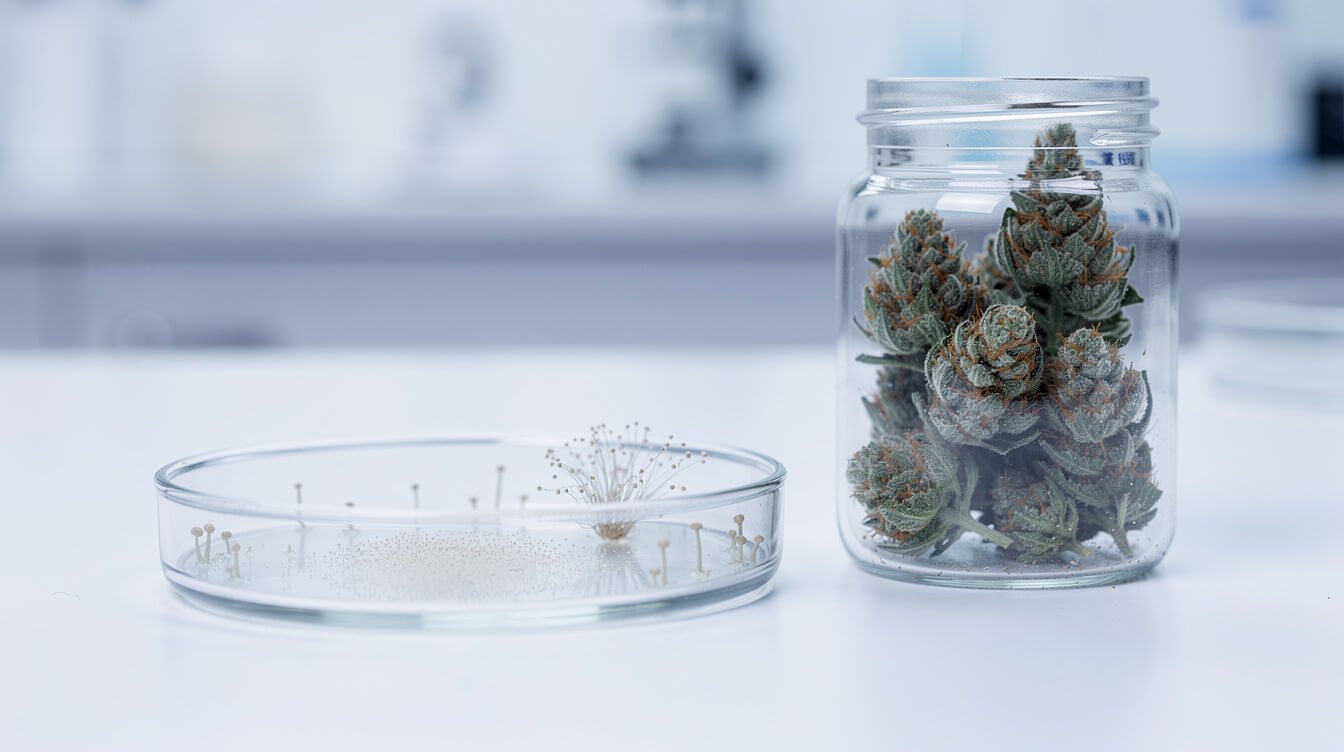
Here’s what the “just look for fuzz” guides leave out. Visible fuzz is only part of the fungal picture on cannabis.
A 2023 review in Frontiers in Microbiology (Gwinn, Leung, Stephens & Punja) counts more than 100 fungal species associated with cannabis flowers. Some cause obvious disease, like bud rot. Others live inside plant tissue or on its surface without causing visible damage. The authors single out Aspergillus, Penicillium, Fusarium, and Mucor as the groups of most concern for consumers. They also note that Aspergillus and Penicillium tolerate low moisture, which is exactly the condition of dried, cured flower.
The detail that matters most for a home check: the review describes fungal spores sticking to the surface of trichome heads or embedded in the sticky resin. So the very structures you inspect with a loupe can carry spores you can’t see at 60x. A clean-looking bud isn’t a guaranteed clean bud. It’s just a bud with no visible mold.
That’s the real reason licensed cannabis markets lab-test flower for microbial contamination. Requirements vary a lot. Some jurisdictions screen for total yeast and mold, some for specific Aspergillus species, some for mycotoxins, and the limits differ from place to place. We won’t summarize any particular state’s rules here, because they change and they differ. The broad point stands either way: testing exists because eyes can’t do the whole job.
None of this is a reason to panic about every jar. Most well-dried, well-stored flower is fine. It’s a reason to take visible mold seriously when you do see it. If a bud has visibly grown something, the parts you can’t see have had the same conditions and the same time to grow.
Can you smoke, bake, or salvage moldy weed?
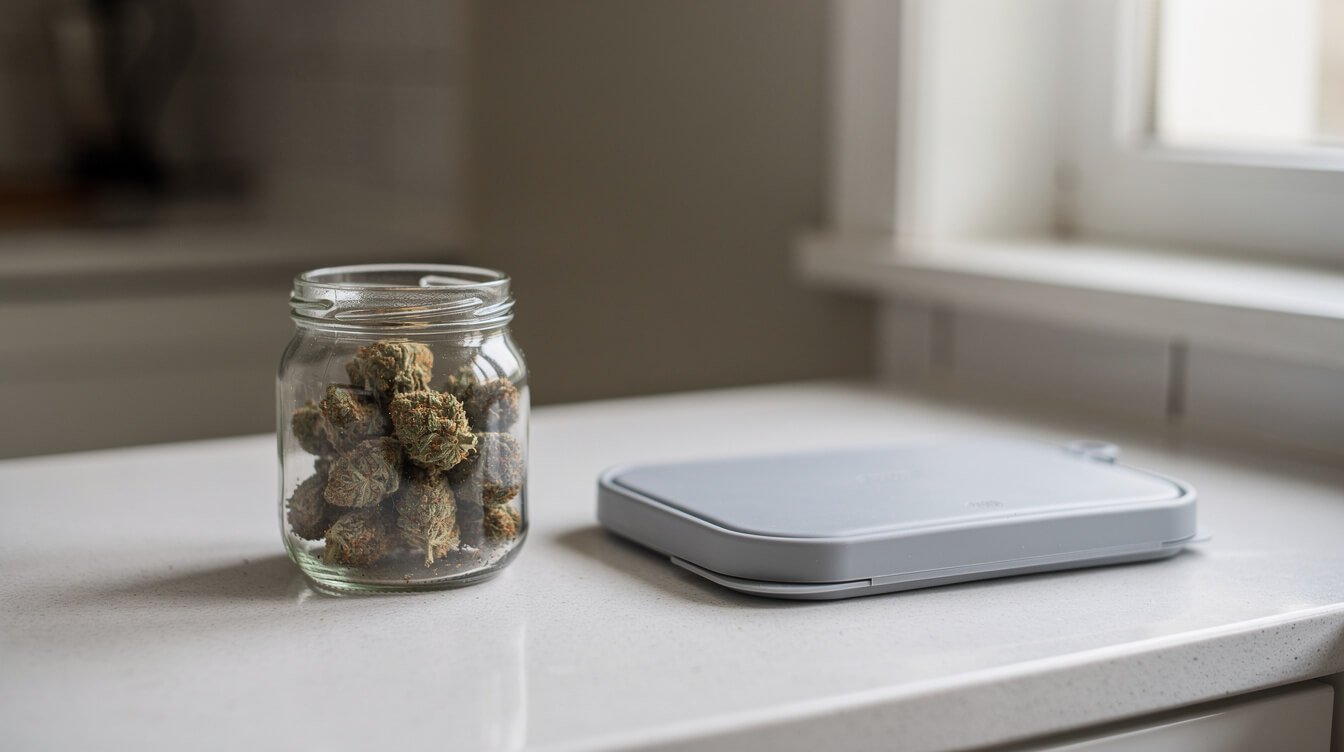
No, no, and no. People ask this one hopefully, because nobody likes binning flower they paid for or spent four months growing. Here’s why the answer doesn’t bend.
Smoking doesn’t reliably sterilize it
The intuition goes: “it’s on fire, nothing survives that.” The research says otherwise. A 1983 study in Mycopathologia (Kurup et al.) isolated live Aspergillus fumigatus spores from marijuana smoke, not just from the flower. A companion study the same year (Kagen et al.) found fungi in 13 of 14 samples it tested. When the researchers drew smoke through contaminated joints into an air sampler, A. fumigatus “passed easily” through. Those are older samples from a very different era of cannabis, but the physics hasn’t changed. The 2023 review puts it carefully: smoking and vaping temperatures should kill spores, but they “may be insufficient to render all spores nonviable.”
The ember is hot, but the air pulled through the unburned part of the joint is much cooler, and that’s the path spores travel.
Cutting it off, drying it out, or “it’s only a little” doesn’t work either
Trimming away the fuzzy part removes the visible fungus, not the spores that have already spread through the bud and jar. Drying moldy weed stops new growth, but it doesn’t remove what’s already there. Spores are built to survive dry periods. And “only a little” visible mold usually means more you can’t see.
Don’t bake it into edibles or press it into hash
Decarb and infusion temperatures are far below combustion. If decarb heat can’t do what a flame can’t reliably do, it isn’t fixing anything. Heat that kills a fungus also doesn’t necessarily destroy toxins the fungus has already produced. Turning bad flower into cannabutter just turns a bad bud into a bad batch. Making hash is worse in a specific way: hash collects trichome heads, and the 2023 review notes spores stick to exactly those heads. You’d be concentrating the problem.
Who should be most careful
Documented risks from inhaling fungal contamination include allergic reactions, and they’re more serious for some people. Medical literature links certain fungi, especially Aspergillus, to serious lung infections in people with weakened immune systems or existing lung conditions. If that’s you, talk to your doctor about cannabis use in general, not just moldy cannabis. And if you feel unwell after smoking flower you now suspect was moldy (wheezing, a cough that won’t quit, fever, chest tightness), see a doctor and tell them what you smoked. That isn’t the moment for a forum thread.
Honest bottom line: for most healthy adults, one accidental hit of moldy weed is unpleasant rather than an emergency. That still isn’t a reason to finish the jar. When the flower is visibly moldy, the right move is to throw it out, wash the container, and check what it was stored next to.
Why weed molds in the jar, and how to stop it
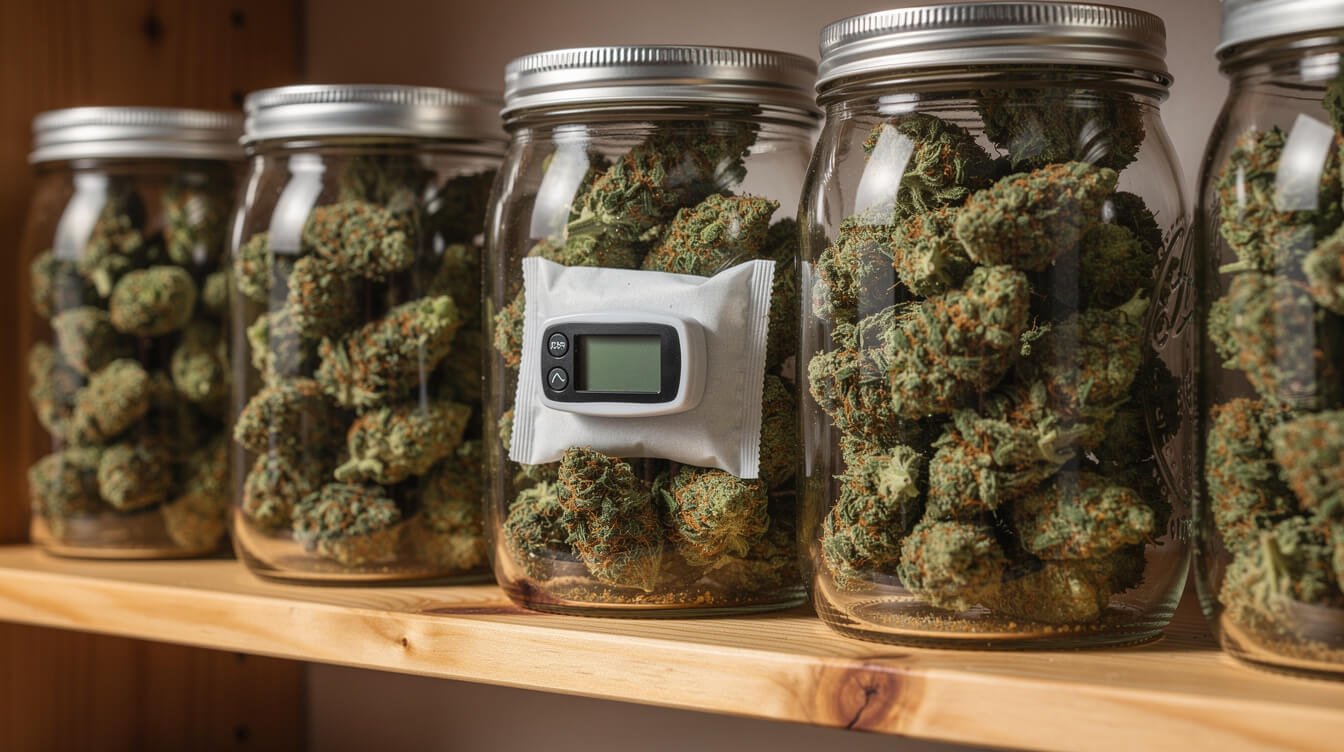
Mold isn’t bad luck. It’s moisture plus time. Understanding one number, water activity, explains almost every moldy jar.
Water activity, the number that actually matters
Water activity (aw) measures how much of the water in a material is available to microbes, on a scale from 0 to 1. Per the 2023 review, most fungi grow best between roughly 0.83 and 0.99, and drying cannabis to a water activity below about 0.7 prevents the growth of most fungi. The handy part: in a sealed jar, flower settles into balance with the air around it, so the jar’s relative humidity roughly mirrors the flower’s water activity. A jar holding 60% RH means flower near 0.60. That’s comfortably below the line.
That’s why the standard storage target is around 58–62% RH. It’s moist enough to keep the flower from going crispy and losing terpenes, and dry enough to stay out of fungal range. It’s also why humidity packs work. They hold the jar in that band and absorb or release moisture as needed.
The usual ways jars go wrong
- Jarring too early. This is the big one. Buds feel dry on the outside while the stems and cores are still wet. Seal them and that hidden moisture redistributes into the jar air, pushing RH well past 70%. Finish the dry properly first. Small stems should snap, not bend.
- No hygrometer. Guessing is how mold happens. A cheap digital hygrometer in the jar tells you within a day whether you’re at 62% or 75%.
- Not burping during the cure. Early in a cure, jars need opening to vent moisture. If a jar reads above about 70%, take the buds out and let them air for a few hours before resealing. Our jar-cure troubleshooting guide walks through the numbers.
- Using a humidity pack to fix wet weed. A two-way pack can absorb some extra moisture, but it can’t rescue flower that went in soaking wet. Packs are for holding a good cure, not for drying.
- The fridge. Moving a cold jar into a warm room causes condensation, which is free water right where fungus wants it. A cool, dark cupboard beats the fridge.
- Rehydration hacks. Orange peels, lettuce, or a slice of bread in the jar add uncontrolled moisture and organic matter. It’s a mold invitation. If flower is too dry, a humidity pack is the controlled way to bring it back.
For the broader picture of what fades over time versus what actually spoils (potency loss, terpene loss, shelf life), see does weed go bad. Mold is the one kind of “going bad” that’s a safety problem rather than a quality problem, and nearly all of it is preventable with a proper dry, a patient cure, and a jar that stays near 60%.
FAQ: what does moldy weed look like, smell like, and can you smoke it?

What does moldy weed look like under a loupe?
Tangled threads or a felt-like powder lying across the surface, with no stalks and no round heads. Healthy trichomes look like tiny glass mushrooms standing upright in an even forest. Mold looks like cotton or dust smeared between and over them, and it doesn’t sparkle.
What does moldy weed smell like?
Musty, like a damp basement, wet cardboard, or mildewed laundry. A grassy or hay smell usually means a rushed dry or cure rather than mold. Ammonia means the jar was sealed too wet and needs checking right away.
Can weed get moldy in a sealed jar?
Yes. Sealing it doesn’t keep mold out, because spores are already on the flower. What matters is moisture. A jar sealed with under-dried buds can climb above 70% RH and grow mold within days. A jar holding near 60% RH with properly dried flower is about as safe as storage gets.
Moldy weed vs trichomes: how do I tell without a loupe?
Tilt the bud under a bright light. Trichomes glitter evenly across the whole surface. Mold looks dull and sits in patches. Then smell it: trichomes smell like the strain, and mold smells musty. If you’re still unsure, get a 30x–60x loupe. It’s cheap and it ends the guessing.
Does a black light show mold on weed?
Not reliably. The UV “glow” test comes from aflatoxin screening in crops. A bright greenish-yellow fluorescence was first linked to Aspergillus flavus contamination in cottonseed in 1969 and later used on grains and nuts. Even there it’s a presumptive screen, and other compounds can make it give false positives. It hasn’t been validated on cannabis. A glow doesn’t confirm mold, and no glow doesn’t clear a bud. Use the loupe, the smell test, and the break-it-open check instead.
Can you still smoke moldy weed if you only see a little?
No. Visible mold means spores have spread beyond what you can see, and smoking doesn’t reliably kill them. Research has recovered live Aspergillus spores from cannabis smoke itself. Throw it out.
Can dried, cured weed still grow mold?
Yes, if it gets damp again from a humid room, condensation, a wet rehydration trick, or a jar sealed too early. Drying lowers water activity, and anything that raises it back up reopens the door.
Final thoughts: when in doubt, throw it out
So what does moldy weed look like, in one line? Grey-white fuzz or webbing, matte instead of sparkly, in patches rather than an even frost, usually with a damp-basement smell. If you can see it and smell it, you’re done deciding.
For everything in between, use the three checks: a loupe for shape (glassy mushrooms good, tangled threads bad), your nose for smell (terpenes good, basement bad), and your hands for the big nugs (clean center good, brown mush bad). Keep the honest caveat in mind too. Some fungal contamination is invisible, and fire isn’t a sterilizer, so visible mold is a “throw it out” signal, not a “trim around it” one.
The good news is that prevention is cheap and boring. Dry properly, cure patiently, keep jars near 60% RH with a hygrometer to prove it, skip the fridge, and skip the orange peel. Do that and you’ll rarely need this page. Great plant. Respect it, know your local laws, and enjoy it responsibly.
Before you go
Get the next explainer first
We publish a new one every day. The best of the week, plus what's new in the shop, lands in one short email.