Limonene Terpene: What It Smells Like, Where It Comes From, and the One Human Study That Tested It With THC
The limonene terpene is the compound behind that bright, citrus-peel note in some cannabis, and it is the same molecule that makes an orange smell like an orange. Here’s the honest short version: limonene is real, common, and responsible for a lot of what you smell in the jar. But most of the health “benefits” you’ll see attached to it online come from lab dishes, rodents, and high-dose supplements, not from people using cannabis. There is exactly one controlled human study that tested limonene alongside THC, and almost nobody explains what it found.
Below: what limonene is, where it shows up (including the twist that the plant makes a slightly different form than your orange does), what that one human study actually found and didn’t, why lemon-smelling weed isn’t always high in it, and how to keep it from evaporating out of your flower. Quick framing: this is education for adults 21+. Cannabis laws differ by state and country, so know yours before anything else.
What is the limonene terpene? The short answer
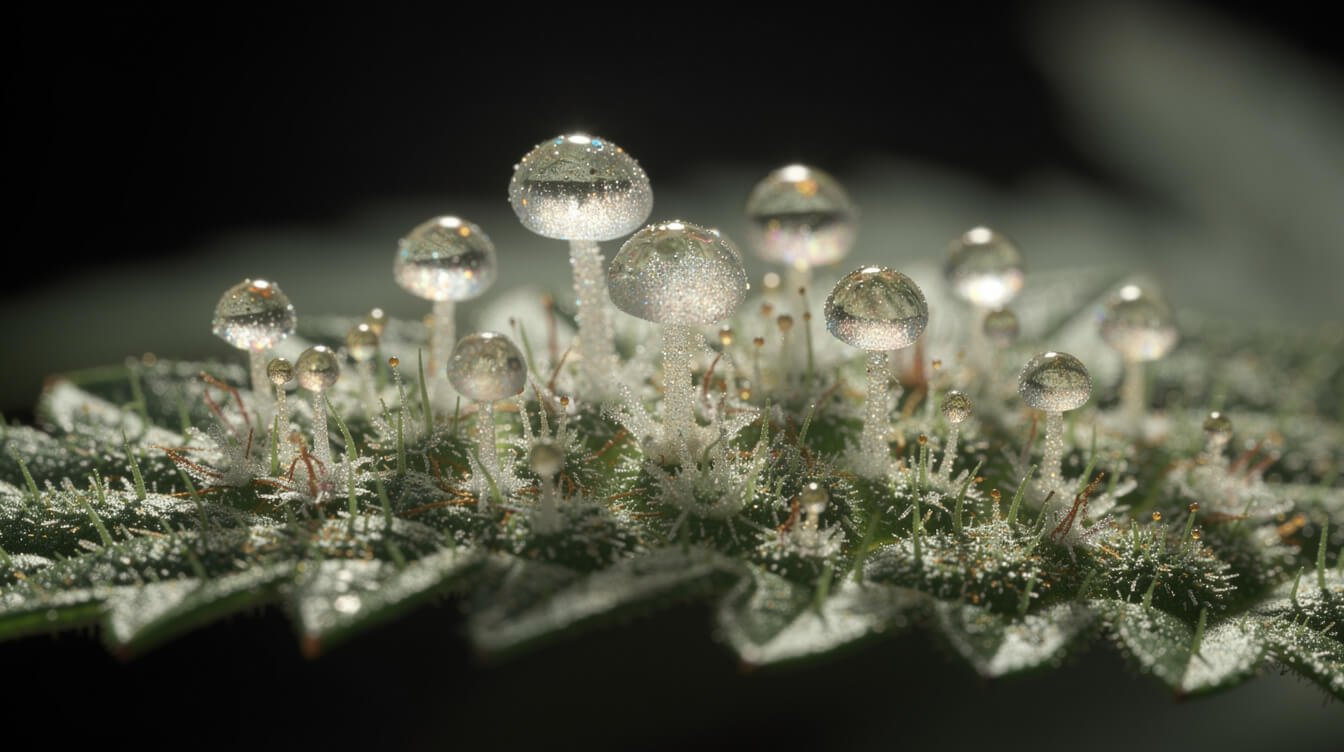
Limonene is a monoterpene, a small, light, aromatic molecule built from two five-carbon units. Cannabis makes it in the same place it makes THC: the glandular trichomes, those tiny mushroom-shaped resin heads that coat the flowers. Terpenes are part of the plant’s chemical defense and signaling system, and to us they’re most of what a cultivar smells and tastes like.
A few facts that matter for everything below:
- It’s one of the big three. In a dataset of nearly 90,000 lab-tested commercial samples from six US states, myrcene, beta-caryophyllene, and limonene were, on average, the terpenes present at the highest levels (Smith et al., 2022).
- It’s present in small amounts. Total terpenes in that dataset averaged about 2% of the flower by weight. That’s all of the terpenes combined, so limonene alone is a fraction of that.
- It’s volatile. Limonene boils at roughly 176–178 °C (about 350 °F) and evaporates readily at room temperature, according to the PubChem record. That’s why it’s among the first aromas to fade from poorly stored weed.
How small is “small”? The Johns Hopkins team behind the human study (more on that below) chose its doses using 107 Canadian flower samples across 29 cultivars. Those averaged 0.11% limonene, with a range of 0 to 0.45%. That works out to about 1 mg of limonene in a 1-gram joint of average flower, and up to roughly 4–5 mg in a high-limonene one. Keep that number in your back pocket. It’s the key to reading every claim about the limonene terpene.
If you see a page saying some cultivars contain “15% limonene,” be skeptical. Total terpenes in real lab data average around 2%. A single terpene at 15% of dry weight would be extraordinary, and nothing in the large datasets supports it.
Where the limonene terpene shows up: cannabis, citrus, and your cleaning cupboard
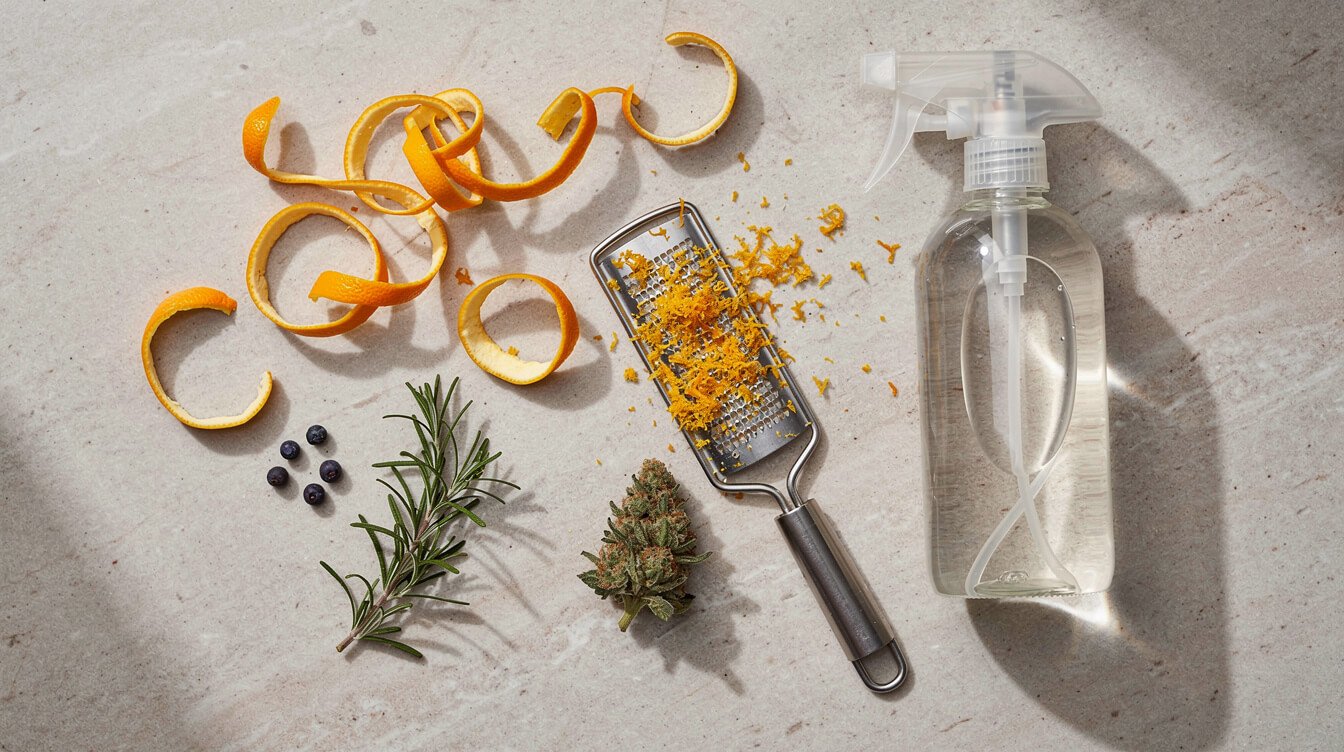
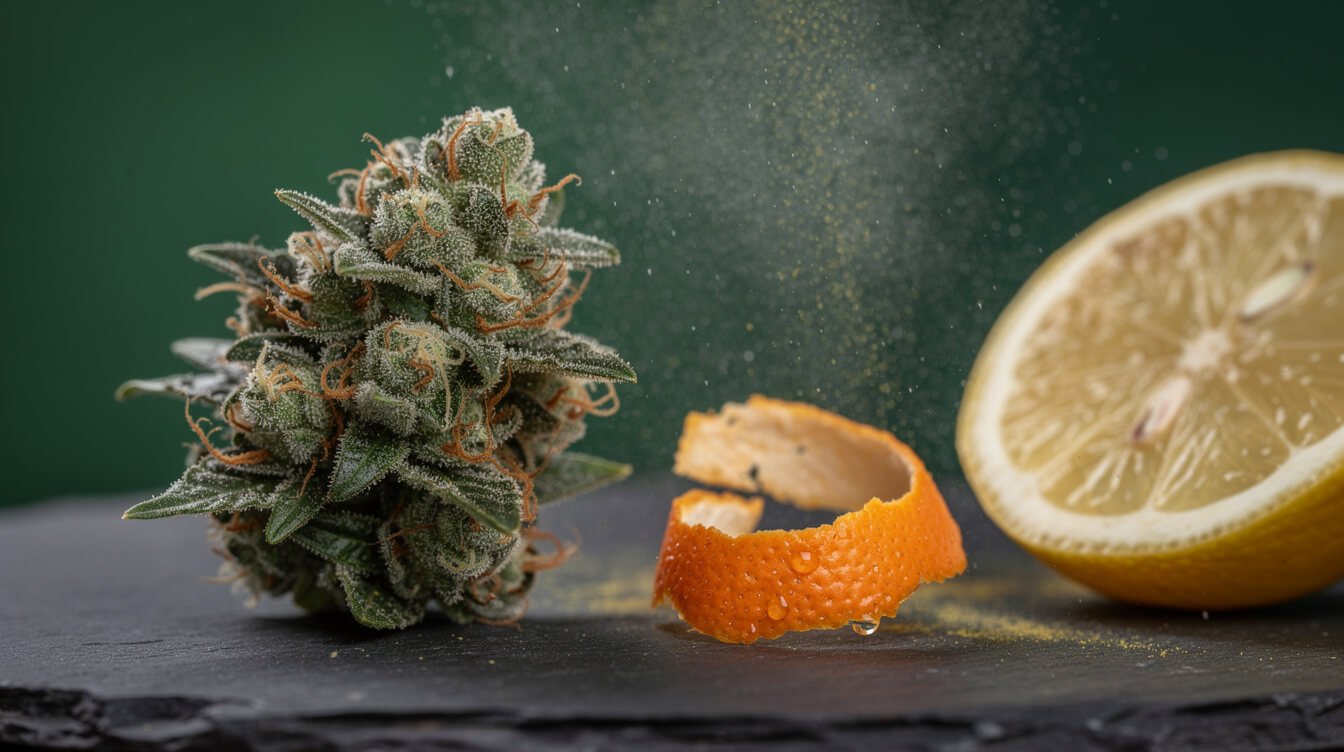
The limonene terpene is everywhere once you start noticing it. It dominates citrus peel oils, which is why a zester leaves your fingers smelling the way it does. It also shows up in juniper, rosemary, peppermint, and conifer oils, and it’s added to food flavorings, fragrances, and “citrus” cleaning products. In the US, limonene (d-, l-, and dl-) is on the FDA’s list of synthetic flavoring substances generally recognized as safe for use in food. Hold onto the phrase “for use in food.” It comes back later.
The twist: cannabis makes the “other” limonene
The limonene terpene comes in two mirror-image forms, like a left and right hand. Chemists call them (+)-limonene (also called d-limonene, or R-limonene) and (−)-limonene (l-limonene, or S-limonene). Citrus peel oil is overwhelmingly the (+) form. Cannabis is different: the main limonene-making enzyme in the plant’s trichomes is a (−)-limonene synthase. It was first characterized from cannabis in 2007 (Günnewich et al., Natural Product Communications), and it was later confirmed as the gene CsTPS1, whose expression tracked with limonene content in the plant (Booth, Page & Bohlmann, 2017).
Does that change the smell? Less than you might think. PubChem’s records describe d-limonene as having a citrus, “lemon-like” odor and l-limonene as “lemon-like” too. You’ll see the (−) form described as piney or turpentine-ish on terpene sites, but the chemical safety records don’t say that. It does matter for research, though, because the human study below used the citrus form, not the one the plant mostly makes. Almost no one points that out.
Limonene in your living room air
Here’s one that rarely makes the cannabis pages. The limonene terpene reacts with ozone, and that reaction makes fine particles. In a classic chamber study, researchers released limonene from a lemon-scented air freshener and added ozone at 60–100 ppb. Particles formed almost entirely in the 0.1–0.3 micrometer range, with an estimated peak particle mass of about 23.5 µg/m³ (Wainman et al., 2000). It’s a big reason we tell people not to run “ozone” machines in rooms where anyone breathes; our guide to getting rid of weed smell at home covers what to use instead.
Does the limonene terpene change a high? What the one human study found
This is the section most limonene terpene pages skip, and it’s the most useful one. In 2024, a Johns Hopkins team published the first controlled human study of limonene combined with THC (Spindle et al., 2024, Drug and Alcohol Dependence; full text).
How the study worked
- Who: 20 healthy adults (10 men, 10 women, average age 26) who used cannabis infrequently, no more than twice a week. Everyone had felt anxious after cannabis at least once before.
- What: Pure synthetic THC and pure d-limonene, inhaled through a medical-grade vaporizer at 210 °C. Not flower, not a vape cart, not an edible.
- Design: Double-blind and crossover, so each person did multiple sessions with a different combination each time: placebo, limonene alone (1 or 5 mg), THC alone (15 or 30 mg), and THC plus limonene at each pairing.
- The add-on: Later, the team added a tenth session pairing 30 mg THC with 15 mg limonene. Only 12 people completed it, it always came last, and it wasn’t randomized.
What it found
- Limonene alone did nothing measurable. At 1 or 5 mg, it didn’t differ from placebo on any measure. On its own, it didn’t get anyone high.
- The effect showed up only at the high dose. With 30 mg THC + 15 mg limonene, participants rated themselves significantly less “anxious/nervous” and “paranoid” than with 30 mg THC alone. Their ratings of “unpleasant” dropped too.
- Plenty didn’t change. “Heart racing” ratings didn’t differ. A standard anxiety questionnaire trended lower but didn’t reach significance. Cognitive test performance and heart rate weren’t changed by limonene.
- It wasn’t by lowering THC. Blood THC was actually higher in the 30 mg THC + 15 mg limonene session than with THC alone. Whatever happened, it wasn’t limonene blocking THC from getting into the body.
The fine print that matters
Now the nuance. The dose that mattered, 15 mg, is about 14 times the limonene in an average 1-gram joint by the study’s own numbers. The authors themselves describe that dose and its 2:1 THC-to-limonene ratio as “unlikely to be encountered in unadulterated cannabis flower products.” The sample was small, the key session wasn’t randomized, only inhalation was tested (oral and smoked forms weren’t), and it used the citrus (+) form, not the plant’s main (−) form.
Conflicts of interest are worth knowing too. The study was NIH-funded (NIDA). But co-author Ethan Russo founded CReDO Science and advises True Terpenes, the company that supplied the limonene. Two other authors report industry consulting. And Johns Hopkins filed a patent application on limonene for reducing THC-related anxiety that names three of the authors. None of that makes the data wrong. It does mean the study needs independent replication before anyone treats it as settled.
So the honest summary: in one small lab study, a high vaporized dose of limonene alongside a high dose of THC came with lower self-rated anxiousness and paranoia. That’s a genuinely interesting research lead. It is not evidence that a lemony strain will keep you from getting anxious, and it’s not a treatment for anxiety. If THC tends to make you anxious, a smaller dose of THC is the well-established lever (start low, go slow). Persistent anxiety is a conversation for a doctor, not a terpene.
What the limonene terpene doesn’t do (as far as the evidence goes)
Search for the limonene terpene and you’ll find “benefits” lists running from mood and stress to heartburn, antioxidants, and tumors. Some of the cited research is real. The problem is the leap from that research to “this is what limonene does in your cannabis.” Here’s how to read those claims:
- Cell-dish and animal studies aren’t human effects. A compound that does something to cells in a petri dish, or to mice at body-weight-scaled doses, often does nothing comparable in a person.
- Supplement doses aren’t flower doses. Human research on oral limonene has mostly used concentrated supplements, not anything close to the ~1 mg in a joint. Even Leafly’s explainer concedes that most of the evidence “comes from studies using doses far higher than what’s naturally found in cannabis.”
- Aromatherapy isn’t inhaling smoke or vapor. Smelling citrus oil is a different exposure from heating flower, and studies of one don’t transfer to the other.
We don’t publish health-benefit lists for any terpene, and limonene is no exception. None of the research on it is a reason to use cannabis for a medical problem. That’s a decision for you and a doctor who knows your history.
The “sativa terpene” myth
You’ll also see limonene called “the sativa terpene,” the reason a cultivar feels “energizing.” The data doesn’t back the category. In the 90,000-sample study, terpene profiles couldn’t distinguish products labeled indica from those labeled sativa (Smith et al., 2022). A genetic study found sativa- and indica-labeled samples weren’t genetically distinct either (Watts et al., 2021). Limonene-forward plants turn up under every label. We dig into why the labels drift in indica vs hybrid, honestly, and the terpene myths section of our list of terpenes and effects covers the rest.
Does that mean people’s reports of limonene-forward cultivars feeling “upbeat” are imaginary? Not necessarily. Reported effects are real experiences, shaped by dose, setting, expectation, and the whole chemical profile, with THC doing most of the heavy lifting. They just aren’t proof that one terpene is steering the ride.
GanjaTech, weekly
Cannabis, explained. In your inbox.
One email a week: the clearest explainers, honest gear picks, and what the science actually says. 21+ only. No spam, unsubscribe anytime.
Why lemon-smelling weed isn’t always high in the limonene terpene
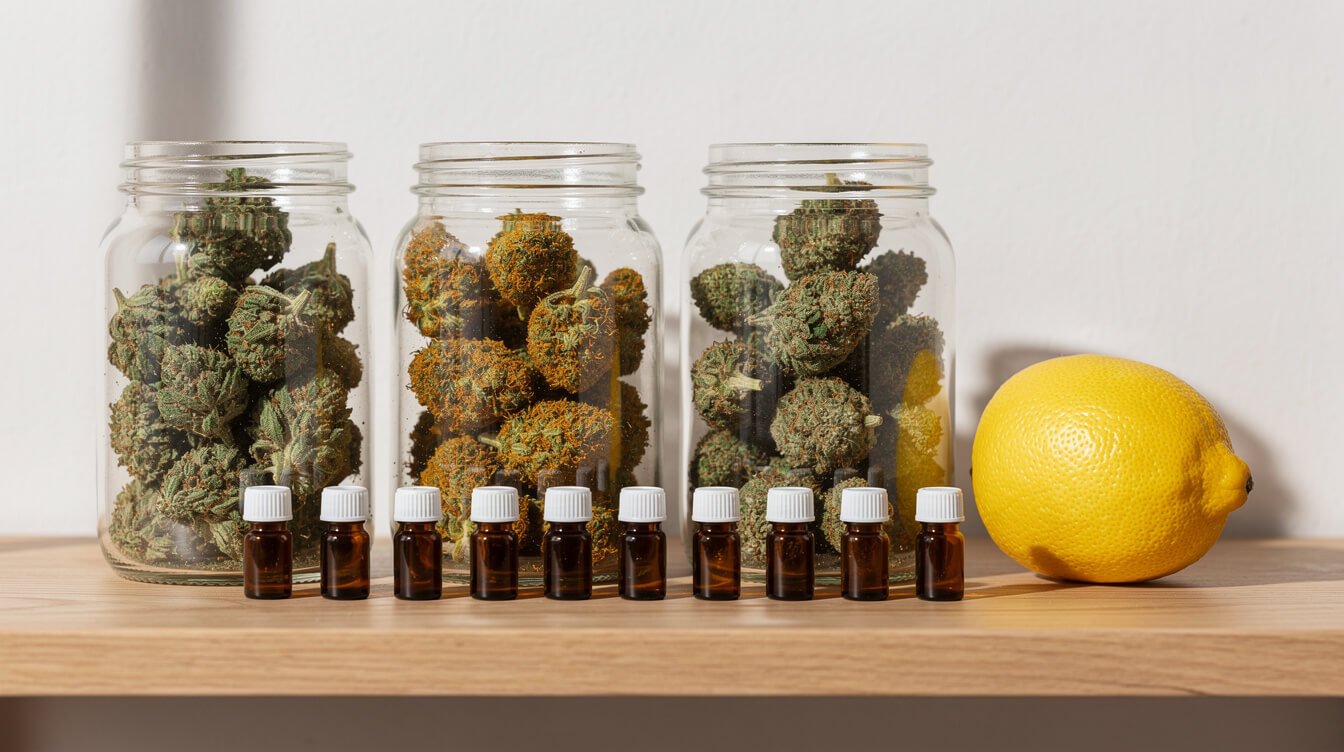
It seems like it should be simple: smells like lemon, must be full of limonene. Often it’s not, for a few reasons.
Aroma is a blend, not a single note
What you smell is dozens of compounds at once, and the loudest ones aren’t always the most abundant. Some trace compounds have very low odor thresholds, so a tiny amount can dominate. We covered the most dramatic example in why weed smells like skunk: a sulfur compound present at trace levels drives the “skunk” note, not the terpenes that make up most of the aroma by volume. “Citrus” can come from limonene, but other terpenes and esters can push a profile citrusy too, and limonene can be partly masked by heavier notes.
Names and labels track chemistry poorly
Cultivar names are marketing as much as genetics. Watts and colleagues found that samples sold under the same name were often as genetically distant from each other as samples with different names. The Smith dataset found commercial labels “do not consistently align with the observed chemical diversity.” A “Lemon”-something on the jar tells you what someone decided to call it, not what’s inside. (We haven’t seen a study that specifically tests lemon-named cultivars against their limonene, so treat this as an inference from the label research, not a measured fact.)
The only real answer: the lab report
If you want to know whether a product is limonene-forward, look at its certificate of analysis (COA), where markets require one. Read the terpene panel and look at the top two or three terpenes, not just one. Remember that numbers are batch-specific and fade with age. Our terpene reference walks through reading a COA. And if you sit down with three jars and your nose disagrees with the label, your nose isn’t wrong. It’s just answering a different question than the lab.
Keeping the limonene terpene in your flower: drying, curing, and storage
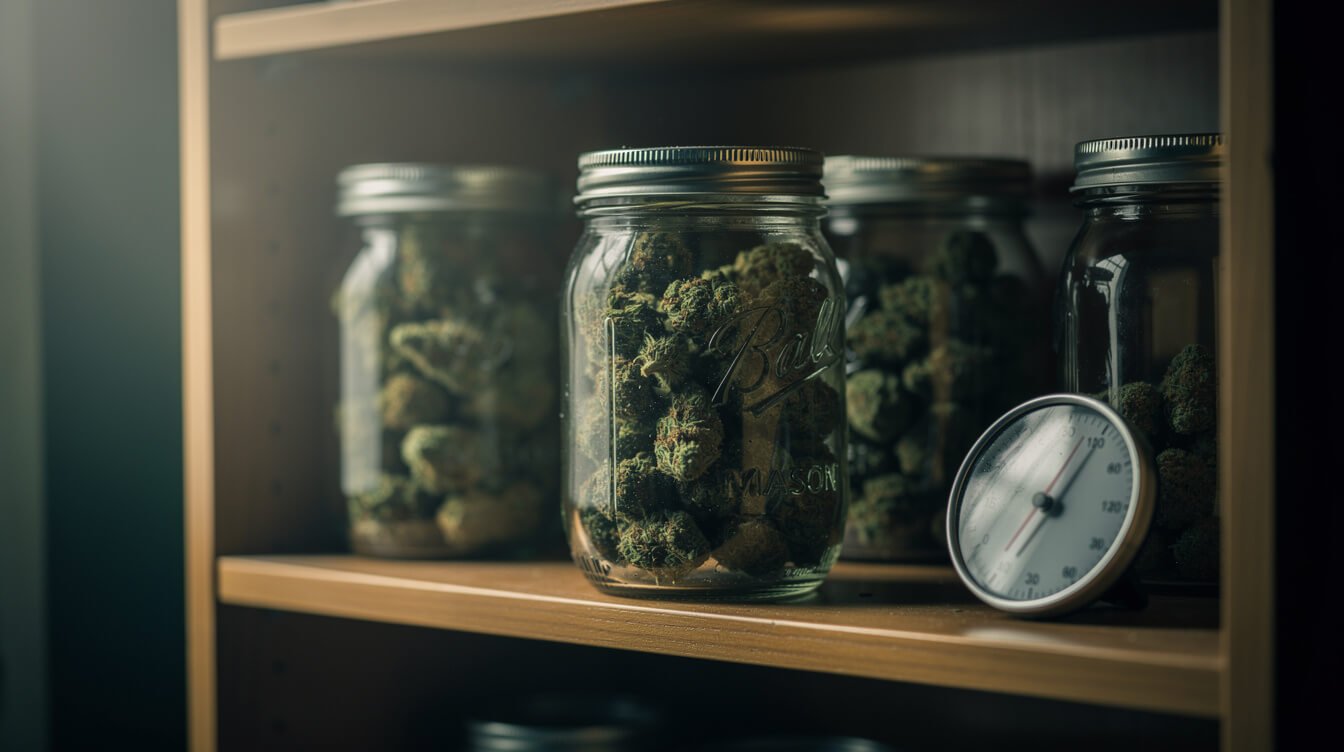
Because the limonene terpene is a light, volatile monoterpene, it’s one of the first things you lose when flower is handled badly. That bright top note on a fresh jar is the first casualty of heat, airflow, and time. The good news is that the fixes are the same ones that protect everything else in your weed.
- Dry slow and cool. Fast, hot drying drives off the light monoterpenes first. Our guide to drying cannabis covers the temperature and humidity targets that protect them.
- Store whole, cool, dark, and sealed. In a year-long storage study, terpene levels fell quickly under every condition tested. Whole buds kept around 4 °C held up best, while grinding before storage and freezing below −20 °C did worst (Milay et al., 2020). For the full picture of what degrades and how fast, see does weed go bad?
- Don’t expect packaging to stop it. Even under nitrogen-flushed packaging, limonene decreased during storage in a 2024 study (MacLaughlin & MacDonald, 2024). That’s a reminder that the lighter terpenes are the hardest to keep.
- Keep humidity steady. A sealed glass jar with stable relative humidity slows the loss. Whether a two-way pack is worth it depends on your setup; we break that down in cannabis humidity packs.
- Grind right before use. Grinding breaks open trichome heads and exposes terpenes to air. Do it just before the session, not days ahead.
One temperature note for vaporizer people: limonene boils around 176–178 °C (roughly 350 °F), well below the 210 °C used in the Hopkins study. Lower vape temperatures tend to keep the citrus top notes more noticeable, though boiling points of pure compounds don’t map neatly onto what happens inside a plant matrix.
The limonene terpene in concentrates, vapes, and “added terpenes”
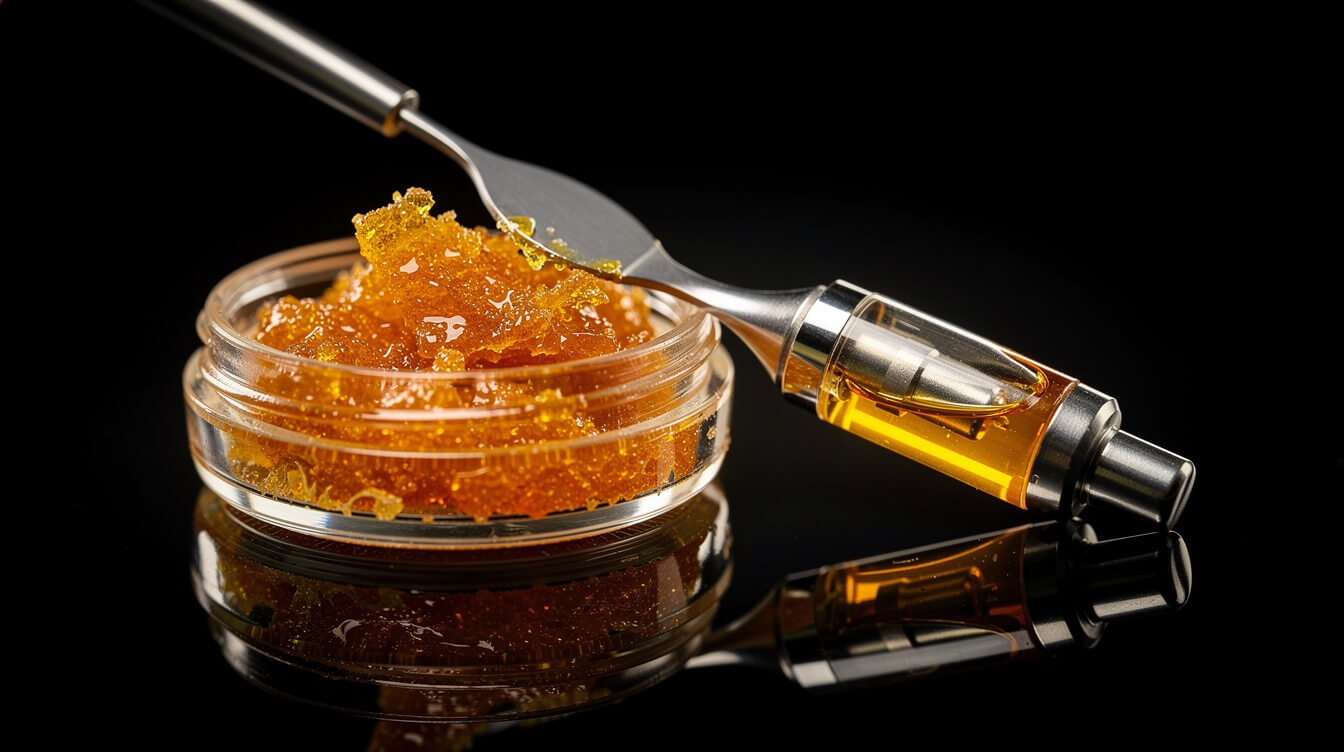
Concentrates change the limonene picture in two different directions.
Processes that keep more of it
Because the light monoterpenes are the first to go during drying and curing, products made from fresh-frozen plants tend to keep more of them. That’s most of the point of live resin: freeze the plant at harvest and extract before the volatile terpenes evaporate. Solventless rosin, especially “live” rosin from fresh-frozen material, aims for the same thing using heat and pressure instead of solvents. Either way, the COA is still where the actual numbers live.
“Added terpenes” are a different product
Many vape cartridges and some infused products have terpenes added back after extraction. Sometimes these are “cannabis-derived,” sometimes “botanical” blends built from compounds like limonene sourced from citrus or made synthetically. That’s how a cart can taste intensely of lemon while the original plant didn’t.
Two honest cautions. First, the “generally recognized as safe” status covers limonene as a food flavoring. That’s not the same as being studied for repeated heated inhalation, and the research on inhaling terpene additives is thin. Second, limonene that has sat exposed to air oxidizes, and its oxidation products are a well-documented skin allergen. In an international study of 2,900 dermatitis patients, 5.2% reacted to air-oxidized limonene on patch testing (Bråred Christensson et al., 2013). The cannabis form oxidizes into an allergen too (Matura et al., 2006). Fresh limonene is a weak allergen at most; old, air-exposed limonene is the problem.
We’re not going to recommend specific products here. If you use vapes, regulated, lab-tested products from legal markets are the baseline, and any cough, wheeze, or chest symptom is a reason to stop and see a doctor.
Limonene terpene FAQ
Does the limonene terpene get you high?
No. In the Hopkins study, vaporized limonene on its own (1 or 5 mg) didn’t differ from placebo on any measure. THC is what produces the high; terpenes shape the smell and taste, and their contribution to the experience is still being studied.
Is limonene a sativa or indica terpene?
Neither. Large lab datasets can’t distinguish indica- and sativa-labeled products by terpene profile, and limonene-forward plants appear under every label.
What strains are high in limonene?
The honest answer is: check the lab report, not the name. Terpene content varies by batch, grow, harvest, and storage, and names track chemistry poorly. Where your market requires COAs, look for limonene among the top two or three terpenes on the panel.
What does the limonene terpene smell like?
Citrus peel: bright, clean, a little sweet. Both mirror-image forms are described as lemon-like in chemical safety records. In cannabis it usually shares the stage with myrcene, caryophyllene, and others, so it often reads as a citrus top note over something earthier.
Is limonene safe to inhale?
There isn’t a simple yes. Limonene is approved as a food flavoring, and that’s about eating it, not heating and inhaling it. In a controlled human exposure study, people breathed d-limonene vapor at up to about 450 mg/m³ for two hours. About 70% was absorbed, no irritation or nervous-system symptoms were reported, but vital capacity (a lung-function measure) decreased at the high exposure level (Falk-Filipsson et al., 1993). Oxidized limonene is a skin allergen. If you have a lung condition or any symptoms, talk to a doctor before inhaling any concentrated terpene product.
Will eating lemon peel or drinking lemon juice calm a too-strong high?
Nobody has tested that. The only human data used high-dose vaporized limonene, and the authors note that oral routes are untested. If you’ve overdone it, the evidence-based steps are the boring ones: stop consuming, get somewhere calm, hydrate, and wait it out. If anything feels like a medical emergency, get medical help.
Final thoughts
The limonene terpene is one of the most common aroma compounds in cannabis and one of the most over-marketed. What’s solid: it’s real, it’s abundant relative to most terpenes, it’s volatile enough that storage matters, and the plant makes mostly the (−) form rather than the citrus (+) form. What’s interesting but early: one small, industry-linked lab study in which a high vaporized dose alongside high-dose THC came with lower self-rated anxiousness and paranoia. What’s not supported: benefit lists built on petri dishes, “sativa terpene” labels, and lemon names as a stand-in for lab data.
If you like that bright citrus note, the practical moves are simple: read the COA where you can, store your flower whole, cool, and sealed, and let your own nose and experience guide you. Great plant. Respect it, know your local laws, and enjoy responsibly.
Before you go
Get the next explainer first
We publish a new one every day. The best of the week, plus what's new in the shop, lands in one short email.