Where Does Weed Grow Naturally? The Genes Point to East Asia, Not Just “Central Asia”
Where does weed grow naturally? The honest answer comes in three parts, because people are usually asking three different questions. Cannabis first evolved in Asia, and the fossil pollen record points to the northeastern Tibetan Plateau, millions of years ago. It was first domesticated in East Asia, around 12,000 years ago according to a large 2021 genome study. And today it grows on its own almost anywhere humans have disturbed the ground, from riverbanks in China to roadside ditches in the American Midwest. Most of those “wild” plants aren’t truly wild, though. They’re escapees from old crops.
That last part is the nuance most sites skip. Nearly every article on this topic repeats “Central Asia” and moves on. The genetics tell a more interesting story, including a hint that the plant’s truly wild ancestor may no longer exist. This guide covers the science and the history: where the plant came from, how it spread, what landraces and ditch weed actually are, and what all of it means for the indica/sativa labels. It’s written for adults (21+) and curious readers. It is not a guide to finding or picking plants, which can be illegal even when they’re growing on their own. Laws vary a lot by state and country.
Where does weed grow naturally? The short answer
If you only have thirty seconds, here’s the whole thing:
- Where it evolved: Asia. A map of fossil pollen sites puts the genus’s center of origin on the northeastern Tibetan Plateau. Cannabis split from its closest relative, hops (Humulus), roughly 27.8 million years ago, according to a molecular clock analysis summarized in McPartland’s 2018 review of cannabis systematics.
- Where it was domesticated: East Asia, in early Neolithic times. A 2021 whole-genome study in Science Advances found that all modern hemp and drug-type cannabis descends from an ancestral gene pool now best represented by feral plants and landraces in China.
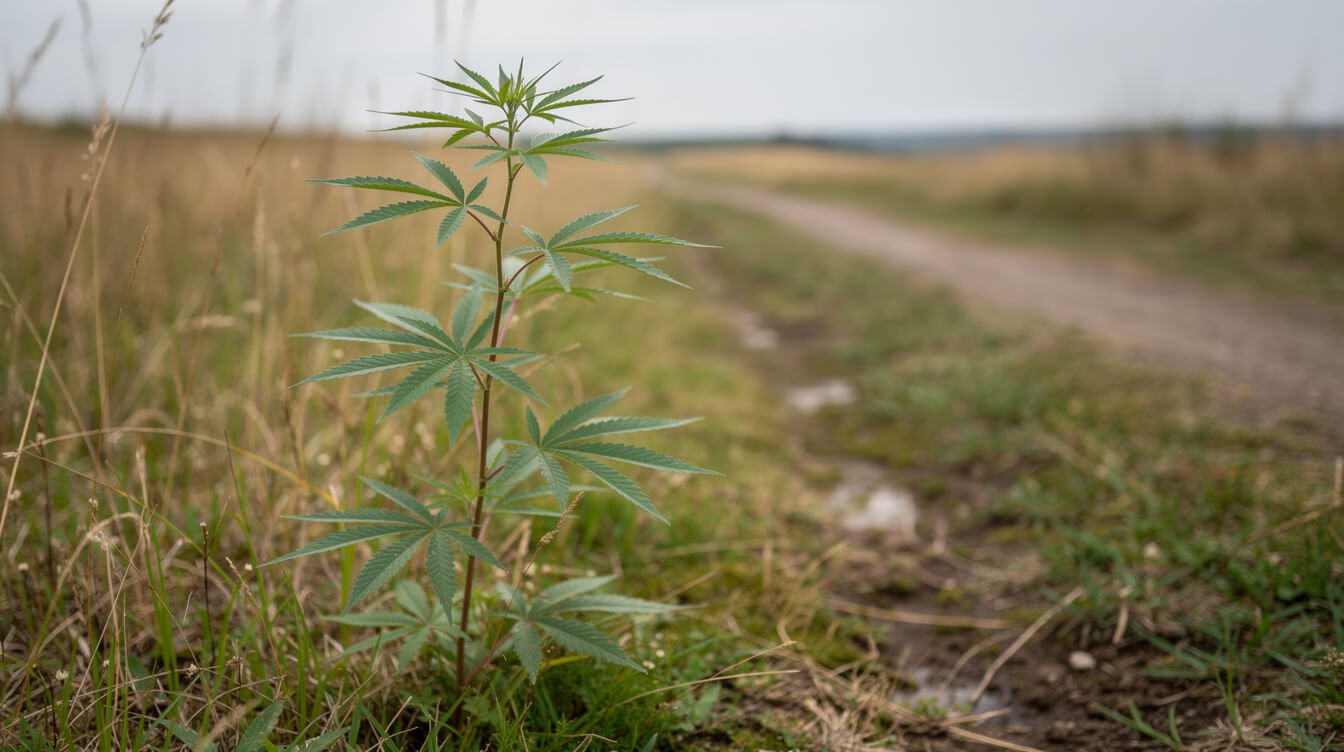
- Where it grows on its own today: Pretty much every temperate-to-tropical region people have farmed, usually on roadsides, field edges, riverbanks, vacant lots, and other disturbed ground. Botanists call this kind of plant a ruderal.
- Whether any of it is truly wild: Probably not. The same genome study concluded that every feral plant it sampled was a historical escape from cultivation, and that the pure wild ancestors of Cannabis sativa may have gone extinct.
So when someone asks where does weed grow naturally and gets “Central Asia” back, that answer isn’t exactly wrong. It’s just old, and it blends together the questions of where the plant evolved, where people first grew it, and where it grows now. Pull those apart and the picture gets much clearer.
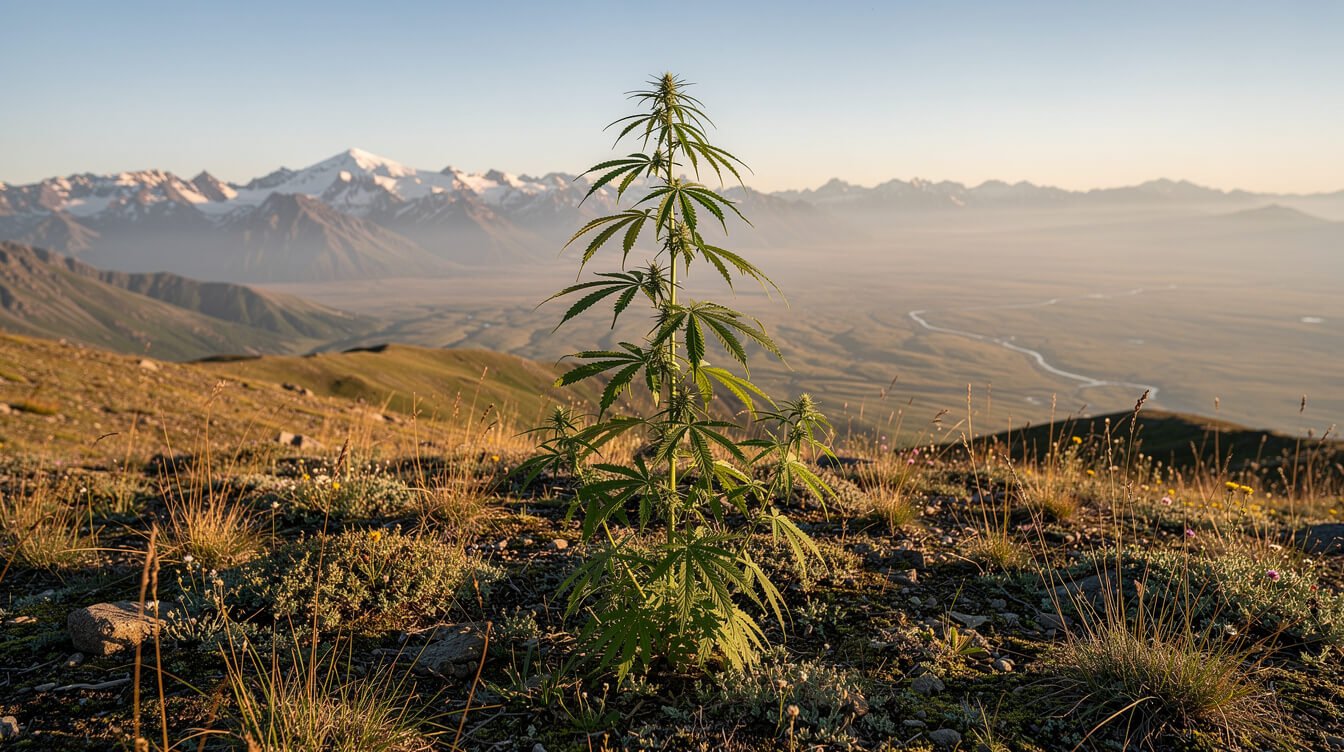
Where cannabis first evolved: fossil pollen and the Tibetan Plateau

Here’s the first problem: cannabis barely shows up in the fossil record. McPartland’s review notes that only three cannabis print fossils are known worldwide. That’s not much to build an origin story on. So researchers turned to pollen, which survives for millions of years in lake beds and sediment layers.
There’s a catch there too. Cannabis pollen and hop pollen look almost identical under a microscope. The workaround is context. Pollen found alongside other steppe plants is read as cannabis, because that’s the open, sunny habitat cannabis likes. Pollen found with forest trees like alder, willow, and poplar is read as hops, which climb in damp woodland.
Using that method, a meta-analysis of 88 fossil pollen sites across Asia mapped where the oldest steppe-associated grains turn up. The oldest came from Ningxia Province in China, dated to about 19.6 million years ago. Mapping the sites with GIS software pointed to the northeastern Tibetan Plateau as the genus’s center of origin.
Why a high plateau makes sense
McPartland notes that this location fits two hypotheses about why cannabis makes cannabinoids at all. One is that the resin helps protect plant tissue from intense ultraviolet light, which rose as the Tibetan Plateau uplifted. The other is that cannabinoids deter grazing animals, which were spreading across the expanding steppe. Neither is proven, and the plant may have more than one reason. But it’s a nice reminder that THC and CBD didn’t evolve for us. They’re plant chemistry, shaped by a harsh, high, sunny environment long before anyone smoked anything.
Then it moved west, slowly
Fossil pollen shows cannabis had reached Europe by about 1.8 to 1.2 million years ago. Through the ice ages, its range kept expanding and shrinking. When forests took over, cannabis retreated to open refuges like the Pontic steppe north of the Black Sea and the Mediterranean coast. Each contraction squeezed the population through a genetic bottleneck. McPartland argues that this drift is where the long-running chemical split began: European plants that lean CBD-dominant and Asian plants that lean THC-dominant. In other words, the earliest divergence in cannabis chemistry likely came from climate and geography, not from breeders.
Where it was domesticated: what the 2021 genome study found

Evolution and domestication are different clocks. A plant can be millions of years old as a species and only a few thousand years old as a crop. For cannabis, the best current evidence on the crop side comes from Ren and colleagues (2021), who resequenced whole genomes from 110 cannabis accessions sampled worldwide. The set included wild-growing feral plants, traditional landraces, historical cultivars, and modern hybrids, both hemp and drug types.
Three findings matter for our question:
- One domestication, in East Asia. The authors write that their results run “contrary to a widely accepted view, which associates Cannabis with a Central Asian center of crop domestication.” That older view, they note, was mostly based on where feral plants happened to be growing. The genomes instead fit a single origin of the crop in East Asia.
- About 12,000 years ago. Their genomic dating puts the split between early domesticated cannabis and its basal ancestral group at roughly 12,000 years before present, with a 95% confidence interval of about 6,500 to 15,700 years. That lines up with cord-impressed pottery from South China and Taiwan from around the same time, and with pottery-associated seeds from Japan around 10,000 years ago.
- Hemp and drug types split later. The study suggests early cannabis was a multipurpose crop, used for fiber, seed, and more, until about 4,000 years ago. After that, people selected separately for fiber and for psychoactive resin. Today’s hemp and marijuana lines turned out to be genetically distinct groups with surprisingly little mixing between them.
The ancestor may be gone
This is the finding that most changes the answer. When the researchers looked at feral plants, including wild-growing ones from Central Asia, they nested among domesticated and landrace groups rather than standing apart as a wild lineage. The authors concluded that the feral plants they studied “are not wild types, but historical escapes from domesticated forms,” and that this suggests “pure wild progenitors of C. sativa have gone extinct.” They also flag that more sampling of feral plants in key regions is still needed, so treat it as the current best evidence rather than a final verdict.
The practical meaning is that when you see cannabis “growing wild” anywhere today, you’re almost certainly looking at the descendants of a crop, not at the original wild plant. The closest living stand-ins for the ancestral gene pool, per Ren, are some feral plants and landraces in China.
How it spread: people, seeds, and a very weedy plant
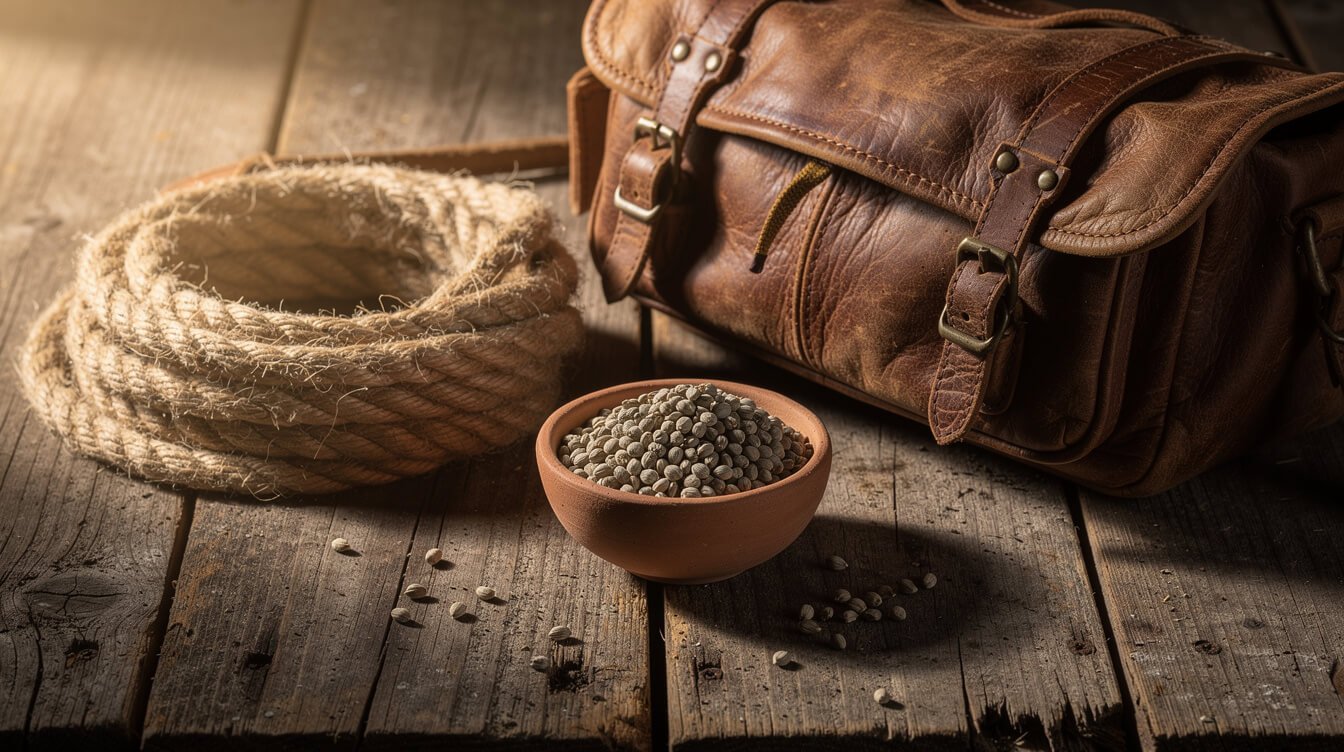
Once people started growing cannabis, they carried it everywhere, because it was useful three ways at once: fiber for rope and cloth, seeds for food and oil, and resin for ritual and medicine traditions. Ren’s paper pulls together the archaeological and historical timeline:
- Hemp artifacts appear consistently in China and Japan from about 7,500 years ago.
- Around 4,000 years ago, fiber-grown cannabis was spreading westward into Europe and the Middle East.
- The first archaeobotanical record of cannabis in the Indian subcontinent dates to about 3,000 years ago, likely introduced from China along with other crops.
- Ritual and inebriant use is documented from remains in Western China at least 2,500 years ago.
- Drug-type cannabis reached Africa by around the 13th century and Latin America in the 16th century, then reached North America at the beginning of the 20th century.
- Hemp-type cannabis came to the New World with European colonists in the 17th century. By the mid-1800s, Chinese hemp landraces had largely replaced it in North America.
Why the “Central Asia” answer stuck
Some of the old consensus traces back to sources like a 1914 U.S. Department of Agriculture yearbook. In his chapter on hemp, USDA botanist Lyster Dewey wrote that “the evidence points to central Asia, or the region between the Himalayas and Siberia.” In the very next breath, he warned that historical records had to be trusted over wild specimens, “for hemp readily becomes naturalized.” A century later, the genomes confirmed his warning: feral plants are a poor guide to origins because the crop escapes so easily.
The plant is built to hitchhike
Cannabis is a classic ruderal, a plant of disturbed ground. A 2023 review in Frontiers in Pharmacology describes weedy cannabis growing in “fields, trash heaps, vacant lots, pastures, ditches, creeks, and open woods”. The same review notes that it’s poorly adapted to pushing into established plant communities and usually moves in after soil has been plowed or disturbed. That’s why it follows people. We keep making the kind of habitat it loves.
Animals likely help too. In a small but memorable experiment, McPartland and Naraine (2019) tested whether cannabis seeds survive a trip through a digestive system. They used a simulated gut, a dog, and a human. Undigested control seeds sprouted at 76%. Seeds from the simulated gut sprouted at 34.7%, seeds that went through the dog at 10.3%, and seeds through the human, who chewed more, at 1.3%. The authors concluded that, despite having no fleshy fruit, cannabis “seems well adapted” to being carried by animals. Darwin had shown something similar with pigeons more than a century earlier.
GanjaTech, weekly
Cannabis, explained. In your inbox.
One email a week: the clearest explainers, honest gear picks, and what the science actually says. 21+ only. No spam, unsubscribe anytime.
Landraces: what climate did to wild-growing cannabis

A landrace is a traditional, locally adapted population that farmers kept growing in one region for generations. It isn’t a wild plant and isn’t a modern bred strain, but something in between. Landraces matter for our question because they’re the closest thing to “naturally grown weed” most people will ever hear about. Names like Hindu Kush, Afghani, Thai, and Durban usually refer to these regional populations or their descendants.
The most careful attempt to sort them out is McPartland and Small (2020), who examined morphology in 1,100 herbarium specimens and combined it with published chemical and genetic data. Their take on drug-type cannabis:
- The “Sativa”-type domesticate had its origins in South Asia (India) and spread early to Southeast Asia, Africa, and the Americas. They name it C. sativa subsp. indica var. indica. Yes, the naming is confusing. That’s the point.
- The “Indica”-type domesticate had its origins in Central Asia (Afghanistan, Pakistan, Turkestan). They name it var. afghanica.
- Each has a wild-growing relative: var. himalayensis in South Asia and var. asperrima in Central Asia.
Their summary of how those types formed fits everything above: “Natural selection initiated divergence, driven by climatic conditions in South and Central Asia. Subsequent domestication drove further phytochemical divergence.” In their data, the South Asian type tends to run a THC:CBD ratio of 7 or higher, while the Central Asian type runs under 7 and often carries different terpene profiles.
Why landraces are called endangered
Here’s the twist. McPartland and Small describe these original populations as “critically endangered reservoirs of germplasm,” meaning genetic resources that are disappearing. Over the past 50 years, the two types have been crossed and recrossed so heavily that the authors say hybridization “has obliterated differences” between the “Sativa” and “Indica” sold today. A modern strain with a landrace-sounding name is usually a hybrid with an undocumented background.
The labels on a jar tell you even less than they seem to. For the plant’s actual chemistry, the cannabinoid and terpene numbers on a tested label are far more useful. Our list of terpenes and effects is a good place to start.
Feral cannabis and US “ditch weed”
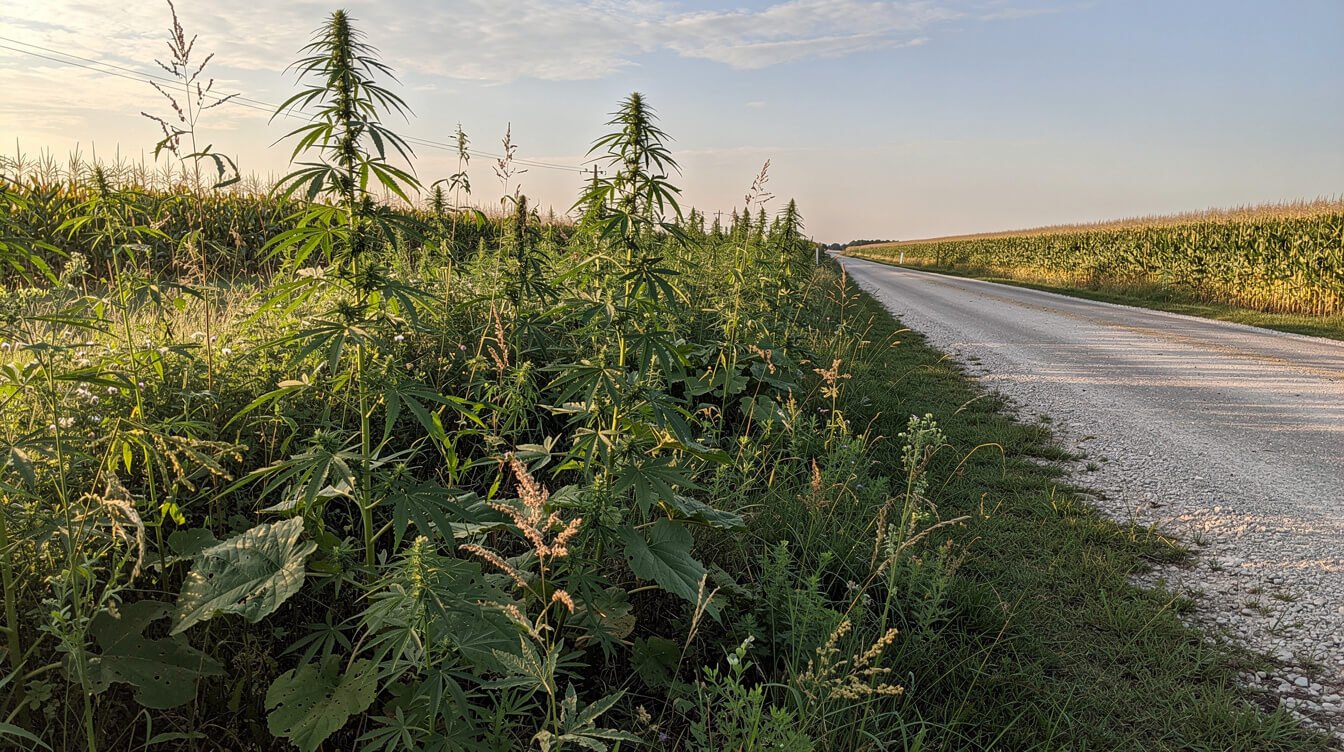
In the US, the plant people most often find “growing wild” is what’s called ditch weed. The name is literal: it tends to show up along roadsides, fence lines, and drainage ditches in farm country. It’s feral hemp, the descendants of fiber crops that farmers grew for generations.
The history goes back further than most people think. Dewey’s 1914 USDA chapter already described hemp as “abundant as a wild plant in many localities in western Missouri, Iowa, and in southern Minnesota,” and “often found as a roadside weed throughout the Middle West.” Hemp farming then had a large revival during World War II, when the US needed domestic fiber. Plants from those fields kept reseeding themselves long after the farms stopped growing them.
How common is it? Federal eradication data gives a sense of scale. According to DEA figures reported by NORML in 2004, about 247 million plants were destroyed in 2003, and more than 243 million of those were classified as ditch weed. The DEA’s own definition of ditch weed was “wild, scattered marijuana plants [with] no evidence of planting, fertilizing, or tending.” In other words, about 99% of the “marijuana” pulled up that year was feral hemp.
Is ditch weed potent?
Generally, no. Because it descends from fiber hemp, feral US cannabis is typically very low in THC. NORML described it as containing “virtually no detectable levels of THC.” That doesn’t mean every roadside plant is identical, since cross-pollination with other cannabis can happen. But the reputation of ditch weed as harsh, weak, and not worth the headache is earned.
The part that matters: leave it alone
Some sites suggest feral hemp is automatically legal to pick because it’s “just hemp.” Don’t assume that. Whether a given plant legally counts as hemp or marijuana comes down to a lab test, not how it looks or where it grew. Hemp definitions have been shifting at the federal level, and state rules differ on top of that. Wild-growing cannabis is still on someone’s land, whether that’s a farm, a road right-of-way, or a park. Picking it can mean trespassing, theft, or a cannabis charge depending on where you are. Treat ditch weed as a piece of agricultural history, not a harvest. If you want to know what you’re looking at, our guide to what a weed plant looks like covers identification and the common look-alikes.
Indica, sativa, ruderalis: what “wild” tells us about the labels
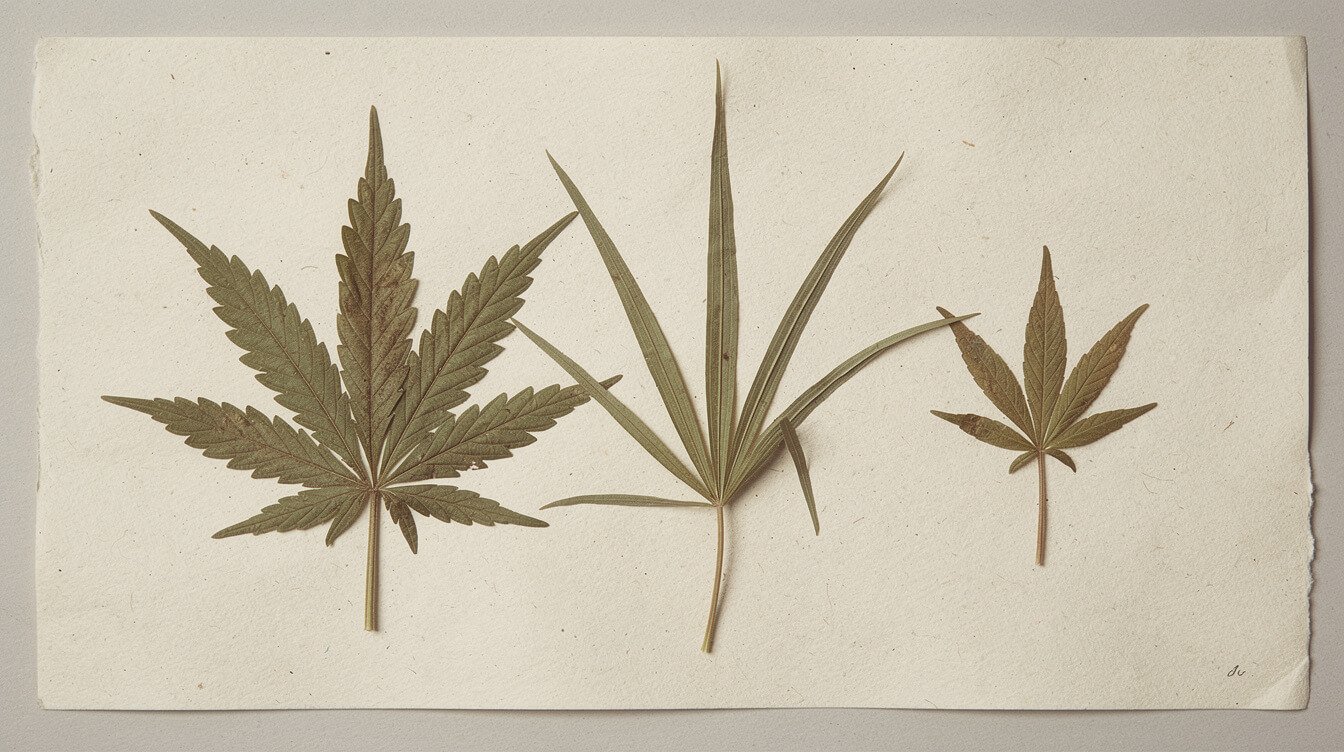
Once you know where the plant came from, the familiar three-way split of sativa, indica, and ruderalis looks a lot less tidy. Many sites present these as three settled species, each with its own native home. The scientific picture is messier.
“Ruderalis” is a habitat name, not a species name
The word comes from “ruderal,” the term for plants that colonize disturbed ground. As McPartland and Small explain, two Russian botanists in the 1920s, Vavilov and Janischevsky, named the same population of wild-type plants near Saratov, Russia. Vavilov called it a variety (spontanea), and Janischevsky called it ruderalis. Janischevsky offered the species rank but added, “I am inclined to consider it a well marked variety.” So the “third species” started out as a weedy roadside population that its own describer wasn’t sure deserved species status. Its day-neutral, autoflowering trait is real and genuinely useful to breeders. The species label is much shakier.
Sativa and indica don’t match the science either
McPartland’s 2018 review puts it bluntly: the folk taxonomy of “Sativa” and “Indica” “totally misaligns with formal C. sativa and C. indica,” and “ubiquitous interbreeding and hybridization” has “rendered their distinctions almost meaningless.” He also notes that historical field botanists tended to assign names according to their cultural biases, and that mapped herbarium records show no clean native ranges for either taxon.
That’s why we keep saying the label on the jar is mostly marketing. If you want the longer version, read what is stronger, sativa or indica and indica vs hybrid. Both get into why chemistry, dose, and the person consuming matter more than the leaf shape.
Where does weed grow naturally? Common questions
Is weed a natural plant or man-made?
Both, in a sense. Cannabis is a natural genus that evolved millions of years before people existed. But the plants you’ll see today, including the “wild” ones, have been shaped by roughly 12,000 years of human selection. Modern high-THC flower is about as far from its wild ancestor as a supermarket ear of corn is from teosinte.
Is there still truly wild cannabis?
Possibly not. The 2021 genome study found that every feral plant it sampled was an escape from cultivation and suggested the pure wild ancestor may be extinct. The authors also say more sampling is needed, so it’s not fully settled. Wild-growing relatives like var. himalayensis and var. asperrima are described in the taxonomy literature, but how “wild” any surviving population is remains an open question.
So where does weed grow naturally today?
Across much of the temperate and tropical world, on its own, wherever people have disturbed the soil: field margins, roadsides, riverbanks, and vacant lots. In the US, that mostly means feral hemp in farm country, the legacy of old fiber crops. For the deep-history answer of where does weed grow naturally in the original sense, it’s the high, open country of Asia, with the Tibetan Plateau as the best-supported starting point.
Where does weed grow naturally in the US?
Mostly in farm country, and it has for more than a century, as the 1914 USDA quote shows. What grows that way is almost always low-THC feral hemp, not escaped high-THC cannabis. Picking it can still be illegal, so leave it where it is.
Did cannabis originate in Africa, Mexico, or Jamaica?
No. Those places have deep cannabis cultures and well-known landraces, but the plant arrived there with people: in Africa by around the 13th century and in Latin America in the 16th, per the timeline in Ren et al. Long history in a place isn’t the same as being native to it.
Why does weed grow so easily in some climates?
It’s a sun-loving annual of open ground, and it’s genetically diverse enough to adapt fast. Most types flower when nights get long in late summer, so local populations tuned to their latitude over generations. That’s the same adaptability that made it such a successful crop. If you’re thinking about growing your own where it’s legal, our indoor growing walkthrough and how long it takes to grow weed are the practical next reads.
Final thoughts
Ask where does weed grow naturally and most of the internet will hand you “Central Asia” and stop. The fuller answer is better. Cannabis evolved on the high steppe of Asia, with the Tibetan Plateau as the best-supported origin. People first domesticated it in East Asia about 12,000 years ago, carried it across the world for fiber, food, and resin, and it went feral almost everywhere they plowed. What we call “wild” weed today is mostly the crop’s runaway descendants. The original wild plant may be gone.
That history also explains why the labels on modern cannabis are such a mess. Climate split the plant into regional types, farmers sharpened those differences into landraces, and 50 years of hybridizing blurred them again. If you want to understand what’s in your jar, read the lab numbers, not the origin story on the label. If you’re curious about how male and female plants factor into all of this, start with male vs female cannabis plants.
Great plant, long story. Respect it, know your local laws, and leave the ditch weed in the ditch.
Before you go
Get the next explainer first
We publish a new one every day. The best of the week, plus what's new in the shop, lands in one short email.